Cramer Says High Yields Are Dangerous. Wes Moss Says That’s Where Retirement Income Lives.
Jim Cramer calls high-yield dividend stocks some of the most dangerous in the market right now, while retirement strategist Wes Moss says those same yields are exactly what retirees need to fund their spending. Both men are right, and that…

This post may contain links from our sponsors and affiliates, and Flywheel Publishing may receive compensation for actions taken through them.
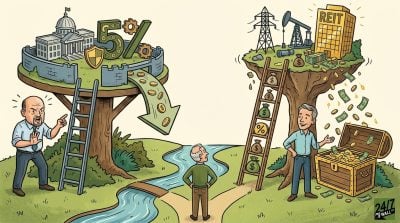
Jim Cramer told Mad Money viewers on Monday that high-yield dividend stocks have become hazards. Wes Moss told listeners of The Clark Howard Podcast that retirees should build income from higher-paying categories to fund spending.
Cramer on CNBC: “There was a time when high yields were the ultimate safety stocks, but that’s no longer the case. Instead of safety stocks, these have become some of the most dangerous stocks in the market.”
Moss argues the yield ladder funds available retirement income and that annuities are optional.
The stakes are concrete. Follow Cramer, and you may hold low-yield assets you fear to sell. Follow Moss, and a dividend cut can shrink the paycheck your budget depends on.
Why Cramer Thinks a 5% Treasury Rewrites Dividend Math
Cramer’s first argument is competition. On Mad Money, he said, “Because who cares about a juicy dividend when the ten-year is paying 5.24% virtually risk-free? When rates are high, dividend stocks simply can’t compete with the bond market.”
The verified benchmark supports his direction. FRED’s latest reading puts the 10-year Treasury yield at 5% on September 25, 2026. The trailing one-year high was also 5%, reached on September 24, 2026.
The range is his strongest evidence. The trailing-year low was 4% on February 27, 2026. Today’s yield ranks at the 99.2nd percentile, having climbed 1 percentage point in a month. A retiree can lock in government income near the year’s best level without taking on company payout risk.
His second argument is cut risk. “Super-high yields are a signal that the payout simply can’t be maintained. They are true red flags,” Cramer said. A yield rises when share price falls, so outsized yields often signal the market expects a cut. When it lands, the investor loses income and principal together.
How Moss Builds Income One Rung at a Time
Moss starts from a low base. The S&P 500 yields only about 1.2%, delivering roughly 12 grand in dividends on a million dollars, according to The Clark Howard Podcast.
The tiers: utility ETFs around 3%, big energy companies closer to 4% to 4.5%, and REITs and closed-end funds in the 7% to 8% range. Individual funds vary, of course.
Moss is Managing Partner and Chief Investment Strategist at Capital Investment Advisors, a fee-only SEC Registered Investment Adviser in Atlanta. He is the designated financial expert on the podcast.
His sharper point is behavioral. Wealthier retirees underspend by 47% to 53%. “Having more of your money in the form of income rather than assets seems to give retirees a license to spend,” he said. Income comes like a paycheck. Selling shares feels like losing ground. (We laid out the mix, the payment calendar, and the withdrawal order in a free guide to turning a nest egg into something that behaves like a paycheck.)
Moss described how Jean Chatzky’s mother refused to touch principal and, after 20 years, died with more than the $1.6 million she started with. She could have taken more trips and worried less.
On annuities, Moss was direct: “I don’t think you need to do an annuity. You can go out into the wide world of investments. I’d rather have higher current income, still control the assets, not turn it over to an annuity company.”
Two Warnings, Two Different Ways a Retirement Fails
Cramer warns the income stream may not survive. Moss warns the retiree may never spend it. Each is right about his own risk.
Moss, who takes listener questions at wesmoss.com/ask, lays out the framework in The Retire Sooner Method.
For someone already retired, Moss’s concern is more pressing. A retiree who hoards principal loses years of spending that never happens. Cramer’s warning works best as a filter on the top band, where a yield far above its category average deserves examination.
For someone still saving, Cramer’s risk matters more. With the 10-year near its one-year high, a saver gains little by reaching for yield.
What to Do Before Your Next Rebalance
- Map your holdings to the tiers. Sort each income position into Moss’s categories to see how much depends on the top band.
- Flag the outliers. Any holding yielding well above its category deserves a look at payout coverage from cash flow.
- Check the risk-free alternative. Pull the current 10-year yield from FRED and ask whether each dividend holding pays enough extra to justify its cut risk.
- Test your spending. Compare last year’s dividend and interest income against what you actually spent. A large gap signals the underspending Moss describes.
- Price the annuity. Request a quote and compare its guaranteed payout with what your ladder returns while you keep control of assets.
Retirees should fear the unspent dollar more than the cut dividend, and savers should fear the reverse.
Contact [email protected] for any questions or corrections.
Trey has been an editor and author at 24/7 Wall St. for more than a decade, where he has published thousands of articles analyzing corporate earnings, dividend stocks, short interest, insider buying, private equity, and market trends. His comprehensive coverage spans the full spectrum of financial markets, from blue-chip stalwarts to emerging growth companies.
Beyond 24/7 Wall St., Trey has created and edited financial content for Benzinga and AOL's BloggingStocks, contributing additional hundreds of articles to the investment community.
Trey's editorial expertise extends across multiple publishing environments. He served as production editor at Dearborn Financial Publishing and development editor at Kaplan, where he helped shape financial education materials. Earlier in his career, he worked as a writer-producer at SVE. His freelance editing portfolio includes work for prestigious clients such as Sage Publications, Rand McNally, the Institute for Supply Management, the American Library Association, Eggplant Literary Productions, and Spiegel.
Outside of financial journalism, Trey writes fiction and has been an active member of the writing community for years, moderating workshop sessions at regional conventions.