Bond Market Collapse Sends Yields to Decades-Old Highs. Dividend Stocks Are Most at Risk.
Treasury yields just hit levels not seen in two decades, and that quiet shift is forcing income investors to ask a question they haven't had to seriously consider in years: why own dividend stocks at all?


The bond market is reminding investors that interest rates can move in both directions — and the latest move is creating a problem for stocks bought primarily for their income. Today, the U.S. 30-year Treasury yield reached 5.44%, its highest level since June 2004. The 10-year Treasury yield also climbed to about 5.15%, its highest level since 2007. The move comes as stronger economic data, higher oil prices, and renewed inflation concerns push investors to price in additional Federal Reserve tightening.
For dividend investors, that changes the math. A Treasury now offers a 5.44% nominal yield without the business risk attached to owning a company. That doesn’t make dividend stocks uninvestable, but it raises the bar.
The Bond Market Has Come a Long Way
The Federal Reserve’s FRED database shows the 30-year Treasury yield fell to just 0.99% on March 9, 2020. At 5.44% today, the yield has risen 4.45 percentage points, or 445 basis points, from that pandemic-era low.
That is close to the 500-basis-point increase investors have watched develop since the extraordinary monetary-policy environment of 2020.
The latest leg higher has been driven by more than the Fed. CNBC reported that stronger-than-expected September business activity, elevated oil prices, and inflation concerns have pushed markets toward expectations for another rate increase.
Higher Treasury yields matter because they reset the hurdle rate for every other income-producing asset.
Dividend Stocks Have a New Competitor
Consider what investors can receive from several familiar dividend stocks:
| Investment | Dividend Yield |
| 30-Year U.S. Treasury | 5.44% |
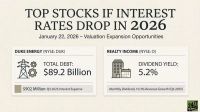
| Realty Income (NYSE:O) | 5.85% |
| Verizon Communications (NYSE:VZ | VZ Price Prediction) | 6.01% |
| Duke Energy (NYSE:DUK) | 3.79% |
The numbers show the risk income investors face. Although Realty Income and Verizon still offer yields above the 30-year Treasury, the spread is now only 41 and 57 basis points, respectively. Duke Energy’s dividend yield is already 165 basis points below the Treasury.
That makes income stocks increasingly dependent on dividend growth and potential share-price appreciation to compensate investors for taking on greater equity risk.
REITs and utilities face an additional challenge because their businesses often require substantial capital. Higher interest rates can increase financing costs while simultaneously making their dividends less distinctive compared with government bonds.
Don’t Throw Every Dividend Stock Overboard
That said, investors shouldn’t treat a 5.44% Treasury yield as an automatic sell signal for every dividend stock.
A company that can grow earnings and dividends faster than inflation has something a Treasury bond does not: a potentially rising income stream. Verizon’s 6.01% yield, for example, gives shareholders more current income than the 30-year Treasury, while Realty Income’s monthly dividend provides another distinction.
The key is valuation. When Treasury yields were near 1% in 2020, investors had little choice but to accept lower yields elsewhere if they wanted income. Today, the risk-free alternative is much more competitive.
In short, the bond-market selloff does not make dividend stocks bad investments. It makes weak dividend stocks easier to identify.
Key Takeaway
The 30-year Treasury’s 5.44% yield is a new hurdle for income investors. With the rate nearly 500 basis points above its 2020 low, dividend stocks now have to justify their equity risk through higher yields, faster dividend growth, stronger earnings, or some combination of the three.
Investors should be especially careful with high-yield stocks whose dividends are only marginally above Treasuries. A 6% yield is less compelling when a government bond offers 5.44% and doesn’t depend on corporate earnings.
Ultimately, this is a market for selectivity. The bond market has brought income back into competition — and dividend stocks now have to earn their place.
Contact [email protected] for any questions or corrections.
After two decades of patrolling the dark corners of suburbia as a police officer, Rich Duprey hung up his badge and gun to begin writing full time about stocks and investing. For the past 20 years, he’s been cruising the markets looking for companies to lock up as long-term holdings in a portfolio while writing extensively on the broad sectors of consumer goods, technology, and industrials. Because his experience isn’t from the typical financial analyst track, Rich is able to break down complex topics into understandable and useful action points for the average investor. His writings have appeared on The Motley Fool, InvestorPlace, Yahoo! Finance, Money Morning, and, of course, 24/7 Wall St. He has been featured in both U.S. and international publications, including MarketWatch, Financial Times, Forbes, Fast Company, and USA Today.