Jim Cramer and Clark Howard Agree on Debt. Here’s Why One Says Act Today and One Says Wait
Jim Cramer and Clark Howard looked at the same economic threat and reached opposite conclusions about what you should do right now. Understanding why both of them are correct depends entirely on which pile of your money you're talking about.

This post may contain links from our sponsors and affiliates, and Flywheel Publishing may receive compensation for actions taken through them.
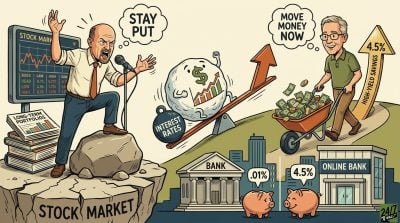
Within half a day, two of America’s best-known money voices pointed at the same cause: rising government debt driving long-term interest rates higher. On CNBC’s Mad Money on the evening of October 6, 2026, Jim Cramer told investors to stay put. On The Clark Howard Podcast the morning of October 7, 2026, Howard told savers to move their money today.
Both men are right. Following only one of them can cost you money. The 10-year Treasury yield rose from 4.8% in early September to 5.3% this week, its highest reading in over a month.
Cramer’s Market Read: Hold Your Positions Through the Debt Scare
Cramer, a former hedge fund manager, saw the bond selloff as a rate story. He said on Mad Money: “I think what you’re seeing is related to the fact that interest rates in 30 years headed towards 6%, maybe six and a quarter, which is what I can ultimately expect, that it could happen.” The 30-year Treasury already yields about 5.6%.
On Europe, Cramer said: “We’ll get a raft of stories that will scare us into thinking we’re going to be embroiled in a worldwide sovereign debt crisis. But if Europe’s good at one thing, it’s kicking the can down the road.” He signed off: “Panic is not a strategy.”
For long-term stock money, that reasoning holds up. Selling on a headline forces you to time two moves: the exit and the re-entry. Most people miss the second one.
Your Bank Is Pocketing the Rate Hike, Says Clark Howard
Howard, a consumer advocate, blamed the same cause: “The world has lost faith in the U.S. government. The reckless spending that we’re not paying for, increasing the debt and the deficit, has made big players around the world say we don’t trust the U.S. anymore. So interest rates having to be paid to finance the debt keep going up.”
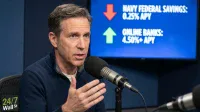
He then turned to the listener’s bank statement: “Chase, by far the nation’s largest bank, is paying savers .01%. I mean, an insult to your intelligence.” His fix: “Today, without a heavy lift, you can move your savings to an online bank, credit union, or small community bank and earn 4.5% on your idle savings.”
Take $50,000 in savings. At 0.01%, it makes $5 a year, but at 4.5%, it makes $2,250. The FDIC’s national average 12-month CD rate of 1.73% brings in just $865.
Over five years with compounding, 4.5% grows that $50,000 by roughly $12,309. The 0.01% account adds about $25. With the Fed’s target rate at 4%, a cut would shrink the higher figure, but the gap stays wide.
Howard also noted the same pressure on housing: “In almost every market in the country, it remains much more affordable to rent than to buy right now. So even though interest rates have pushed home prices down, the effective cost is still much lower to rent.”
Why Sitting Still and Moving Fast Both Make Sense
The two men agree on the cause. They only seem to disagree because they’re talking about different pools of money. Cramer addresses a stock portfolio; Howard addresses idle cash.
Time horizon determines it. Rising rates can drive stock prices down temporarily, and money you won’t touch for a decade can wait that out. For cash, higher rates are a gift, but only if your bank passes them along.
Your Move This Week, Bucket by Bucket
- Savings annual percentage yield (APY) is the first number to check. An APY that starts with a zero means the bank’s convenience is costing you interest income.
- Insured high-yield accounts are the option Howard describes. FDIC coverage applies at online banks, and NCUA coverage applies at credit unions.
- Card debt changes the math. With the average credit card annual percentage rate (APR) at 21%, paying off a carried balance beats any savings yield.
- Long-term brokerage accounts fit Cramer’s framework, which favors a set rebalancing schedule over reacting when headlines spike.
Cramer is right about the stock portfolio you’re keeping for the long haul, and Howard is right about the cash sitting in your bank. Each view applies to a different pool of money.
Contact [email protected] for any questions or corrections.
Trey has been an editor and author at 24/7 Wall St. for more than a decade, where he has published thousands of articles analyzing corporate earnings, dividend stocks, short interest, insider buying, private equity, and market trends. His comprehensive coverage spans the full spectrum of financial markets, from blue-chip stalwarts to emerging growth companies.
Beyond 24/7 Wall St., Trey has created and edited financial content for Benzinga and AOL's BloggingStocks, contributing additional hundreds of articles to the investment community.
Trey's editorial expertise extends across multiple publishing environments. He served as production editor at Dearborn Financial Publishing and development editor at Kaplan, where he helped shape financial education materials. Earlier in his career, he worked as a writer-producer at SVE. His freelance editing portfolio includes work for prestigious clients such as Sage Publications, Rand McNally, the Institute for Supply Management, the American Library Association, Eggplant Literary Productions, and Spiegel.
Outside of financial journalism, Trey writes fiction and has been an active member of the writing community for years, moderating workshop sessions at regional conventions.