Wes Moss: America’s “Friendship Recession” Is Hitting the Wealthiest Nation in History
America's net worth has doubled to $190 trillion in a decade, yet retirement researcher Wes Moss says the wealthiest generation in history is facing a crisis that no savings rate can fix.

This post may contain links from our sponsors and affiliates, and Flywheel Publishing may receive compensation for actions taken through them.
Wes Moss borrowed a term from economics to describe what is happening to American social life. “Put all that together and we got a friendship recession, and it doesn’t seem like that’s getting any better,” the retirement researcher and author said in an interview with me about his new book, The Retire Sooner Method.
“All that” refers to three forces he lays out. Making friends gets harder with each decade. Social networks break apart as “people divorce, people move, people die.” And men in particular find it harder to keep friendships as they age, which he credits to neuroscientist Dr. Michael Platt.
The stakes are financial as well as emotional. You can hit every savings target and still end up an unhappy retiree if your social life has emptied out. Moss is right, and his sharpest point is that the problem is growing even as the country gets richer.
A $190 Trillion Nation Running Short on Friends
Moss pointed to the Federal Reserve Economic Database (FRED) for total U.S. net worth. “In 2016, so go back 10 years, it was about 90, let’s call it roughly $90 trillion. Today, it’s $190 trillion. So it’s more than doubled in just 10 years.”
“A little over 4 million people last year turned 65. Same thing this year,” Moss said. “Who gets hit by the friendship recession? It’s the 60 plus.” A rich nation and an aging nation are the same nation. The money keeps piling up while the age group most at risk of isolation keeps getting bigger.
The friendship data in his book shows how far things have slipped. In 1990, only 3% of Americans said they had no close friends. Today it’s 17%.
Moss puts that as going from “1 in 33 people being socially isolated to nearly 1 in 5.” Over the same stretch, the share with five or more close friends fell from 64% to 42%.
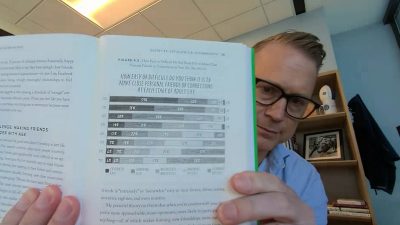
Age makes it worse. In his research, 82% of Americans in their thirties say making close friends is easy. Among people in their sixties, only 34% say the same. So people lose friends at the same age when replacing them gets hardest.
Why Four Close Friends Is the Line That Matters
The variable that decides how this lands for you is how many close friends you have. Moss’s data puts the tipping point at 3.6 close friends. People with one or two fall well below the U.S. happiness baseline. Three to four puts you near neutral, and five or more puts you above it.
The gap shows up among retirees too. 81% of happy retirees say they have “enough” close friends, compared with 38% of unhappy ones. Moss, a CERTIFIED FINANCIAL PLANNER® and chief investment strategist at Capital Investment Advisors, also found that money helps. Americans with $3 million or more in assets are 38% more likely to say making friends is easy.
So wealth makes it easier to connect, but it can’t do the connecting for you. That’s why a nation worth $190 trillion can still be in a friendship recession.
Moss, who takes listener questions at wesmoss.com/ask, lays out his retirement framework in The Retire Sooner Method.
Joiners Beat the Recession
Moss’s fix is concrete, “It is the joiners that are totally fine. They’re like, ‘What friendship recession?'” His goal is modest: “a handful. Four people or more.”
His book connects friendship to “core pursuits,” the activities that give retirees daily and yearly purpose. He warns that “even the most electrifying core pursuits can feel hollow when experienced in isolation.” Platt explains why practice matters: “Your social brain network is like a muscle. The more you use it, the more it grows.”
Your Move If You Count Fewer Than Four
- Count your close friends tonight. Leave out family, since Moss’s zero-friends figure measures friends outside family members. If your number is under four, you’re on the wrong side of his tipping point.
- Run his 30-minute exercise. List every core pursuit you could see yourself doing over the next five years. Rewrite your top five or ten around what they mean to you, then mark the ones that involve other people.
- Join one group where you don’t know everyone. Moss names churches, golf groups, workout groups, creative groups, music groups and travel groups. Pick one with a fixed weekly time so you show up out of habit.
- Put connection into your financial plan. Club dues, group trips and class fees are retirement expenses, the same as healthcare. Budget for them in your written plan instead of treating them as extras.
- Start before you retire. Moss suggests building these pursuits “as early as possible,” while you still have your work network as a base.
Your portfolio pays for retirement, but having four or more close friends is what makes it worth living.
Contact [email protected] for any questions or corrections.
Jake has been been working in financial media for almost 15 years. He focuses on all things personal finance for 24/7 Wall St. with high hopes to educate and entertain. Most recently, Jake spent 12 years working various roles at The Motley Fool. He started copy editing fool.com content, worked on premium and marketing campaigns, and helped launch The Ascent, a personal finance brand.
His work has been featured on platforms like MSN, Yahoo Finance, USA Today, and more. He's written about credit cards, social security, ETFs, savings accounts, and just about anything else you can imagine when thinking about money. Jake love to cook, play golf, and tell people he's never had a cavity. (It's true!)