64% of Americans Fear Running Out of Money More Than Death. Wes Moss Says an Ounce of Planning Is the Cure
Most retirees with a million dollars in the bank still lose sleep over money, and the fix has nothing to do with saving more. Wes Moss points to one small exercise that quiets the fear almost immediately.

This post may contain links from our sponsors and affiliates, and Flywheel Publishing may receive compensation for actions taken through them.
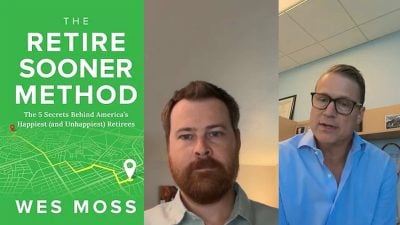
64% of Americans worry more about running out of money than about death itself, according to an Allianz study that Wes Moss cites in his new book, The Retire Sooner Method. Moss is a certified financial planner and hosts the Money Matters radio show. He puts that statistic in his chapter on sleep, under a frank question: “So what’s really keeping Americans up at night?”
The American Academy of Sleep Medicine found that two-thirds (66%) of respondents lose sleep over their finances. Near retirement, that usually means second-guessing every market drop and withdrawal.
Moss’s prescription starts with planning, and his data shows that planning matters more than savings alone.
A Full Tank of Gas Still Leaves Wealthy Savers Awake
Moss’s own research, the 2025 Money and Happiness in America survey, broke this fear down by investable assets. Each percentage below describes only the people inside that bracket.
Among people with $500,000 to $999,999, Moss found that 45% still rank running out of money as a top worry. Moss reports that 39% of those holding $1 million to $2.9 million share the concern.
At the top, Moss’s data shows that 24% of people with $3 million or more still worry about running out. “That’s like having a full tank of gas and worrying you won’t make it across town,” he writes.
The fear steps down as balances rise, yet never reaches zero. Balances alone leave the worry in place.
The fear also tracks happiness. Moss’s data shows unhappy retirees are twice as likely to carry this worry as happy retirees.
In our interview, Moss explained how it works. “I think about headlines as the distraction,” he said. A market drop or a rate hike sets off portfolio anxiety, and then inflation worry piles on. “But ultimately, what am I worried about? I’m worried about this very universal fear, which is running out.”
Moss’s Easiest Fix Is a Timeline You Draw Yourself
Asked how to calm that fear, Moss pointed to something small. “Just the ounce of planning is so powerful,” he said. “Out of all these things, that’s the easiest, quickest thing you can do.”
He named the specific step: “One of those important things to do is draw your own timeline.” Then he named the benefit: “That exercise in itself helps people sleep better at night.”
The fear keeps people awake, and the timeline lets them rest. Moss compares life without a plan to a broken navigation system: “If you don’t have a path, your GPS is broken, then there is anxiety with that.” A timeline gives you the route back.
Moss, who takes listener questions at wesmoss.com/ask, lays out his retirement framework in The Retire Sooner Method.
In the book, Moss describes retirees Charlotte and Ray, whose names he changed. They were physically worn out from daily workouts but still lay awake with racing financial thoughts. Once they had clarity, they called him: “We haven’t slept this well in years.”
Four Green Zone Targets to Mark on Your Timeline
The book calls the four parts of Moss’s Money Green Zone “the elixirs for the fear of running out of money.” Give each one a target year on your timeline.
- A nest egg of $1 million or more. Moss sets the target at $1 million or more in liquid investable assets: cash, CDs, brokerage accounts, IRAs, Roth IRAs, and 401(k)s. Home equity stays off this line because you can’t pay for groceries with it.
- Multiple income sources. Wes Moss wants streams that add up to $100,000 or more and kick in at different times. Put each start date on your timeline as its own point, whether it’s Social Security, a pension, or part-time work.
- A mortgage payoff within sight. Wes Moss sets the target at nine years or fewer. If you’re further out, he suggests refinancing to a shorter term or adding $200 to $500 a month in extra principal.
- The 4%+ rule of thumb. Wes Moss calls the 4+ percent withdrawal guideline the biggest antidote to running out of money. For example, a 4% withdrawal from $1 million produces $40,000 in the first year. Write that number next to your income streams and you can see the size of any gap.
Draw the timeline and mark the four targets before the next market drop comes. Once you have that map, the next headline loses most of its power.
Contact [email protected] for any questions or corrections.
Jake has been been working in financial media for almost 15 years. He focuses on all things personal finance for 24/7 Wall St. with high hopes to educate and entertain. Most recently, Jake spent 12 years working various roles at The Motley Fool. He started copy editing fool.com content, worked on premium and marketing campaigns, and helped launch The Ascent, a personal finance brand.
His work has been featured on platforms like MSN, Yahoo Finance, USA Today, and more. He's written about credit cards, social security, ETFs, savings accounts, and just about anything else you can imagine when thinking about money. Jake love to cook, play golf, and tell people he's never had a cavity. (It's true!)