How Much You Need Invested to Let Dividends Pay Your Property Tax Bill for Life
Property taxes follow homeowners into retirement whether the mortgage is gone or not, but a two-fund municipal bond strategy can turn a modest lump sum into a recurring annual payment that offsets the bill without triggering federal income tax.

This post may contain links from our sponsors and affiliates, and Flywheel Publishing may receive compensation for actions taken through them.
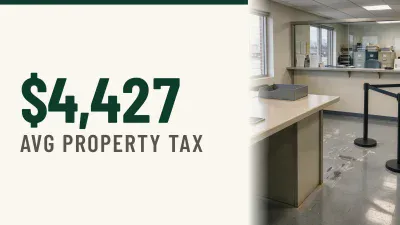
A retiree pays off the mortgage and celebrates, but the county still sends a bill because property taxes never go away. According to ATTOM, the average single-family home had a property tax bill of $4,427 in 2025, up 3% from the previous year.
This piece builds a two-fund municipal bond portfolio meant to pay that bill every year. Half goes in the Vanguard Tax-Exempt Bond ETF (NYSEARCA:VTEB). The other half goes into the Nuveen AMT-Free Municipal Credit Income Fund (NYSE:NVG). All figures were pulled at the start of November 2026.
About $75,000 Covers the Average Bill
Vanguard’s fund yields about 3.5% based on its current monthly payout. Nuveen’s fund pays about 8.3% on its share price. Split evenly, the blend works out to roughly 5.9%. At that combined yield, it takes about $74,800 to throw off $4,427 a year. In New Jersey, where the average bill hit $10,499, the number rises to roughly $177,000.
Why Municipal Bonds Fit This Job
Municipal bonds are loans to states, cities, and school districts. Federal law excludes their interest from gross income under 26 U.S.C. § 103(a), with exceptions such as certain private activity bonds. Funds that pass that interest along keep the same tax treatment under 26 U.S.C. § 852(b)(5)(B).
That break makes a small yield work harder. A 5.9% tax-free yield matches about 7.8% on a taxable bond in the 24% federal bracket, and about 9.1% in the 35% bracket. For 2026, the 24% rate starts above $211,400 of taxable income for joint filers, and 35% starts above $512,450.
There are two catches. First, state tax exemption usually covers only your state’s bonds. So national funds like these are usually partly taxable on a state return. The second is that “tax-free” interest still counts in two income tests.
The IRS adds tax-exempt interest when figuring whether Social Security benefits are taxable. Medicare’s income measure for IRMAA, the surcharge on premiums, also adds tax-exempt interest. In 2026, that surcharge kicks in above $109,000 for single filers and $218,000 for joint filers.
Vanguard Tax-Exempt Bond ETF
This is a plain index fund. It holds a broad range of investment-grade municipal bonds, meaning bonds from issuers rated as solid credits. It’s low-cost and uses no leverage, so it’s the steady half. It gets half the portfolio, about $37,400. At about 3.5%, that adds roughly $1,318 a year. Payments arrive monthly and drift a bit. The latest came to about 14 cents a share.
One thing to know: its income moves with interest rates. Monthly payouts fell as low as about 7 cents a share in 2022 before rising to today’s level.
Nuveen AMT-Free Municipal Credit Income Fund
This is a closed-end fund. It issues a fixed number of shares that trade like a stock. The price is set by market trading, so shares can trade above (a premium) or below (a discount) the value of the bonds inside, called net asset value, or NAV. It aims for income free from regular federal income tax and the alternative minimum tax, a parallel tax that captures some higher earners.
The other half, about $37,400, goes here. At about 8.3%, that adds roughly $3,109 a year from a steady 7.9-cent monthly payout.
The fund borrows to buy more bonds, and while cheap borrowing boosts income, rising rates squeeze it. Regular payouts slipped from 6.75 cents in early 2022 to 4.25 cents in 2023, then rose back to 7.9 cents in mid-2024. Shares are down about 9% over five years. Before buying, check the current discount or premium, the distribution rate on NAV, and the leverage ratio on Nuveen’s site. Paying a premium reduces your real yield.
Plan for a Bigger Bill Down the Road
“For life” needs an asterisk. Property taxes tend to rise, while bond income stays fairly flat, so a portfolio sized for today’s bill will likely come up short in a decade. Many states and counties offer senior relief, such as homestead exemptions, assessment freezes, or tax deferral programs. Any of those can reduce the target. Your county assessor’s office can tell you what you qualify for.
What to Do Before Your Next Bill Arrives
About $74,800 split evenly between these two funds covers the average $4,427 bill, and the risk to watch is Nuveen’s payout, which has been cut before when borrowing costs rise. Each year, when the new tax bill lands, compare it to the portfolio’s income. Then add money or reinvest any surplus to close the gap.
Contact [email protected] for any questions or corrections.
David Beren has been a Flywheel Publishing contributor since 2022. Writing for 24/7 Wall St. since 2023, David loves to write about topics of all shapes and sizes. As a technology expert, David focuses heavily on consumer electronics brands, automobiles, and general technology. He has previously written for LifeWire, formerly About.com. As a part-time freelance writer, David’s “day job” has been working on and leading social media for multiple Fortune 100 brands. David loves the flexibility of this field and its ability to reach customers exactly where they like to spend their time. Additionally, David previously published his own blog, TmoNews.com, which reached 3 million readers in its first year. In addition to freelance and social media work, David loves to spend time with his family and children and relive the glory days of video game consoles by playing any retro game console he can get his hands on.