His Pension Covers the Bills at 75. The IRS Will Still Order a $33,333 Withdrawal From His $820,000 Traditional 401(k)
His pension and Social Security already cover every bill, so he never planned to touch his 401(k). One forced withdrawal could quietly drag part of his Social Security into a steeper tax bracket, and the deadline he picks matters more…

This post may contain links from our sponsors and affiliates, and Flywheel Publishing may receive compensation for actions taken through them.
Consider a 75-year-old who spent his career as an engineer and has enough retirement income to live comfortably. Between his pension and Social Security, every bill is covered. His $820,000 traditional 401(k) is money he doesn’t need to touch, and he’d like to leave it that way for his children. The IRS has other plans.
Because he kept working past 73, he was able to postpone required withdrawals from his employer’s retirement plan. But he retired in 2026, and that protection has ended. Now he’s facing a $33,333 withdrawal he never wanted, with a federal tax bill attached. The longer he waits to take it, the more complicated that bill could become.
A $33,333 Withdrawal He Never Requested
The formula takes two inputs. One is the account balance on December 31 of the prior year. The other is a divisor from the IRS Uniform Lifetime Table, and at age 75 that divisor is 24.6.
Divide his December 31, 2025, balance of $820,000 by 24.6 and you get approximately $33,333. That’s his minimum withdrawal for 2026. He can take more, but he cannot take less. The divisor gets smaller every year, so the share of the account he is forced to withdraw goes up as he ages.
Where the Money Goes When He Doesn’t Need It
The withdrawal is generally taxed as ordinary income in the year it leaves his 401(k). He can’t roll his required distribution into an IRA or Roth IRA, either. The IRS doesn’t allow required minimum distributions (RMDs) to be rolled over.
What he can do is pay the tax and reinvest what’s left in a taxable brokerage account. The money stays invested and only the tax treatment changes. A broad, low-yield index fund such as Vanguard Total Stock Market ETF (NYSEARCA:VTI) keeps future taxable dividends small. Assets held in taxable accounts also get a stepped-up cost basis when they pass to his heirs. That step-up can help the kids more than leftover pre-tax 401(k) money would.
How One Withdrawal Can Trigger a 41% Tax Rate
Assume he receives a $30,000 pension and $45,000 annually from Social Security, and files his taxes as a single individual.
Taxation of benefits begins once provisional income passes $25,000. Up to 85% becomes taxable above $34,000.
Without the distribution, $20,225 of his benefits is taxable. With it, the taxable amount jumps to $38,250, which is the 85% cap.
So a $33,333 withdrawal adds another $18,025 of taxable Social Security benefits, increasing his adjusted gross income (AGI) by $51,358.
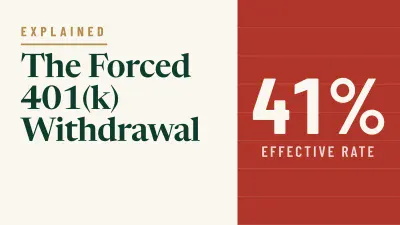
That’s the tax torpedo. Part of his withdrawal falls where each additional dollar makes another 85 cents of Social Security taxable. In the 22% bracket, that produces a marginal federal tax rate of roughly 41%, and the phaseout of his additional senior deduction can push it higher. Under 2026 rules, the full withdrawal increases his federal income tax bill by approximately $9,217.
Addressing that problem is really a pre-75 project. We walked through how to reduce the balance years before the first required withdrawal lands: The First-Year Tax Bomb.
Medicare is the next exposure. His modified adjusted gross income (MAGI) of approximately $101,583 falls below the current $109,000 single-filer threshold for higher Medicare premiums. But Medicare generally looks back two years, meaning his 2026 income will determine whether he owes an income-related monthly adjustment amount (IRMAA) in 2028, using that year’s thresholds.
Missing the Deadline Costs 25%
In the first year only, he can push his 2026 distribution to April 1, 2027. But his 2027 distribution is still due by year-end. If his account balance remains around $820,000 at the end of 2026, his next required withdrawal would be about $34,600. Both distributions would then land on his 2027 tax return.
With his pension and Social Security unchanged, that could push his adjusted gross income above $136,000. It might also trigger higher Medicare premiums in 2029, depending on the thresholds in effect then. For him, taking the first distribution in 2026 is the cleaner choice.
Skipping the required deadline can bring an excise tax of 25% on the shortfall. That falls to 10% if he corrects the mistake and files the tax return within the correction window. The IRS may also waive the penalty for a reasonable error. The correction window can close earlier if the IRS issues a deficiency notice or assesses the tax.
3 Ways to Manage His Next Required Withdrawal
- Consider Roth conversions. Moving traditional 401(k) savings into a Roth IRA can reduce future required withdrawals, and Roth IRAs have no lifetime RMDs for their original owners. But he must first take his annual RMD before converting additional funds. The conversion is taxable and could also raise his Medicare premiums two years later.
- Roll to an IRA and give through QCDs. Qualified charitable distributions (QCDs) sent directly from an IRA to an eligible charity can satisfy IRA required withdrawals without increasing adjusted gross income. The 2026 limit is $111,000 per person. He must first take his 401(k)’s required distribution before rolling the remaining balance into an IRA, where QCDs can help manage future taxes.
- Plan for the tax bill. His pension already covers his expenses, so the required withdrawal creates income he doesn’t need to spend. He can arrange federal tax withholding on the distribution or make estimated payments to avoid an unexpected bill when he files his return.
Contact [email protected] for any questions or corrections.
Gerelyn Terzo is the author of dividend investing handbook "Dividend Investing Strategies: How to Have Your Cake & Eat It Too." A veteran financial journalist, she covers agri-finance for outlets like Global AgInvesting and the broader stock market and personal finance for 24/7 Wall Street. She began at CNBC and later helped launch Fox Business in New York. Gerelyn currently resides in Woodland Park, Colorado and dabbles in nature photography as a hobby.