‘Real Wages Have Gone Up 3.5% This Year’: The Ramsey Show Housing Pitch the Government’s Own Pay Data Contradicts
A Ramsey Show guest promised buyers that raises will soon outrun prices and make homes 10% more affordable. Federal pay figures and a one-point jump in mortgage rates tell a different story about who wins if you stretch your budget…

This post may contain links from our sponsors and affiliates, and Flywheel Publishing may receive compensation for actions taken through them.
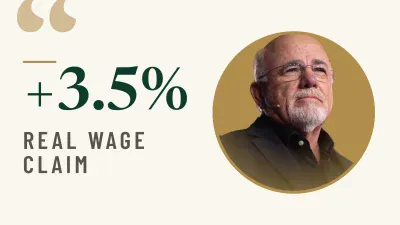
On the November 6 episode of The Ramsey Show, real estate coach Brian Buffini, whom Dave Ramsey introduced as founder of Buffini & Co, told would-be buyers that real wages “have gone up 3.5% this year” while prices rose “nine tenths of 1%.” Then he looked ahead:
“The projection for next year is real wages are going up almost four and a half and prices are going to stay flat or might come down 1%, 1%, not 20%. And so over the next two to three years, real wages are going to go up about double digits and prices are going to stay flat. So what’s happening is you’re going to have 10% more affordability within the next three years.”
A buyer who stretches today on that promise is locking in a fixed payment and counting on raises to catch up. If they don’t, the mortgage stays the same size while the budget behind it shrinks.
Government Pay Data Shows Buying Power Slipped This Year
The pitch fails on its central number. Bureau of Labor Statistics real average hourly earnings for private workers stood at $11.26 in September 2026, a preliminary reading. A year earlier the figure was $11.32. That works out to a decline of about half a percent, the opposite direction from a 3.5% gain.
Real wage growth equals your raise minus inflation. Nominal hourly pay rose from $36.70 to $37.81 over the year, a gain of about 3%. The Consumer Price Index rose about 4% over the same stretch. Prices outpaced paychecks, so the typical worker can buy a little less than last year.
The “nine tenths of 1%” figure matches neither price gauge. Consumer prices ran at about 4%. National home prices, measured by the Case-Shiller index, rose 2% year over year in August.
Mortgage Rates Swallowed the Raise
For a buyer, affordability comes down to income against the monthly payment. That payment depends on the rate as much as the price. Freddie Mac’s 30-year fixed average hit 7.18% on Nov 5, up 1.01 points from a year earlier.
Take an example $350,000 loan. Principal and interest run $2,371 a month at today’s rate versus $2,137 at last year’s 6.17%.
The gap stands at $234 a month, or about $2,810 a year.
Now compare that to a raise. A household making $80,000 that gets the average 3% bump collects about $2,420 more before taxes. The rate increase alone ate more than the entire raise.
Flat Home Prices Hold Up, but Only Half the Equation
Buffini’s price call has support. Case-Shiller read 336.7 in August, slightly below its 337.3 July reading. Prices have leveled off, which removes the pressure of a runaway market.
Flat prices improve affordability only when real pay rises. With real earnings down and rates up a full point, a stable sticker price still costs more each month to own.
Your Rate Path Decides Whether This Pitch Pays Off
The single variable that flips the outcome is where mortgage rates go after you buy. The guest’s advice to buy now and refinance when rates dip depends entirely on that.
If rates return to February’s low of 5.98%, the same $350,000 loan drops to $2,094 a month. This translates to $277 of monthly relief, and the refinance strategy works.
If rates hold near today’s level, or return to October’s peak of 7.40%, there is no refinance. You carry the $2,371 payment for as long as you own the house, on pay that is losing ground to inflation.
Run These Numbers Before Signing a Contract
- Approve at today’s rate. Calculate your payment at 7.18% and confirm it fits your current take-home pay. Treat any future refinance as a bonus, never as the plan that makes the budget work.
- Measure your own real raise. Compare your last raise to the about 4% inflation rate. If your raise came in lower, your buying power fell, whatever the national projections say.
- Stress test the payment. Rerun the math at October’s 7.40% peak. If that payment would strain your budget, the house is too expensive at current rates.
- Track the monthly wage report. The BLS releases real average hourly earnings every month alongside the CPI. Two or three months of rising readings would be the first evidence that the 10% affordability forecast is taking hold.
Home prices may be flat, but the government’s own pay data says the affordability gain is still a forecast, so buy only what fits the payment you can afford today.
Contact [email protected] for any questions or corrections.
Jake has been been working in financial media for almost 15 years. He focuses on all things personal finance for 24/7 Wall St. with high hopes to educate and entertain. Most recently, Jake spent 12 years working various roles at The Motley Fool. He started copy editing fool.com content, worked on premium and marketing campaigns, and helped launch The Ascent, a personal finance brand.
His work has been featured on platforms like MSN, Yahoo Finance, USA Today, and more. He's written about credit cards, social security, ETFs, savings accounts, and just about anything else you can imagine when thinking about money. Jake love to cook, play golf, and tell people he's never had a cavity. (It's true!)