The Portfolio Blueprint for $12,200 a Month in Dividend Income Without Selling a Single Share

This post may contain links from our sponsors and affiliates, and Flywheel Publishing may receive compensation for actions taken through them.
Picture a couple at the kitchen table, outlining their dream retirement income on a napkin. They want $12,200 a month, or $146,400 a year, paid entirely by dividends so they never sell a share. Then comes the real question: how much money does that take?
Here’s one plan that uses seven income payers, each with its own job. The yields below come from each holding’s latest annualized payout and its closing price on November 6, 2026.
Combined Yield and Portfolio Size
Combine the seven at their assigned weights, and the portfolio yields about 8.7%. Divide $146,400 by that yield, and you get roughly $1.69 million invested.
Global X NASDAQ 100 Covered Call ETF
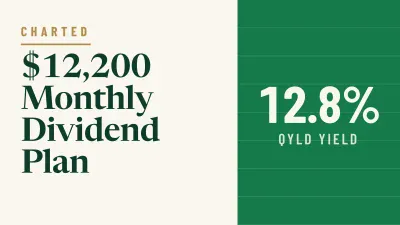
Global X NASDAQ 100 Covered Call ETF (NASDAQ:QYLD) generates income from options. It owns the Nasdaq-100 and writes call options on it. Those index options settle in cash rather than shares, and the fund uses the premiums collected to help fund its monthly distributions. With a 10% weight and a yield near 12.8%, it supplies about $21,600 a year.
Selling calls caps the upside: shares closed at $25 in January 2014 and now trade around $17.
JPMorgan Equity Premium Income ETF
JPMorgan Equity Premium Income ETF (NYSEARCA:JEPI) holds lower-volatility S&P 500 stocks and uses equity-linked notes, which are contracts that work like selling calls. Its 15% slice yields about 7.4% and supplies roughly $18,700. Expect the checks to vary: 2026 monthly payouts ran from $0.34 to $0.45 a share.
EPR Properties
The real estate investment trust EPR Properties (NYSE:EPR) owns theaters, eat-and-play venues, attractions and fitness clubs. It pays $0.31 a month and yields about 6.3%. At 15%, it adds about $15,800. EPR suspended its dividend during the pandemic. Payments stopped after April 2020 and came back at $0.25 in July 2021.
Ares Capital
Ares Capital (NASDAQ:ARCC | ARCC Price Prediction) is the largest publicly traded business development company, lending to midsize private businesses and passing most of the interest through to shareholders. It has paid $0.48 every quarter since 2023, which works out to a yield near 10.0%. At 15%, it supplies about $25,400. Third-quarter adjusted EPS of $0.46 fell short of that dividend.
PIMCO Dynamic Income Opportunities Fund
The PIMCO Dynamic Income Opportunities Fund (NYSE:PDO) is a closed-end bond fund with a fixed number of shares, so its price can sit above or below net asset value, the actual worth of its bonds. It also borrows to boost income, which increases losses. It pays $0.1279 a month, a distribution rate near 12.7%, and supplies about $21,400 at a 10% weight. PIMCO’s site lists the current premium or discount.
Verizon Communications
Paying $0.7075 a quarter, Verizon Communications (NYSE:VZ) yields about 6.2%. Its payout went up every year from 2021 through 2026. The dividend takes about 72% of trailing earnings. At 15%, Verizon supplies about $15,700. The weak spot is its $166.2 billion of debt.
Alerian MLP ETF
Alerian MLP ETF (NYSEARCA:AMLP) owns pipeline partnerships. It carries the largest weight, 20%, yields about 8.2%, and supplies roughly $27,700. Because the fund is set up as a corporation, you get a 1099 instead of a K-1.
Some payouts can count as a return of capital, meaning the fund is handing back part of your own investment. That money is tax-deferred when you receive it because it reduces your cost basis, and once your basis reaches zero, the excess is reported as a capital gain. The fund’s year-end tax notice shows how each year’s payouts were split.
Which Job Pays the Most
The plan needs about $1.69 million. Lending carries the most income at roughly $46,900. Real assets and pipelines bring in about $43,500, and option income about $40,300. The biggest risk is that option income funds can pay big checks while their share prices fall. QYLD’s drop from $25 to $17 shows how this can happen. Each year, compare what you collected with what your shares are worth. If the share value keeps falling, check whether distributions include return of capital and whether the fund is generating enough income to sustain its payouts.
Building a lump sum into something that acts like a paycheck takes discipline, and we laid out the mix, payment calendar, and withdrawal order in a free guide here: The Paycheck Portfolio Method.
Contact [email protected] for any questions or corrections.
David Beren has been a Flywheel Publishing contributor since 2022. Writing for 24/7 Wall St. since 2023, David loves to write about topics of all shapes and sizes. As a technology expert, David focuses heavily on consumer electronics brands, automobiles, and general technology. He has previously written for LifeWire, formerly About.com. As a part-time freelance writer, David’s “day job” has been working on and leading social media for multiple Fortune 100 brands. David loves the flexibility of this field and its ability to reach customers exactly where they like to spend their time. Additionally, David previously published his own blog, TmoNews.com, which reached 3 million readers in its first year. In addition to freelance and social media work, David loves to spend time with his family and children and relive the glory days of video game consoles by playing any retro game console he can get his hands on.