Only 46% of Americans Have Three Months of Emergency Savings, Down From 53%. Adults 55 and Older Have the Easiest Time Paying Their Bills

This post may contain links from our sponsors and affiliates, and Flywheel Publishing may receive compensation for actions taken through them.

A rainy-day fund is cash you set aside for things nobody plans for, like a layoff, a hospital stay, or a car that dies on the highway. In its 2024 National Financial Capability Study, published in July 2025, the FINRA Investor Education Foundation found that only 46% of U.S. adults had enough saved to cover three months of expenses. The FINRA Investor Education Foundation’s earlier reading, from 2021, was 53%.
Spending has been going the wrong way too. The FINRA Investor Education Foundation found that 26% of adults spent more than they earned in 2024, an all-time high for the study, up from 19% in 2021.
Spending more than income can force households to draw down savings or borrow, leaving less protection against emergencies. 24/7 Wall St. used the same survey for a financial literacy ranking on Nov. 11. The savings and bill numbers say more about how people are getting through the month.
Things haven’t gotten easier since the survey was taken. The Bureau of Economic Analysis reports that the personal savings rate fell to 4.1% in the third quarter of 2026, from 6.9% in the first quarter of 2024. People are holding on to a smaller piece of each paycheck than they were two years ago.
Ranking Age Groups by How Easily They Pay Their Bills
FINRA asked people how hard it is to cover their monthly expenses and bills. The percentage in each age group who said it’s not at all difficult, ranked from the easiest time to the hardest:
- People 55 and older: 59%, per the FINRA Investor Education Foundation
- Ages 35 to 54: 38%, per the FINRA Investor Education Foundation
- Ages 18 to 34: 31%, per the FINRA Investor Education Foundation
Younger adults may be covering rent, student loans and child care on entry-level pay, while the middle group may be juggling a mortgage and kids. By 55, some of those costs may have eased. Across all ages, the share who said bills weren’t hard at all fell to 44% in 2024 from 54% in 2021. That’s the first big drop the study has ever recorded.
Ranking Income Groups by the Same Measure
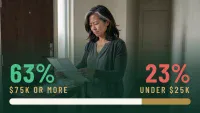
- $75,000 or more: 63%, per the FINRA Investor Education Foundation
- $25,000 to $75,000: 38%, per the FINRA Investor Education Foundation
- Under $25,000: 23%, per the FINRA Investor Education Foundation
Income makes the biggest difference, and the decline was steepest among higher earners. Compared with 2021, the share with no trouble paying bills fell seven percentage points among people earning under $25,000 and 11 to 14 points among higher earners. The decline extended to higher-income families.
Why Retirees Find Bills Easier
Older adults often have two big advantages. Some may have paid off their homes, removing what is often a household’s biggest monthly bill. Social Security also shows up every month and grows with inflation. The average retired worker’s check went up to $2,071 this year after a 2.8% cost-of-living adjustment, and next year’s increase is 3.6%. A regular check plus no mortgage makes a monthly budget much easier to balance.
Retirees Still Need a Rainy Day Fund
A comfortable monthly budget won’t cover a big one-time bill. A new roof, a replacement car, or a hospital stay can all show up with no warning. Medicare also has out-of-pocket costs, and the Part A hospital deductible is $1,736[1] in 2026, and the standard Part B premium is $202.90 a month (those premiums also go up with income, one of several surcharges we mapped in a free Medicare guide).
Without cash on hand, those costs usually end up on a credit card. The FINRA Investor Education Foundation found that 24% of adults 55 and older probably or certainly couldn’t come up with $2,000 for a surprise expense within a month. The average credit card APR was 21%[2] as of August 2026, which makes a credit card an expensive way to pay for a furnace.
Where you keep the money matters too. Competitive one-year CDs currently offer roughly 4.5% to 4.7% APY, substantially above the national average. 24/7 Wall St.’s high-yield savings coverage tracks where those better rates are. For an emergency fund, being able to get the money quickly matters more than squeezing out the last bit of interest.
One Step That Builds the Cushion
The simplest move is an automatic transfer from checking into a separate savings account every payday, even a small one. Keeping that money in its own account, ideally at a different bank, makes it harder to spend on everyday things. Because the transfer is automatic, nobody has to remember to do it. A small amount every paycheck adds up over a year, and that practice is what gets people into the 46% the FINRA Investor Education Foundation counts as having three months saved. The next round of the study will show whether that number starts to go up again.
Contact [email protected] for any questions or corrections.
David Beren has been a Flywheel Publishing contributor since 2022. Writing for 24/7 Wall St. since 2023, David loves to write about topics of all shapes and sizes. As a technology expert, David focuses heavily on consumer electronics brands, automobiles, and general technology. He has previously written for LifeWire, formerly About.com. As a part-time freelance writer, David’s “day job” has been working on and leading social media for multiple Fortune 100 brands. David loves the flexibility of this field and its ability to reach customers exactly where they like to spend their time. Additionally, David previously published his own blog, TmoNews.com, which reached 3 million readers in its first year. In addition to freelance and social media work, David loves to spend time with his family and children and relive the glory days of video game consoles by playing any retro game console he can get his hands on.