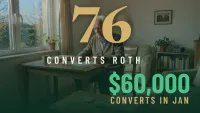
At 55 He’ll Open a Roth IRA With $100 and Forget About It. Seven Years Later, That Account Will Be the Reason the Growth on His $150,000 Conversion Comes Out Tax-Free

This post may contain links from our sponsors and affiliates, and Flywheel Publishing may receive compensation for actions taken through them.

Imagine an investor who opens a Roth IRA at 55 with $100 and never adds another dollar. That small deposit starts the five-year clock, and by 62, the clock has long since run out. So, when the same investor makes a $150,000 Roth conversion, the growth can come out free of federal income tax, since the account is past five years and the owner is past 59.5.
Without that early $100, the clock would have started with the conversion, and the earnings would have to wait five more years. That’s how a Roth IRA’s five-year clock works: it starts with the first contribution, and one clock covers every Roth IRA you own.
Two Tests Decide Whether Roth Growth Comes Out Tax-Free
Roth money has two parts: the dollars the owner put in, and what those dollars earn. The earnings come out tax-free only in a qualified distribution. Under IRS Publication 590-B (2025), that means the payout is made after the 5-year period beginning with the first tax year for which a contribution went into the owner’s Roth account, and on or after age 59½ (disability, death, and a limited first-home exception also apply).
The tax code says the same thing. Under 26 U.S.C. § 408A(d)(1)[1], a qualified distribution from a Roth account “shall not be includible in gross income.”[1] Miss either test and the IRS warns that the earnings portion “may be subject to tax and it may be subject to the 10% additional tax.”
A $100 Deposit Starts a Clock That Never Resets
The key words in the law point to any Roth account, not just one. IRS guidance measures the five years “from the beginning of the year for which you first set up and contributed to a Roth IRA.” So the clock runs from January 1 of the tax year the deposit counts toward, even if the money goes in months later. Publication 590-A (2025) lets contributions for a year be made up to the due date of that year’s return, not including extensions.
Take someone born in 1971 who opens his first Roth this year at 55. His five tax years are complete by 2031, the year he turns 60, so he passes the age test around the same time. From then on, every Roth dollar he owns sits behind a clock that has already run out.
Why the Big Conversion Rides on the Old Clock
Suppose he moves $150,000 from a traditional IRA into the Roth sometime after opening it. That conversion leaves the qualified-distribution clock where it was. Once he’s past 59½ and his original five tax years are done, the growth on the converted money applies for tax-free treatment too. If the conversion had been his first Roth deposit, the clock would start in the conversion year, and the earnings would need five more tax years to apply. The forgotten $100 account removes that wait.
Each Conversion Gets Its Own Five-Year Window, but It Only Covers the Penalty
There’s a second clock, and it causes most of the confusion. According to Publication 590-B (2025), “A separate 5-year period applies to each conversion and rollover.” Taking converted money out inside that window can trigger the 10% additional tax on early distributions, applied to the part that was taxed when it was converted.
That window controls the penalty and has no effect on income tax. The IRS says that after age 59½, distributions can be taken “without having to pay the 10% additional tax.” For a 62-year-old, the per-conversion clock carries no cost.
Two Strings Attached: Earned Income and the Conversion Tax Bill
The $100 has to be a valid contribution, and that requires earned income. Publication 590-A (2025) caps Roth contributions at the lesser of the annual limit or “your taxable compensation,” which includes wages, salaries, tips, commissions, and self-employment income. Income limits also apply: for 2025, single filers could not contribute with a modified AGI of $165,000 or more.
The conversion creates a tax liability for that year, which may require estimated payments or additional withholding. IRS Publication 17 (2025) says converted amounts are “normally included in income on your return for the year that you converted them,” reported on Form 8606, and may require more withholding or estimated payments. The $150,000 gets taxed on the way in, and the Roth rules decide what happens to its growth after that.
The converted money has one more advantage later on. The IRS says, “The RMD rules do not apply to Roth IRAs or Designated Roth accounts while the owner is alive.” Had it stayed in a traditional IRA, someone born in 1971 would face required withdrawals starting at age 75, with 2046 as the first required year.
What to Watch Before the Big Conversion
The clock that rules Roth earnings costs very little to start, and nothing can backdate it later. Anyone in their 50s considering a large conversion without a Roth IRA yet can open one with a small paycheck contribution (the low-tax years between a last paycheck and when required minimum distributions start are the whole subject of our free Roth Window guide).
Before any withdrawal, two dates matter: the 59½ birthday and the end of five tax years from that first deposit. A $100 deposit made years ahead can mean tax-free growth on the conversion at 60 instead of waiting until the mid-60s.
Contact [email protected] for any questions or corrections.
David Beren has been a Flywheel Publishing contributor since 2022. Writing for 24/7 Wall St. since 2023, David loves to write about topics of all shapes and sizes. As a technology expert, David focuses heavily on consumer electronics brands, automobiles, and general technology. He has previously written for LifeWire, formerly About.com. As a part-time freelance writer, David’s “day job” has been working on and leading social media for multiple Fortune 100 brands. David loves the flexibility of this field and its ability to reach customers exactly where they like to spend their time. Additionally, David previously published his own blog, TmoNews.com, which reached 3 million readers in its first year. In addition to freelance and social media work, David loves to spend time with his family and children and relive the glory days of video game consoles by playing any retro game console he can get his hands on.