How to Build $6,575 a Month in Tax-Free Dividend Income Inside a Roth IRA Without Selling a Single Share

This post may contain links from our sponsors and affiliates, and Flywheel Publishing may receive compensation for actions taken through them.
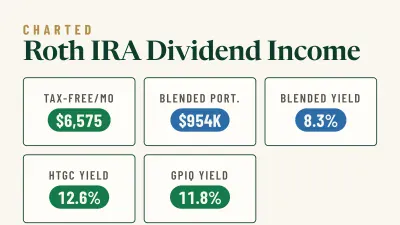
You’ve built a Roth IRA, you’re past 59½, and you’d like it to pay you like a job: $6,575 a month, or $78,900 a year, with nothing owed to the IRS. Here’s what that takes at three yield levels, plus a six-fund portfolio that gets there without selling a share.
Why a Roth Keeps Every High-Yield Dollar
Covered-call funds, BDCs, REITs, and preferreds mostly pay income taxed at ordinary rates in a brokerage account. A Roth makes that tax go away. Under 26 U.S.C. § 408A(d)(1)[1], a qualified distribution isn’t included in gross income.
IRS Publication 590-B for 2025 sets two tests. The withdrawal must occur after the 5-year period beginning with the first tax year in which a contribution was made. You also have to be at least 59½, unless you’re disabled or the money goes to a beneficiary.
Living on dividends also addresses a common retirement risk: a falling market. When the payouts cover your bills, you skip selling shares at low prices to raise cash. Your share count stays whole, but distributions can still fall, and your portfolio can lose value. That is the whole point of a dividend ladder, and we walked through how to build one in a free guide here.
Three Yield Levels, Three Very Different Price Tags
At a conservative 3.5% yield, $78,900 divided by 0.035 equals about $2,254,000. That buys dividend growers and broad market funds. You need the most money up front, but the payouts tend to rise, and the principal tends to grow.
For a moderate 6% yield, $78,900 divided by 0.06 equals $1,315,000. This tier holds preferreds, REITs, and high-dividend equity funds. Payout growth slows, and over decades the income may fall behind inflation.
With an aggressive 12% yield, the required capital drops to $657,500. Here you find BDCs, option-writing income funds and mortgage REITs. Payouts can be cut, and over time the principal frequently shrinks.
Inside the $954,000 Blended Paycheck
Combine six holdings and the blended yield comes to 8.3%. At that yield, $6,575 a month takes about $954,000.
- Goldman Sachs Nasdaq-100 Premium Income ETF, 20%. It sells options against NASDAQ-100 stocks and yields about 11.8% on its forward payout. But the monthly check moves around, from $0.51 in October to $0.47 in November, and shares fell 15% in the past month. Test that yield before you count on it.
- Invesco High Yield Equity Dividend Achievers ETF (NASDAQ:PEY), 15%. It holds dividend raisers like tobacco and pharmaceutical companies and a group of utilities, and yields about 5.0%. Monthly payouts, though, ran from $0.07 to $0.10 this year.
- Lamar Advertising (NASDAQ:LAMR), 15%. This billboard REIT yields about 4.3% and supplies the growth. Its quarterly dividend rose from $0.83 in 2017 to $1.65, and it raised AFFO guidance to $8.87-$8.97[2] per share. Still, Lamar cut the payout to $0.50 in 2020, and it carries $3.5B[2] of net debt.
- Hercules Capital (NYSE:HTGC), 15%. This venture lender yields about 12.6%, and income covered its base dividend 118%[3] last quarter. However, a 25-basis-point Prime cut trims annual income by about $0.03 per share, and shares are down 11% this year.
- Cohen & Steers Quality Income Realty Fund (NYSE:RQI), 15%. This closed-end fund owns REIT stocks and preferreds and yields about 9.7%. Yet shares rose only about 1% over five years, so most of the return came from the payout.
- Invesco Variable Rate Preferred ETF (NYSEARCA:VRP), 20%. It holds floating-rate preferreds from banks, insurers, and utilities and yields about 6.0%. Payouts follow rates, falling from $0.21 last December to as low as $0.09 this year.
Why the Lower Yield Can Win the Decade
A 3.5% portfolio whose payouts grow 8% a year turns $78,900 into about $157,700 of annual income after nine years. A flat 12% yield keeps paying $78,900, and those dollars buy less every year.
The blend sits between the two. Lamar and the Invesco Dividend Achievers Fund supply the growth, while the Goldman Sachs fund, Hercules, and the Invesco Preferred Fund pay more today with no promise of raises.
Run These Numbers Before You Build It
- Find the tax year you first funded any Roth. That year starts the five-year clock under Publication 590-B.
- Rerun the portfolio math using only Hercules’ $0.40 base dividend and a lower Goldman Sachs fund payout. If the paycheck still covers your bills, the plan has room for a bad year.
- Add up your actual monthly spending. If it comes in below $6,575, you need less capital, or you can move more money into the slower-yielding growers.
A bigger yield gets you to the goal sooner. Growing payouts are what keep that paycheck worth the same 20 years from now.
Contact [email protected] for any questions or corrections.
David Beren has been a Flywheel Publishing contributor since 2022. Writing for 24/7 Wall St. since 2023, David loves to write about topics of all shapes and sizes. As a technology expert, David focuses heavily on consumer electronics brands, automobiles, and general technology. He has previously written for LifeWire, formerly About.com. As a part-time freelance writer, David’s “day job” has been working on and leading social media for multiple Fortune 100 brands. David loves the flexibility of this field and its ability to reach customers exactly where they like to spend their time. Additionally, David previously published his own blog, TmoNews.com, which reached 3 million readers in its first year. In addition to freelance and social media work, David loves to spend time with his family and children and relive the glory days of video game consoles by playing any retro game console he can get his hands on.