After His Alzheimer’s Blood Test Comes Back Positive, He Moves $600,000 in Savings Into His Wife’s Name. Medicaid Counts It All Anyway, Letting Her Keep at Most $162,660

This post may contain links from our sponsors and affiliates, and Flywheel Publishing may receive compensation for actions taken through them.

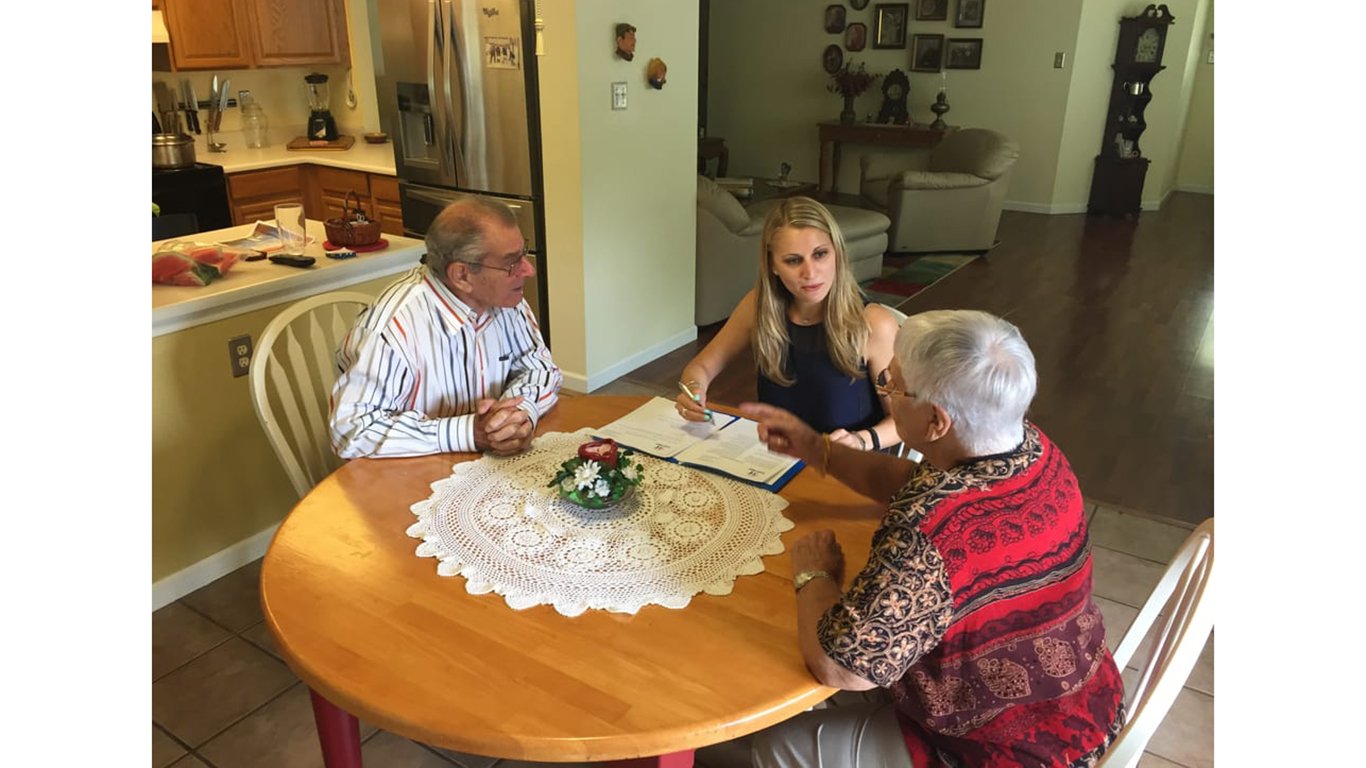
Picture a retired husband whose doctor calls with the results of an Alzheimer’s blood test. It’s reveals the markers of the disease. By the weekend, he has transferred the couple’s $600,000 in savings into his wife’s name. His thinking: Medicaid can’t touch money he doesn’t own.
Medicaid can, and it will. Under federal spousal impoverishment rules, the state adds up both spouses’ countable assets no matter whose name is on the account. The wife at home keeps only the Community Spouse Resource Allowance (CSRA). For 2026 the allowance has a floor of $32,532 and a ceiling of $162,660, so she keeps at most $162,660.
Elder law attorneys describe this as a common scenario, and blood tests now catch Alzheimer’s earlier. Research published in JAMA in 2026 found that a blood test can flag people at higher risk of Alzheimer’s-related decline years before memory problems appear. More couples will get this news early. That gives them more time to make this exact mistake, and more time to plan around it.
How the $162,660 CSRA Cap Shrinks a $600,000 Nest Egg
Medicaid takes its count on a “snapshot date”: the first day of the applicant’s first continuous stay in a nursing home or medical institution expected to last at least 30 days. On that day, the state totals checking, savings, CDs, stocks, bonds, mutual funds and, in many states, IRAs and 401(k)s. The home is exempt while the wife lives there, and so is one car.
Many states use a 50% method. Half of the couple’s $600,000 comes to $300,000. That’s above the federal ceiling, so the wife keeps $162,660. The other $437,340 counts as his, and he can only keep his state’s asset limit, often $2,000; about $435,340 must be spent down.
The math changes by state. Florida and some other states let the spouse at home keep 100% of countable assets up to the federal maximum. That helps couples with smaller savings, but this couple still hits the same $162,660 ceiling. New York sets its own higher floor of $74,820 for 2026. Some states also exempt the community spouse’s retirement accounts. That’s a big deal if much of the $600,000 sits in her IRA.
Retitling Accounts Changes Nothing, and Medicare Won’t Cover the Bill
Medicaid doesn’t punish transfers between spouses. The money stays inside a household the state already counts as one unit. After approval, states actually expect the applicant to move the protected allowance into the at-home spouse’s name. The husband just did that paperwork a few years early.
Many families assume Medicare will step in. It won’t. Medicare is federal health insurance for people 65 and older. Medicaid is the joint federal-state program for people with limited assets, and it pays most long-term nursing home bills.
Medicare covers skilled nursing care for up to 100 days[1] per benefit period. Patients pay $217[1] a day for days 21 through 100 in 2026, rising to $222[2] in 2027. In most cases, Medicare doesn’t pay for custodial care when that’s the only care someone needs. Help with bathing, dressing and eating is custodial care, and it makes up most of what Alzheimer’s patients need.
The private-pay bill adds up fast. CareScout’s 2025 survey put the national median for a private nursing home room at $355 a day, or $129,575 a year. That works out to about $10,798 a month. At that rate, the excess above the wife’s allowance pays for roughly 40 months of care before Medicaid kicks in.
What Families Do With the Years a Blood Test Buys
A positive test today often comes years before a nursing home admission. That gap is the planning window.
Gifts to children or a trust go under Medicaid’s 60-month look-back. Families who make transfers more than five years before applying keep that money. Transfers made inside the window set off a penalty period, and Medicaid won’t pay during it.
Spending on exempt assets protects value right away. Couples pay off the mortgage on the home the wife keeps, fix the roof, replace an aging car or prepay funeral costs. Each of these turns countable cash into property Medicaid ignores.
In many states, a Medicaid-compliant annuity converts extra savings into an income stream for the spouse at home. A wife whose income falls short of her state’s monthly maintenance allowance can also ask for a fair hearing to raise her CSRA above the standard cap. States handle both strategies differently, so the same move can work in one state and fail next door.
Time matters for one more reason. Every one of these strategies needs signatures. Powers of attorney, trust documents and annuity contracts all need the husband to have legal capacity when he signs. A positive blood test starts that clock too. The federal allowance figures reset each January, but a lost ability to sign doesn’t come back.
Contact [email protected] for any questions or corrections.
Gerelyn Terzo is the author of dividend investing handbook "Dividend Investing Strategies: How to Have Your Cake & Eat It Too." A veteran financial journalist, she covers agri-finance for outlets like Global AgInvesting and the broader stock market and personal finance for 24/7 Wall Street. She began at CNBC and later helped launch Fox Business in New York. Gerelyn currently resides in Woodland Park, Colorado and dabbles in nature photography as a hobby.