At 65 He Locked In $3,000 a Month for Life. The Check Will Never Shrink. At 3% Inflation, by 85 It Buys What $1,661 Gets You Today

This post may contain links from our sponsors and affiliates, and Flywheel Publishing may receive compensation for actions taken through them.
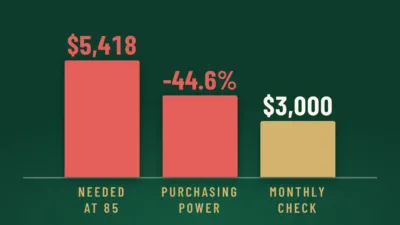
Imagine a retiree who hands an insurer a lump sum at 65 and gets a promise in return: $3,000 monthly[1] for as long as he lives. The check arrives on schedule and the amount never changes. Prices keep rising, though. If inflation runs at 3% for 20 years, the check he gets at 85 will buy about what $1,661 buys today.
A 3% assumption looks mild right now. Consumer prices rose 3.7% in the 12 months through September 2026, according to the latest BLS data. The bureau’s R-CPI-E, a research index that follows spending by households headed by someone 62 or older, puts more weight on housing and medical care. Social Security beneficiaries will see a 3.6% cost-of-living adjustment (COLA) in 2027. A level fixed annuity check gets no adjustment at all.
What a Level Check Buys Over 20 Years
Hypothetical example: The retiree’s single premium immediate annuity (SPIA) pays the same amount every month. The table shows what that payment buys in today’s dollars if inflation holds at 3% a year.
| Age | Nominal Check | Buying Power in Today’s Dollars |
|---|---|---|
| 65 | $3,000 | $3,000 |
| 75 | $3,000 | $2,232 |
| 85 | $3,000 | $1,661 |
By 85, the check has lost about 44.6% of its buying power. To buy the same basket of goods he bought at 65, he would need about $5,418 a month.
Plug in your own numbers to see how a level income stream fares against rising prices:
Why 3% Could Turn Out Too Kind or Too Harsh
The inflation rate you assume changes the outcome a lot. Here is the same check at 85 under three different rates:
- 2% a year (the Fed’s target, measured by the PCE price index[2]): about $2,019 in today’s dollars
- 3% a year: about $1,661
- 3.7% a year (the latest CPI pace): about $1,451
Inflation rarely moves in a straight line. Past Social Security adjustments show how much it moves: 0% in 2009, 2010 and 2015, 8.7% in 2022 and 14.3% in 1980. Social Security adapts for those swings and a level annuity doesn’t, so a few high-inflation years early in retirement can permanently reduce what the check buys.
What “Guaranteed” Rests On
The lifetime payment depends on the insurer’s ability to pay its claims. If an insurer fails, state guaranty associations act as a backstop. Coverage limits vary by state, so buyers should check their own state’s association before placing a large premium to one carrier. Both protections cover the number of dollars he’s owed. The risk that those dollars buy less over time remains with the retiree.
How Taxes Change the Math
If he buys the annuity with nonqualified (after-tax) savings, the tax code treats a portion of every payment as a return of his money and excludes it from income. The excluded share equals the ratio of his “investment in the contract” to the expected return under the contract (26 U.S.C. § 72(b)(1)). That exclusion stops once he has recovered his full investment (26 U.S.C. § 72(b)(2)). If he outlives the expected return, every later payment is taxable. So the checks that already buy the least also lose a larger share to tax. If he bought the annuity inside an IRA with no after-tax basis, payments are generally fully taxable as income from the first check.
Ways Retirees Add Inflation Protection
- Increasing-payment options: Some contracts raise payments by a set percentage each year in exchange for a smaller first check. Compare quotes for the level and increasing versions and find the age at which total payments under the increasing version catch up.
- Buying in stages: Buying annuities at 65, 70 and 75 spreads the purchases across different interest-rate environments and holds back money for later needs.
- Taking Social Security later means a larger monthly benefit that receives cost-of-living adjustments. The average retired worker’s 2026 benefit was $2,071 after the adjustment.
- Keeping some money invested for growth: Some savings remains invested to make up for lost buying power in later decades.
Building income that acts like a paycheck, rather than leaning on one contract, is the whole point of the method we laid out in a free guide here: The Paycheck Portfolio Method.
Suze Orman addressed a similar choice on her podcast in March 2023. A listener was choosing between a pension with an inflation adjustment and a higher one without it. Orman said that if a listener is “in your 60s or again early 70s, you are in good health and your lifespan carries over to you, I would absolutely do the cost of living adjustment.” She also warned that the extra income is taxable and could affect Social Security tax and Medicare premiums.
Who a Level Annuity Suits and Who Should Check the Numbers Twice
A level payment tends to suit retirees who:
- Expect a shorter retirement because of health or family history
- Want to spend more in their active early years
- Already cover most essential bills with income that rises with inflation
Retirees should take a harder look if they:
- Are healthy and come from a long-lived family
- Would rely on the annuity for most of their income
- Expect rising medical costs
To keep the numbers current, watch the R-CPI-E, which is updated monthly, and the next Social Security adjustment announcement. Before signing, get level and increasing-payment quotes on the same date. Then calculate what the level check would buy at 75 and 85 using your own inflation assumption.
Contact [email protected] for any questions or corrections.
Gerelyn Terzo is the author of dividend investing handbook "Dividend Investing Strategies: How to Have Your Cake & Eat It Too." A veteran financial journalist, she covers agri-finance for outlets like Global AgInvesting and the broader stock market and personal finance for 24/7 Wall Street. She began at CNBC and later helped launch Fox Business in New York. Gerelyn currently resides in Woodland Park, Colorado and dabbles in nature photography as a hobby.