He Chooses Medicaid Home Care Over a Nursing Home to Keep His $350,000 House in the Family. After He Dies, the State Can Bill His Estate for Every Dollar It Paid His Aides

This post may contain links from our sponsors and affiliates, and Flywheel Publishing may receive compensation for actions taken through them.

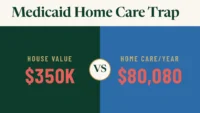
Picture a widower in his 80s who can no longer shower or dress safely on his own. His savings are gone, but his paid-off house is worth $350,000. He qualifies for Medicaid and picks aides at home over a nursing home bed. Part of his reasoning: he figures home care keeps the house safe for his kids.
That holds while he’s alive. After he dies, the Medicaid Estate Recovery Program sends the bill. For enrollees age 55 or older, Medicaid.gov says state programs “are required to seek recovery of payments from the individual’s estate for nursing facility services, home and community-based services,” alongside relevant hospital and prescription drug costs. To the state, his home care aides count the same as a nursing home bed.
How a $350,000 House Becomes a $288,000 Medicaid Claim
Federal law has required states to go after this money since 1993. The state can’t collect until he dies. Then its claim goes against whatever his estate holds, and for most retirees the house is the biggest item.
Say Medicaid paid an agency $4,000 a month for six years of aide visits. That adds up to a $288,000 claim. The house sells, the claim gets paid out of the proceeds, and his children split $62,000 before probate costs and agent commissions.
Medicaid never made him sell while he lived there. A home the applicant lives in doesn’t count toward eligibility as long as the equity stays under the state’s cap. That cap is $752,000 in most states for 2026, or $1,130,000 in states that chose the higher limit. Starting January 1, 2028, a federal cap of $1,000,000 replaces both. Families often treat “exempt when you apply” and “safe from recovery” as one rule, but they’re two different rules.
Many families expect Medicare to cover this. Medicare, the federal health insurance program for people 65 and older, doesn’t cover custodial care[1] like help with bathing, dressing or eating. Medicaid, the joint federal-state program for people with low income and few assets, does cover it. Medicaid is also the program that wants its money back.
Cost explains why states lead people toward home care. According to CareScout’s 2025 survey, the national median for a non-medical caregiver is $35 an hour, or $80,080 a year at 44 hours a week. Nursing home care costs more, with a semi-private room at $114,975 a year. For heirs, a cheaper monthly bill means a smaller claim at the end.
Surviving Spouses and Disabled Children Freeze the Claim
The state has to wait until a surviving spouse dies before it can recover, and it can’t collect while there’s a surviving child under 21 or a child who is blind[2] or disabled. If the widower’s wife had outlived him, the house would have stayed with her. Even so, some states will attempt to collect once the spouse dies.
States also offer hardship waivers. Justice in Aging’s review of state policies lists waivers for homes of modest value and for family caregivers, among others.
How far the claim reaches depends on the state. Justice in Aging counts 36 states that recover more than federal law requires, and Nebraska is one of them. Some states stick with the narrow federal definition of an estate and limit recoveries to only those assets that pass through probate[3], so a house that passes outside probate can slip past the claim. Other states use a broader definition built to stop families from shifting assets out of the future probate estate[4].
In some states, just getting home care is getting harder. In November 2026, Nebraska said its Aged and Disabled waiver will have its first-ever waiting list in April 2027. Developmental disability provider rates drop 4% on January 1, and the state health department still needs about $500 million in extra money from lawmakers, WOWT reported.
Five-Year Look-Back Decides Whether the House Survives
Families who keep the house usually get it out of the parent’s name years before care starts. Suze Orman has told listeners that “an irrevocable trust can help protect your assets and qualify you for Medicaid benefits,” because moving assets into the trust parts the owner from them.
The catch is timing. When someone applies, Medicaid looks back five years at every transfer. Gifts or trust transfers made during that period can trigger a penalty period when Medicaid won’t pay for care, Orman explained in a March 2026 episode. A house moved into a properly written trust well before the look-back window generally sits outside both the eligibility count and the estate. A house moved two years before the first aide arrives leaves the family paying privately, at a median of $35 an hour, until the penalty runs out.
Home care was a reasonable choice for the widower. Keeping it from turning into a $288,000 claim on his house took a decision made years before he needed help (we put the full estate checklist, beneficiary forms and titling included, in a free guide here).
Contact [email protected] for any questions or corrections.
Gerelyn Terzo is the author of dividend investing handbook "Dividend Investing Strategies: How to Have Your Cake & Eat It Too." A veteran financial journalist, she covers agri-finance for outlets like Global AgInvesting and the broader stock market and personal finance for 24/7 Wall Street. She began at CNBC and later helped launch Fox Business in New York. Gerelyn currently resides in Woodland Park, Colorado and dabbles in nature photography as a hobby.