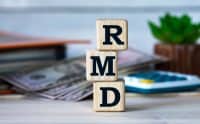
Miss a $200,000 RMD and the IRS Takes $50,000. Fix It in Time and the Penalty Drops to $20,000

This post may contain links from our sponsors and affiliates, and Flywheel Publishing may receive compensation for actions taken through them.

Saving for retirement in a traditional IRA or 401(k) might seem like a good idea when you’re in the midst of your career. But in reality, it can backfire on you. That’s because traditional retirement accounts do not give you complete control over your money.
Once you turn 73 or 75, depending on the year you were born, you’ll be forced to take required minimum distributions, or RMDs, from a traditional retirement account. Those RMDs are due by Dec. 31 each year, and they could create a huge tax headache.
First, RMDs could bump you into a higher tax bracket, especially if they’re combined with multiple income streams. RMDs could also cause your Social Security benefits to become taxable.
If your RMDs are on the larger side, they could leave you facing Medicare surcharges known as income-related monthly adjustment amounts. Those surcharges could add hundreds of dollars per month to the cost of Part B.
Based on all of this, you may be thinking, “Maybe it makes sense to blow off my RMDs.” But that line of thinking is flawed.
The penalty for a missed RMD is steep
The IRS gives you a tax break on contributions to a traditional retirement account. It wants to tax you on that cash eventually, which is why RMDs exist. As such, the IRS does not take kindly to not getting its money.
If you don’t take an RMD on time, you could face a 25% penalty on the sum you fail to remove from your account. And if you think that’s bad, you should know that the penalty used to be 50%. However, it was lowered to 25% as part of the SECURE 2.0 Act.
Of course, a 25% penalty is no laughing matter. On a $200,000 missed RMD, that’s a $50,000 loss. But if you end up missing an RMD, you should know that correcting your mistake quickly could lead to a much better outcome.
Correct your mistake within two years for a reduced penalty
While the standard penalty for missing an RMD is 25%, if you realize your mistake and withdraw your RMD within two years of the missed deadline, the IRS will typically reduce your penalty to 10%. In other words, on a $200,000 missed RMD, instead of getting hit with a $50,000 penalty, you could whittle that penalty down to $20,000.
Of course, a $20,000 penalty is still a significant sum. Now if you’re on the hook for a $200,000 RMD, it means you clearly have a large savings balance. But even so, no one wants to part with a huge sum of money like $20,000. So your best bet is to make sure you don’t miss the RMD deadline in the first place.
To avoid penalties, it pays to set your RMDs to come out automatically by the Dec. 31 deadline. Most financial institutions will allow you to arrange for preset withdrawals on a schedule that works for you, whether it’s monthly, quarterly, or once a year.
Putting RMDs on autopilot could lead to significant savings if it helps you avoid costly penalties. It could also give you peace of mind knowing you don’t have to actively remember to log in to your various accounts and make your withdrawals on time.
Contact [email protected] for any questions or corrections.
Maurie Backman has more than a decade of experience writing about financial topics, including retirement, investing, Social Security, and real estate. Her work has appeared on sites that include The Motley Fool, USA Today, U.S. News & World Report, The Washington Post, and Kiplinger.
Prior to becoming a full-time financial writer, Maurie worked in the financial industry trading distressed debt. She then changed course and spent a few years designing electronic toys. After a stint in content marketing and UX, she shifted back into writing and has since covered everything from the housing market to estate planning to Medicare.
When she's not busy writing, Maurie can be found hiking, walking her dogs, driving her kids to their various sports practices and games, and curling up with a good book. She cooks on occasion and bakes way too often.