A 64-Year-Old Rolled a $1.09 Million 401(k) Into Dividend ETFs Instead of an Annuity. Here’s What Happened to His $5,868 Monthly Paycheck

This post may contain links from our sponsors and affiliates, and Flywheel Publishing may receive compensation for actions taken through them.
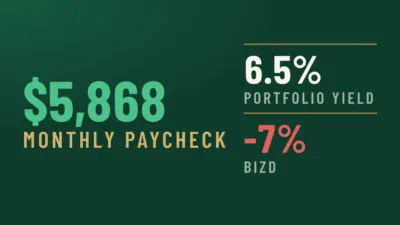
He’s 64 and choosing between two ways to turn savings into retirement income. One option is an annuity that promises a lifetime check. The other is rolling over his $1.09 million 401(k). He signed the rollover, put the money into seven ETFs, and now gets about $5,868 a month. Below is how that paycheck works, what the same income would cost at other yields, and where it could contract.
Direct Rollover Kept Every Dollar Invested
He had the plan send the money straight to a traditional IRA. In a direct rollover, no tax is withheld. If he had taken a distribution payable to himself, the plan would have withheld 20% of the taxable amount.
Both paths end in taxable income. Under 26 U.S.C. § 408(d)(1)[1], IRA payouts count as gross income, whether they come from an annuity or from ETFs. Because he was born in 1962, his required minimum distributions don’t start until 2037.
Certainty Traded for Control
An annuity guarantees income for life, backed by the insurer’s ability to pay claims. That removes the risk of outliving the money. The ETF route lets him stay in control and leave any remaining principal to his heirs. In exchange, payouts can be cut, and prices move every day.
What Pays His $5,868 a Month
The portfolio has a 6.5% combined yield. Trailing yields below are based on the past 12 months of payouts. The others are typical ranges.
| ETF | Weight | Yield | Catch |
|---|---|---|---|
| JPMorgan Equity Premium Income ETF (NYSEARCA:JEPI) | 20% | About 8.2% | Covered calls limit upside. November paid $0.35 a share, down from $0.45 in May |
| iShares Select Dividend ETF (NASDAQ:DVY) | 20% | About 3.4% | Pays quarterly, and the amounts vary |
| Schwab International Dividend Equity ETF (NYSEARCA:SCHY) | 15% | Typically 4% to 5% | Currency swings change what foreign dividends are worth in dollars |
| VanEck BDC Income ETF (NYSEARCA:BIZD) | 15% | About 13% | Exposed to the credit cycle |
| State Street Blackstone Senior Loan ETF (NYSEARCA:SRLN) | 15% | Typically 7% to 9% | Floating-rate income falls when rates fall |
| First Trust Preferred Securities and Income ETF (NYSEARCA:FPE) | 5% | Typically 6% to 7% | Mostly banks and insurance companies, so prices respond to rates and credit spreads |
| PIMCO Enhanced Short Maturity Active ETF (NYSEARCA:MINT) | 10% | Typically 4% to 5% | A cash bucket with no principal growth |
BIZD’s double-digit yield has come under pressure. Its July payout fell to $0.24 from $0.48 in April, and the shares are down about 7% this year.
How Much You Need at Three Yields
His target is $70,416 a year.
- At a conservative 3.5%, $70,416 divided by 0.035 equals about $2,012,000. These are broad dividend-growth funds. You need the money up front, but dividend-growth funds offer potential income and capital appreciation without guaranteeing either.
- Moderate, about 6.5%: $70,416 divided by 0.0646 equals about $1,090,000. That’s his portfolio of covered calls, preferreds, and senior loans. Income growth slows, and some upside is capped.
- At an aggressive 12%, $70,416 divided by 0.12 equals $586,800. These are funds that lend to midsize companies, mortgage REITs, and high-yield bond funds. You need the least money up front, but principal erosion and payout cuts are common.
Why a Lower Yield Can Pay More by Year Nine
Put the full $1.09 million in a 3.5% yielder and the first year pays only $38,150. If those payouts rise 8% a year, year nine pays about $76,262. That’s more than his current paycheck. A 12% stream that never grows pays the same dollars every year while inflation contracts what they buy. Social Security’s 2027 raise is 3.6%. His ETF paycheck gets no automatic raise.
Three Moves Before You Copy His Plan
- Put the high-yield funds through a stress test. Recalculate your monthly income as if BIZD and SRLN cut their payouts in half for a year, as BIZD’s July payout did. If the budget breaks, dividend-growth funds are one alternative worth exploring.
- Measure your cash in months. His 10% MINT allocation covers about 18 months of paychecks, so he doesn’t have to sell stocks during a downturn.
- Plan taxes and Medicare together. A single filer’s 22% bracket starts above $50,400 of taxable income. Medicare surcharges start above $109,000 of MAGI, based on income from two years earlier. So the withdrawals you take today set your premiums later.
Skipping the annuity gave him control over his principal. Keeping that check steady means reviewing his two riskiest funds every year and building the mix, payment schedule, and withdrawal order the way we laid out in a free guide here: The Paycheck Portfolio Method.
Contact [email protected] for any questions or corrections.
David Beren has been a Flywheel Publishing contributor since 2022. Writing for 24/7 Wall St. since 2023, David loves to write about topics of all shapes and sizes. As a technology expert, David focuses heavily on consumer electronics brands, automobiles, and general technology. He has previously written for LifeWire, formerly About.com. As a part-time freelance writer, David’s “day job” has been working on and leading social media for multiple Fortune 100 brands. David loves the flexibility of this field and its ability to reach customers exactly where they like to spend their time. Additionally, David previously published his own blog, TmoNews.com, which reached 3 million readers in its first year. In addition to freelance and social media work, David loves to spend time with his family and children and relive the glory days of video game consoles by playing any retro game console he can get his hands on.