At 62 He Spent $230,000 of His 401(k) on an Annuity That Runs Out in Eight Years. That Was the Plan: It Let Him Wait for a Social Security Check 77% Bigger

This post may contain links from our sponsors and affiliates, and Flywheel Publishing may receive compensation for actions taken through them.
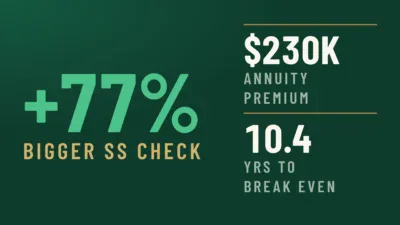
A 62-year-old who moves $230,000 out of his 401(k) into an annuity that stops paying at 70 can look like he bought a product built to run dry. In a Social Security bridge strategy, that end date is the whole design. The annuity covers living costs for eight years, so the retiree can leave his benefit alone until 70, when the monthly check is as large as it will ever get.
Where the 77% Comes From
Social Security cuts your benefit if you claim early and adds credits if you claim after full retirement age (FRA). Take someone whose FRA is 67. Claiming at 62 pays 70% of the full benefit. Waiting until 70 pays 124%. The age-70 check comes out 77.1% bigger.
Hypothetical example: Picture a retiree with a $3,000 benefit at full retirement age. He would get $2,100 a month at 62 or $3,720 at 70, a difference of $19,440 a year. To get there, he gives up eight years of $2,100 checks, or $201,600. Before any cost-of-living adjustments (COLAs), it takes about 10.4 years of the larger check to earn that back, which puts the payback point a little past age 80.
COLAs make the larger check grow faster in dollar terms, because each raise is a percentage of a bigger base. The COLA was 2.8% for 2026, and the 2027 COLA is 3.6%. Waiting works like buying an inflation-adjusted lifetime annuity, and the federal government backs it up instead of an insurance company.
What a Period-Certain Annuity Actually Buys
The bridge product is usually a period-certain immediate annuity. The insurance company pays a fixed monthly amount for a set number of years, then stops. Payments don’t depend on how long the buyer lives, so there are no mortality credits, meaning no extra income from pooling longevity risk with other buyers. Essentially, the insurance company hands back your principal plus interest on a fixed schedule. If the account holder passes away prior to the end of the term, the contract sends the remaining payments to a beneficiary.
If you spread $230,000 evenly over eight years with no interest, you’d get $28,750 a year. An annuity pays more than that because the insurance company credits interest, and how much more depends on rates on the day you buy. Only the insurance company’s ability to pay claims stands behind the payments. When an insurer fails, state guaranty associations act as a backstop, but their coverage limits differ from state to state.
The $230,000 premium is above the $210,000 QLAC premium limit for tax year 2026. That cap only applies to qualifying longevity annuity contracts, which are deferred life annuities used to push back required distributions. A short-term income annuity bought for immediate payments is a different product.
How the IRS Taxes Every Payment
Annuity payments from a qualified plan fall under section 72. For those plans, 26 U.S.C. § 72(d)(1)[1] sets out a simplified method for recovering the after-tax money you put into the contract. Most 401(k) money went in pre-tax, so there is usually no investment to recover, and every dollar of each payment is taxed as ordinary income. Any after-tax contributions come back tax-free. The IRS covers fully and partly taxable payments in Publication 575 for 2025 returns. If the money is rolled into an IRA first, 26 U.S.C. § 408(d)(1)[2] taxes the distributions “in the manner provided under section 72.”
At 62, the 10% early-distribution tax doesn’t apply. 26 U.S.C. § 72(t)(2)(A)(i)[1] exempts distributions made on or after age 59½. The timing also works around RMDs: for anyone born in 1960 or later, the first required minimum distribution (RMD) is for the year the account holder turns 75, and the annuity stops paying at 70. Moving $230,000 out of the 401(k) also leaves a smaller balance for later RMDs to be calculated on.
Annuity or Treasury Ladder: Run Both Quotes
A period-certain annuity has no mortality credits, so the fair comparison is an eight-year ladder of Treasuries or CDs held inside the same retirement account. You can sell a ladder in an emergency, and whatever you don’t spend stays in your account. An annuity is usually permanent. Its price also includes the insurer’s profit margin and the commission that determines what gets sold. Get the annuity’s monthly payout and the ladder’s yield on the same day, then compare them.
Financial planners often recommend a cushion of safe assets. The Retire Sooner Method describes keeping several years of withdrawals in “short- to intermediate-term US Treasuries, high-quality municipal bonds, or investment-grade corporate bonds” so a retiree can avoid selling stocks after a drop of 20% or more. The annuity bridge does the same job with a fixed contract instead of bonds you hold yourself.
Who the Bridge Suits and Who Should Pause
- Strongest fit: healthy retirees whose parents lived long, married higher earners whose larger check could become a survivor benefit, and savers who will still have a large balance after the purchase.
- Weaker fit: retirees in poor health, people who would use up most of their savings on the premium, and anyone who needs flexible access to cash for medical bills or home repairs.
- Key test: Does the payback age, about 80 in the example above, look likely based on your health and family history?
What to Check Before Signing
Before signing, check four things. First, get your projected benefits at 62, 67 and 70 from your Social Security statement. Second, compare the annuity quote against Treasury and CD ladder yields from the same day. Third, look up the insurer’s financial strength ratings. Fourth, find your state’s guaranty association limit. The maximum benefit at full retirement age is $4,152 a month in 2026, and every year you wait up to age 70 increases that base, which also boosts the dollar value of each COLA.
Contact [email protected] for any questions or corrections.
Gerelyn Terzo is the author of dividend investing handbook "Dividend Investing Strategies: How to Have Your Cake & Eat It Too." A veteran financial journalist, she covers agri-finance for outlets like Global AgInvesting and the broader stock market and personal finance for 24/7 Wall Street. She began at CNBC and later helped launch Fox Business in New York. Gerelyn currently resides in Woodland Park, Colorado and dabbles in nature photography as a hobby.