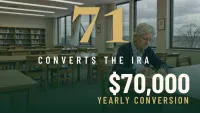
Their Father Will Convert His Whole IRA Before He Dies. The Kids Will Inherit $600,000, Have Ten Years to Empty It, and Never Owe a Dollar of Tax on It

This post may contain links from our sponsors and affiliates, and Flywheel Publishing may receive compensation for actions taken through them.

A traditional IRA left to adult children comes with a tax bill attached. A Roth IRA can arrive with no tax due. One father’s plan to convert his entire account before he dies raises the key question for any legacy-minded retiree: who pays the tax, at what rate, and when? The idea holds up well. The promise that the kids will “never owe a dollar” comes with conditions.
Why a Roth Leaves Heirs With a Tax-Free Account
The law says “Any qualified distribution from a Roth IRA shall not be includible in gross income”[1] (26 U.S.C. § 408A(d)(1)). A distribution “made to a beneficiary (or to the estate of the individual) on or after the death of the individual”[1] counts as qualified under § 408A(d)(2)(A)(ii). The father also never has to take RMDs. According to the IRS, “The RMD rules do not apply to Roth IRAs or Designated Roth accounts while the owner is alive.”
Three conditions decide whether the heirs really owe nothing:
- The five-year clock. A distribution made within the 5-taxable year period beginning with the first taxable year for which the individual made a contribution to a Roth IRA[1] is not qualified (§ 408A(d)(2)(B)). In an IRS example, beneficiaries who took money out before that period ended had to pay tax on the earnings portion, though not the 10% penalty (Publication 590-B).
- The ten-year rule still applies. The IRS says “RMD rules do apply to the beneficiaries of Roth IRA and Designated Roth accounts.” For most non-spouse heirs, the account must be emptied within ten years (26 U.S.C. § 401(a)(9)(H)(i)). Exceptions cover a surviving spouse, a minor child, disabled or chronically ill heirs, and anyone not more than ten years younger than the owner.
- Missed withdrawals cost money. A shortfall triggers an excise tax of 25%[2] of the amount that should have come out (§ 4974(a)).
Rules That Trip Up a Full Conversion
A converted amount is includible in gross income[3] in the year it leaves the old retirement account (26 CFR 1.408A-4, A-7). That income counts for all purposes[3], including the formula that decides how much of the benefit gets taxed (A-9). In any year with a required minimum distribution, the RMD has to come out before anything can be converted (A-6). For anyone born from 1951 through 1959, RMDs start at age 73.
If the father ever made nondeductible contributions, his basis has to be averaged across his accounts. Under § 408(d)(2)(A), all individual retirement plans shall be treated as 1 contract[4], so his after-tax basis gets spread across every IRA he owns. There is no reversing a conversion once done. Under § 408A(d)(6)(B)(iii), it cannot be recharacterized.
Example: One Big Conversion Versus Six Smaller Ones
Take a example widowed father who files single in 2026. He has $600,000 in a pretax account and two adult children. He pays the tax on the conversion from a taxable account, so the full $600,000 lands in the Roth. The math stays simple if you assume his other income and deductions cancel out, which makes his taxable income equal to whatever he converts. This example uses 2026 brackets only.
Under Option A, he converts all $600,000 in 2026. For single filers, income over $256,225 is taxed at $58,448 plus 35% of the excess.
- Amount beyond the threshold: $600,000 − $256,225 = $343,775
- $343,775 × 35% = $120,321.25
- $58,448 + $120,321.25 = $178,769.25, an effective rate of about 29.8%
Option B: convert $100,000 a year for six years. Income over $50,400 is taxed at $5,800 plus 22% of the excess.
- ($100,000 − $50,400) × 22% = $10,912
- $5,800 + $10,912 = $16,712 per year
- $16,712 × 6 = $100,272 in total, assuming no growth and no change to the brackets
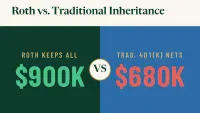
Option C: do nothing. Each child inherits $300,000 of pre-tax money. Withdrawn evenly over ten years, that adds $30,000 a year to each child’s income. If both children are in the 24% bracket, $600,000 × 24% = $144,000.
In this setup, the one-year conversion costs more than the children would have paid. The six-year plan costs less. The savings came from spreading the work across several years.
Spacing conversions across the quiet years before RMDs begin is the whole point of what planners call the Roth window, and we sized up that opportunity in detail in a free guide here.
Medicare Surcharges Arrive Two Years Later
Medicare sets premiums using income from 2 years prior (20 CFR 418.1135(a)). On the 2026 schedule, an individual with MAGI over $500,000 pays a total Part B premium of $689.90 a month, compared with the standard $202.90. Surcharges for single filers start above $109,000, so even the $100,000 annual plan only stays under that line if his other income is small. Big conversions could also cut the senior deduction of up to $6,000, which phases out above $75,000 of MAGI for single filers.
A Decision Framework Before Converting Anything
- Compare tax rates. A conversion helps the family when the father’s rate on converted dollars is lower than the rate his heirs would pay.
- Check where the tax money comes from. Paying the tax out of the account being converted leaves less in the Roth.
- Confirm the five-year clock. An older Roth already meets it. A first-ever Roth starts the clock in the year of the conversion.
- Keep an eye on state tax, along with the beneficiaries’ own brackets and Medicare tiers.
The strategy goes poorly for owners who would need IRA money to pay the tax, whose heirs are in low brackets, who plan to leave the account to charity, or who may need the money for long-term care. Final RMD regulations are still pending. Announcement 2026-7 tells taxpayers to use a “reasonable good-faith interpretation” of the statute until those rules take effect.
Contact [email protected] for any questions or corrections.
Vilma Rios is a tax professional, tax researcher, and financial writer with more than 15 years of experience in tax and accounting. Her work spans federal tax research, financial journalism, retirement planning, investment taxation, capital gains, inherited assets, and tax education. She specializes in translating complex tax and financial topics into clear, practical information that helps individuals, families, retirees, and investors make informed decisions.
She has presented tax information through webinars, including Spanish-language tax education, and has appeared on Telemundo 47 discussing tax topics and helping viewers understand important tax-filing requirements.
Her experience also includes tax and accounting work, tax research, IRS-related matters, and public tax education. While in college, Vilma volunteered in an IRS-sponsored tax assistance program and was recognized for her community service by local and state officials.
Known as "Your Tax Geek," Vilma is passionate about making taxes easier to understand and helping people navigate an increasingly complex tax system.