What’s the Tax Bill on $7,125 a Month in Dividend Income? The Taxable Account vs. Roth IRA Math

This post may contain links from our sponsors and affiliates, and Flywheel Publishing may receive compensation for actions taken through them.
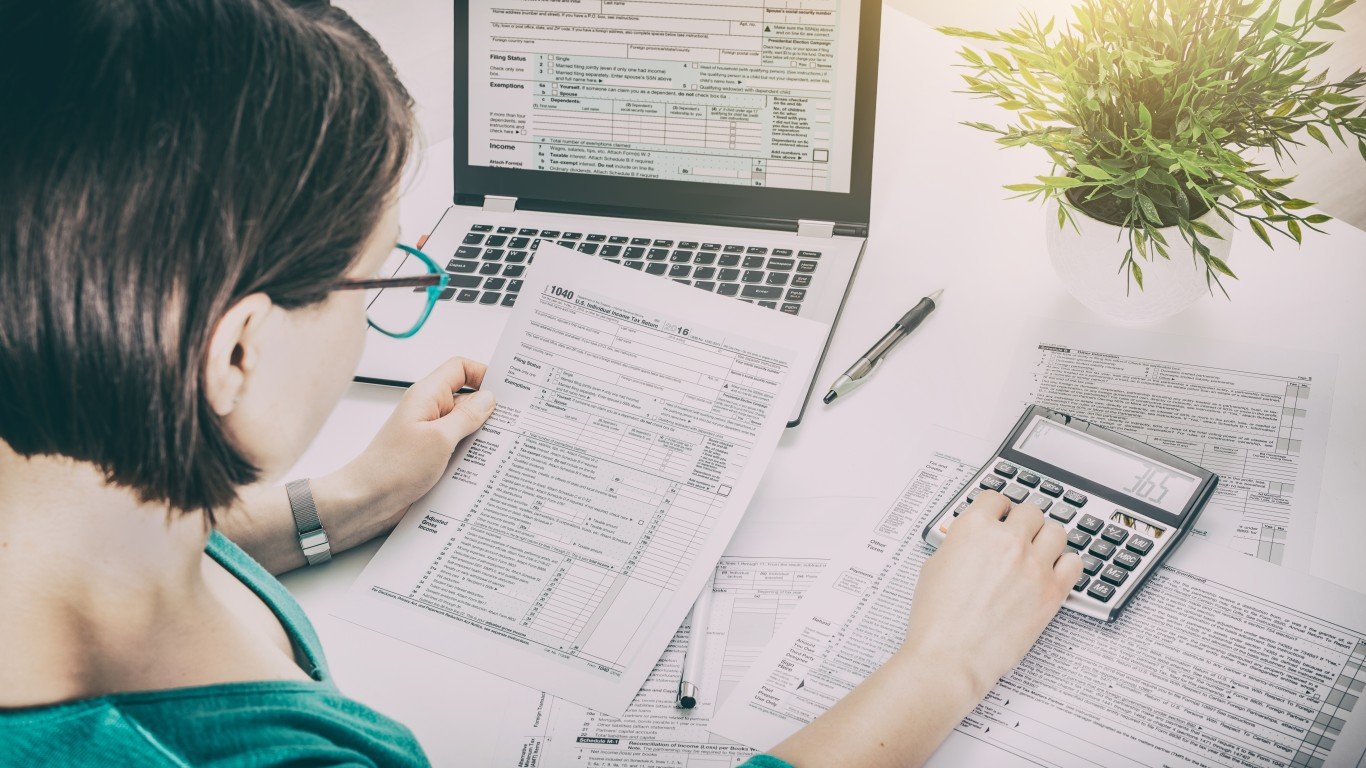
Dividend income arrives on a regular schedule, but each dollar on the 1099 carries its own tax rule. A married couple drawing $7,125 a month, or $85,500 a year, can owe close to nothing or a few thousand dollars, depending on what kind of income those dollars were.
Here’s the full math for a seven-fund portfolio in a taxable account, next to the same income inside a Roth IRA.
How Much Money $7,125 a Month Takes
Capital needed equals income divided by yield. This portfolio blends to a 6.88% yield, so $85,500 divided by 0.0688 takes about $1,243,000.
At a 3.5% dividend growth yield, $85,500 divided by 0.035 equals roughly $2,443,000. At 12%, it falls to about $712,500, though payers in that range often eat away principal.
Seven Holdings, Seven Catches
- NEOS Nasdaq 100 High Income ETF (NASDAQ:QQQI), 15% weight, yields about 14.8% by selling NASDAQ-100 call options. Catch: in fiscal 2025, 94% to 99% of each payout was return of capital, which reduces your cost basis and pushes the tax to the day you sell.
- WisdomTree U.S. Total Dividend Fund (NYSEARCA:DTD), 20% weight, yields about 1.9% from broad U.S. dividend payers. Catch: monthly checks drop from $0.065 to $0.21 this year.
- Agree Realty (NYSE:ADC), 15% weight, yields about 4.4% from 2,825 net-lease retail properties. Catch: REIT dividends are generally taxed as ordinary income.
- PIMCO Corporate & Income Strategy Fund (NYSE:PCN), 10% weight, yields about 13% from leveraged corporate credit. Catch: its distribution character can shift year to year.
- Bristol Myers Squibb (NYSE:BMY | BMY Price Prediction), 15% weight, yields about 4.1% on a $0.63 quarterly dividend. Catch: management trimmed 2026 non-GAAP EPS guidance to $6.35 to $6.55[1].
- DNP Select Income Fund (NYSE:DNP), 10% weight, yields about 7.9% from utilities. Catch: its mix of qualified income and return of capital changes yearly.
- iShares iBoxx $ High Yield Corporate Bond ETF (NYSEARCA:HYG), 15% weight, yields about 6.1% from junk bonds. Catch: interest is taxed at ordinary rates.
Worked Example: Your 2026 Federal Bill in a Taxable Account
Assumptions: married filing jointly, both under 65, no other income, no state tax, and the $32,200 standard deduction. Income splits in proportion to each fund’s current payout, scaled to $85,500. DNP counts as ordinary income to stay conservative. QQQI is treated as a return of capital.
Step 1: Sort by character. Qualified dividends from DTD and Bristol Myers: $12,365. REIT dividends from Agree Realty: $8,202. Bond interest from PCN and HYG: $27,527. DNP: $9,818. QQQI return of capital: $27,589.
Step 2: ordinary income comes to about $45,547. Subtract the $32,200 standard deduction and the estimated $1,640 Section 199A deduction for qualifying REIT dividends, leaving about $11,706 in taxable ordinary income. Tax: approximately $1,171.
Third, qualified dividends stack on top, bringing taxable income to $25,071. That’s under the $98,900 ceiling for the 0% rate. Tax: $0.
Step 4, return of capital owes nothing now but cuts your basis by $27,560 a year. Comes to federal bill: about $1,171.
Where a Small Bill Gets Bigger
If QQQI’s payouts came through as ordinary income instead, taxable ordinary income rises to $40,930 and the bill to about $4,219. Add a pension or Social Security and those ordinary dollars pile higher: 12% up to $100,800 of taxable income, then 22%. That stacking is what creates the surprise bill.
Same $85,500 Inside a Roth IRA
Qualified Roth distributions are excluded from gross income under 26 U.S.C. § 408A(d)(1)[2], once you’re past age 59½[2] and the five-year clock. Federal bill: $0. No basis tracking, and the IRS says RMD rules “do not apply to Roth IRAs” while the owner is alive.
Getting $1.3 million into a Roth usually means conversions, taxed as ordinary income in the year you convert. The quiet years between a last paycheck and the first RMD are when that bill is smallest, the window we sized up in a free Roth conversion guide. Converted money withdrawn within five years may trigger a 10% early withdrawal penalty for investors younger than 59.5, unless another exception applies.
Three Moves Before Next Tax Season
- Pull last year’s 1099-DIV and each fund’s Form 8937, and sort payouts into qualified, ordinary, and return of capital.
- Compare the bill with the ordinary-income payers (HYG, PCN, Agree Realty) held in the Roth and the qualified payers held in taxable, where the 0% rate can apply.
- Size Roth conversions to fill the 12% bracket without spilling into 22%.
On $85,500 a year, the type of income sets the tax bill. Sort it before you spend it.
Contact [email protected] for any questions or corrections.
David Beren has been a Flywheel Publishing contributor since 2022. Writing for 24/7 Wall St. since 2023, David loves to write about topics of all shapes and sizes. As a technology expert, David focuses heavily on consumer electronics brands, automobiles, and general technology. He has previously written for LifeWire, formerly About.com. As a part-time freelance writer, David’s “day job” has been working on and leading social media for multiple Fortune 100 brands. David loves the flexibility of this field and its ability to reach customers exactly where they like to spend their time. Additionally, David previously published his own blog, TmoNews.com, which reached 3 million readers in its first year. In addition to freelance and social media work, David loves to spend time with his family and children and relive the glory days of video game consoles by playing any retro game console he can get his hands on.