65.1% of Working-Age Families Have a Retirement Plan, Up From 64.4%. Among Families 45 to 64, About 70% Do

This post may contain links from our sponsors and affiliates, and Flywheel Publishing may receive compensation for actions taken through them.
Many working-age families have no retirement plan. The Federal Reserve’s latest Survey of Consumer Finances shows how common this is nationwide. Its report, Changes in U.S. Family Finances from 2022 to 2025, found that 65.1% of working-age families took part in a retirement plan in 2025, up slightly from 64.4% in 2022.
This article explains what that figure counts, which age groups moved it, and where families without a plan stand.
What Counts as Having a Retirement Plan
The Fed counts a family as participating if it holds any one of three things. Those are an individual retirement account (IRA), an account-type defined contribution plan through an employer such as a 401(k) or 403(b), or a defined benefit pension through a current or former employer.
The measure only includes families whose head is 64 or younger, a cutoff meant to capture households that generally haven’t retired yet.
Under this broad definition, a family with a small IRA opened years ago counts the same as one contributing the maximum to a 401(k) every year. The measure tracks ownership, and the survey reports account balances separately.
The Fed links participation to lower taxes on savings, a guaranteed income in retirement, and increased compensation from employer contributions.
Participation Climbs With Age
Families closest to retirement are the most likely to have a plan. In 2025, about 70% of families aged 45 to 64 took part, compared with 66% of families aged 35 to 44. The Fed describes both rates as similar to, or slightly higher than, those in 2016.
It took time for the older group to reach that level. From 2010 through 2019, participation among families closer to retirement age fell before rebounding in recent years. Families in the 35 to 44 range saw modest increases over the same period.
Younger Families Drove the Gains
Families under 35 have increased their participation the most over the past 15 years, according to the Fed. Most of that growth came from workplace savings plans and IRAs.
Among the youngest families, participation in those account types rose from 42% in 2016 to near 50% in 2025, the largest increase of any age group.
For the oldest working-age families, registration in those plans reached around 65%.
The increases also extended to lower-income families. Over the past decade, lower-income families became a larger share of plan participants under 35, which reduced the participation gap by income in that age group. Fidelity’s data on nonprofit plans found that automatic enrollment drove 56% of new plan participation.
Pensions Still Cover About One in Four Families
Defined benefit pensions, which typically pay retirement income based on salary and years of service, are held by around one-fourth of working-age families. Pension participation has gone down somewhat among families near retirement over the past decade, and those declines came mostly from lower-income households.
Registration has risen among every other age group since 2016, and the Fed notes that pensions remain important even for younger families.
Where Retirement Account Money Sits
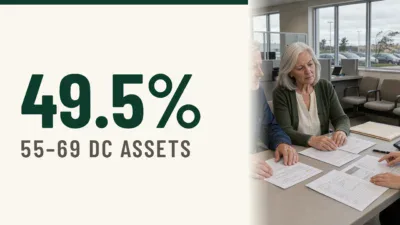
Participation and wealth follow different patterns. In the Fed’s Distributional Financial Accounts, households aged 55 to 69 held 49.5%[1] of all defined contribution retirement assets in the second quarter of 2026. Households under 40 held 7.9%[1]. Younger families have participated in retirement accounts for fewer years on average.
Options for Families Without a Plan
Families outside the 65.1% miss out on the tax breaks and employer contributions the Fed describes. Where an employer offers a 401(k), registration counts toward participation, and any matching contribution adds to total pay.
For 2026, the standard 401(k) contribution limit is $24,500. Workers 50 and older can add $8,000 in catch-up contributions, and those aged 60 to 63 can add up to $11,250.
A new rule applies to higher earners this year. Employees 50 and older whose 2025 Social Security wages from the employer sponsoring their plan exceeded $150,000 must make 2026 catch-up contributions on a Roth basis. This means no upfront tax break on that money (one of several IRS rules that quietly reshape retirement accounts, and we mapped the rest in a free guide).
The rule doesn’t apply to IRAs. An IRA remains open to workers whose employer offers no plan at all, and it counts toward participation in the Fed’s measure.
A Small National Gain With a Shift Underneath
The national participation rate edged up only slightly between 2022 and 2025. Meanwhile, more younger and lower-income families moved into 401(k)s and IRAs, pensions covered about one in four families, and households aged 45 to 64 remain the most likely to have a plan, at around 70%. Under the Fed’s definition, either a workplace 401(k) or an IRA counts toward participation.
Contact [email protected] for any questions or corrections.
David Beren has been a Flywheel Publishing contributor since 2022. Writing for 24/7 Wall St. since 2023, David loves to write about topics of all shapes and sizes. As a technology expert, David focuses heavily on consumer electronics brands, automobiles, and general technology. He has previously written for LifeWire, formerly About.com. As a part-time freelance writer, David’s “day job” has been working on and leading social media for multiple Fortune 100 brands. David loves the flexibility of this field and its ability to reach customers exactly where they like to spend their time. Additionally, David previously published his own blog, TmoNews.com, which reached 3 million readers in its first year. In addition to freelance and social media work, David loves to spend time with his family and children and relive the glory days of video game consoles by playing any retro game console he can get his hands on.