Converting a $2.5 Million Traditional IRA to a Roth Before Age 73 Prevents Massive RMD Tax Spikes in Retirement

This post may contain links from our sponsors and affiliates, and Flywheel Publishing may receive compensation for actions taken through them.

Building a $2.5 million retirement account balance is a pretty big accomplishment. But here’s something many successful savers don’t think about until it’s too late. A large traditional IRA balance could create a serious tax headache once required minimum distributions (RMDs) kick in.
The IRS eventually wants its share of the money you’ve been saving tax-deferred for decades. Starting at age 73 or 75, you’re generally required to withdraw a minimum amount from traditional IRAs every year. And those withdrawals are usually taxed as ordinary income, whether you actually need the money or not.
For someone with $2.5 million in a traditional IRA, those mandatory withdrawals can become pretty substantial. Add Social Security and other retirement income, and you could find yourself pushed into a much higher tax bracket than expected.
If you’re sitting on a $2.5 million traditional IRA, one strategy worth considering is converting some or all of that balance to a Roth IRA before RMDs begin. With careful planning, it could help you avoid much bigger tax spikes later on.
Why a $2.5 million traditional IRA can become a tax problem
Traditional IRAs offer a great deal of flexibility while you’re saving for retirement. Contributions are usually made on a pretax basis, and investments grow tax-deferred. The catch is that withdrawals are taxable.
Once you reach RMD age, the IRS requires you to take annual distributions based on your account balance and life expectancy. The larger your account, the larger your RMDs are.
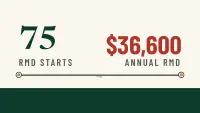
Let’s say you reach age 73 with $2.5 million in a traditional IRA. Using the IRS Uniform Lifetime Table, that puts your first-year RMD at approximately $94,340. Add in Social Security and other income, and you could land in a higher tax bracket than you want to be in.
Meanwhile, as you get older, you’re generally required to withdraw a larger percentage of your account balance each year. If your investments continue growing, those mandatory withdrawals could climb even higher.
Large RMDs could have unwanted consequences. They could push you into higher federal income tax brackets, increase the taxable portion of your Social Security benefits, and potentially trigger higher Medicare premiums through income-related monthly adjustment amounts.
In other words, you might spend decades building retirement savings only to discover that the IRS has a pretty big say in how you manage that money, and how much tax you pay each year.
How a Roth conversion can change the retirement tax equation
A Roth conversion involves moving money from a traditional IRA into a Roth IRA and paying income taxes on the converted amount. Unlike traditional IRAs, Roth IRAs don’t impose RMDs. Roth IRA withdrawals are also tax-free. That makes Roth conversions particularly attractive for people who have substantial balances.
However, you don’t want to convert a $2.5 million balance at once. Doing so could create an enormous tax bill and push you into the highest federal income tax bracket. Spreading conversions across multiple years could help you take advantage of lower tax brackets.
Now if you have a $2.5 million balance, a full Roth conversion may be tough. But let’s say you have 10 years before RMDs start. But if you move $100,000 per year into a Roth IRA, you’ll have a much lower balance subject to RMDs later on.
The key, though, is to plan ahead to spread your conversion across as many tax years as possible when you’re dealing with a large sum of money. If you time it right, a Roth conversion before RMDs begin could result in lower taxes over your lifetime.
Contact [email protected] for any questions or corrections.
Maurie Backman has more than a decade of experience writing about financial topics, including retirement, investing, Social Security, and real estate. Her work has appeared on sites that include The Motley Fool, USA Today, U.S. News & World Report, The Washington Post, and Kiplinger.
Prior to becoming a full-time financial writer, Maurie worked in the financial industry trading distressed debt. She then changed course and spent a few years designing electronic toys. After a stint in content marketing and UX, she shifted back into writing and has since covered everything from the housing market to estate planning to Medicare.
When she's not busy writing, Maurie can be found hiking, walking her dogs, driving her kids to their various sports practices and games, and curling up with a good book. She cooks on occasion and bakes way too often.