Two Retirees Reach 75 With $900,000 Saved. One Faces a $36,600 IRS-Ordered Withdrawal. The Other Emptied It Into a Roth at 62 and Gets None
Two retirees start at 62 with identical 401(k) balances and identical growth assumptions, but by 75 they face completely different tax situations because of one decision made early in retirement.

This post may contain links from our sponsors and affiliates, and Flywheel Publishing may receive compensation for actions taken through them.
Two married retirees, both 62, have about $422,000 each in a traditional 401(k). They’re making very different decisions about what to do with it. One plans to leave the money untouched. The other wants to move every dollar into a Roth before the IRS starts requiring withdrawals.
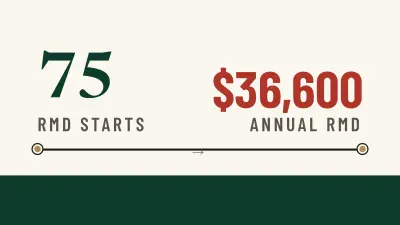
Assume both accounts earn 6% annually. By 75, each could hold roughly $900,000. But only one retiree will face a mandatory withdrawal of about $36,600. The other will have already paid the taxes and moved the money out of the IRS’s required withdrawal schedule.
Why look at 75? Under current law, anyone born in 1960 or later starts required minimum distributions (RMDs) at that age. Both retirees in this example fall into that group.
Same $900,000, Two Very Different Letters From the IRS
The traditional couple’s first RMD is their prior year-end balance divided by 24.6, the Uniform Lifetime Table factor for age 75. On $900,000, that comes to $36,585. That figure applies to the first year only. Every year the factor shrinks, so the share they have to withdraw keeps rising.
The Roth couple has no required withdrawals at all. Under current IRS rules, neither Roth 401(k)s nor Roth IRAs require minimum distributions during the original owner’s lifetime.
Why Converting at 62 Changes the Tax Bill
Suppose the Roth retiree and spouse have no other income in 2026. Converting the entire $422,000 traditional balance produces about $78,748 in federal income tax for the couple.
After the $32,200 standard deduction, the top piece of the conversion lands in the 24% bracket.
The age matters because Medicare’s IRMAA surcharge (the income-related monthly adjustment amount) is based on your income from two years earlier. Income at 63 sets your insurance premiums at 65, so a conversion at 62 never results in a Medicare bill.
Make a large conversion at 70 instead, and the income could push both spouses into one of Medicare’s highest premium brackets two years later. Under 2026 rates, that means paying as much as $649 a month each for Part B, compared with the standard $203.
The Roth retiree paid the tax from a brokerage account, so the full $422,000 compounded inside the Roth. The traditional retiree kept that $78,748 invested instead. At 6%, it grows to about $168,000 by 75, before tax on the gains. So at 75 the traditional retiree actually has more total money, although taxes are still owed on the 401(k).
A $78,748 Check Today Versus RMD Taxes Later
At 75, assume each couple receives today’s average aged-couple Social Security benefit of $3,208 a month, or $38,496 a year.
For the traditional couple, the RMD plus half their benefits pushes them over the $44,000 adjusted base amount for joint filers. That makes $16,058 of their Social Security taxable.
Using 2026 tax brackets and the standard deduction for a married couple over 65, the traditional retiree’s household would owe about $1,714 in federal income tax. The Roth retiree’s household owes nothing under the same assumptions. Half of their Social Security benefits falls below the $32,000 base amount, so none of those benefits are taxable.
The tax effect shows up one dollar at a time. While they’re in the 85% Social Security tax zone, each additional $1,000 of RMD makes another $850 of benefits taxable. That means an effective marginal rate of 18.5% in the 10% bracket, rising to 22.2% in the 12% bracket.
Converting everything in one year comes at a steep price. The Roth retiree pays $78,748 upfront to avoid mandatory withdrawals later. But comparing that payment with a single year’s tax bill misses the growth of both accounts and the taxes the traditional 401(k) owner will face over time.
Spreading conversions across several years can keep more money in the lower tax brackets. The years between the final paycheck and the first RMD often provide some of retirement’s best opportunities to do that, and we sized it up in detail in a free Roth guide here.
What the Roth Really Buys at 75: Control
The Roth couple chooses the amount to withdraw each year. They can take nothing after a market drop, or pull $60,000 for a new roof without coming near the $218,000 joint IRMAA threshold or making Social Security taxable.
The difference can become even more important when one spouse dies. The survivor generally files as single, with Social Security tax thresholds of $25,000 and $34,000 and a lower Medicare surcharge threshold. A large traditional balance can become more expensive to draw down, while the Roth offers greater flexibility without adding taxable income.
Three Moves to Make Before Your Window Closes
- Confirm your RMD age. If you turn 74 after 2032, your RMDs start at 75. At 62, that leaves 13 tax years to convert before the IRS tells you how much to withdraw.
- Consider converting more before Medicare’s two-year income lookback begins affecting your premiums at 65. Under 2026 rules, the first surcharge starts above $218,000 for joint filers or $109,000 for singles. Keep those limits in mind when sizing conversions.
- Run the numbers for the surviving spouse. Divide the projected traditional 401(k) balance at 75 by 24.6 and consider how the resulting withdrawals would affect a single filer’s taxes and Medicare premiums. Compare that future cost with the tax on conversions today.
Contact [email protected] for any questions or corrections.
Gerelyn Terzo is the author of dividend investing handbook "Dividend Investing Strategies: How to Have Your Cake & Eat It Too." A veteran financial journalist, she covers agri-finance for outlets like Global AgInvesting and the broader stock market and personal finance for 24/7 Wall Street. She began at CNBC and later helped launch Fox Business in New York. Gerelyn currently resides in Woodland Park, Colorado and dabbles in nature photography as a hobby.