Following Dave Ramsey’s Baby Steps, She Pauses Her 401(k) at 38 to Clear $90,000 of Debt in 3 Years. Her Employer’s $3,600 Yearly Match Stops Too: About $58,700 Less by 65

This post may contain links from our sponsors and affiliates, and Flywheel Publishing may receive compensation for actions taken through them.
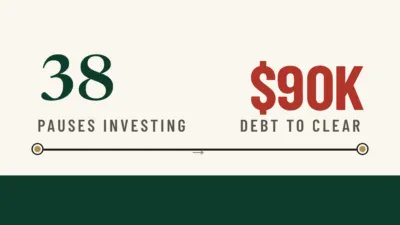
Take a hypothetical 38-year-old woman with $90,000 of consumer debt who follows Dave Ramsey’s Baby Steps to the letter. She builds the $1,000 starter emergency fund, moves into Baby Step 2 and turns off her 401(k) contributions for three years. Every spare dollar goes to the debt snowball.
The plan works, and she is debt-free at 41. Her employer’s matching contribution of $3,600 a year also ended the day her own contributions did. That gap keeps compounding for the next quarter century.
Ramsey’s commitment is real. In 2020, his company, Ramsey Solutions, paid off approximately $10 million in debt for about 8,000 consumers. He is willing to put his company’s money where his mouth is. His rule on pausing the 401(k) match still deserves a hard look.
Why Ramsey Tells Her to Stop Investing First
Ramsey’s plan has seven steps. In Baby Step 2, you pay off all debt except the mortgage with the snowball method, starting with the smallest balance. Investing 15% of household income for retirement comes at Baby Step 4, after the debt is gone and a full emergency fund is in place.
On The Ramsey Show from 2023, hosts tell Baby Step 2 callers to pause investing so the debt disappears as fast as possible. They admit that callers push back about compound interest and losing the match. Their answer is that the match will still be there once the debt is paid off.
Three Skipped Matches Cost Her About $58,700 by 65
The match is still there when she comes back. The three years she skipped are gone for good. In this example, each year’s match is credited at year-end and grows at 7% a year until she turns 65.
| Age skipped | Missed match | Years of growth | Value at 65 |
|---|---|---|---|
| 38 | $3,600 | 26 | $20,906 |
| 39 | $3,600 | 25 | $19,539 |
| 40 | $3,600 | 24 | $18,261 |
| Total | $10,800 | About $58,700 |
That total counts only the employer’s money. The contributions she paused out of her own paycheck make the retirement gap larger still.
Paying Off Debt Earns a Guaranteed Return
Ramsey has the math on his side. Every dollar that pays off a credit card balance makes that card’s interest rate with no risk. The average credit card APR is about 21%[1], well above the 7% market return assumed in the table.
Ramsey’s main argument is about behavior. His plan gives her one goal, full focus and a payoff date close enough to keep her motivated. A plan she gives up on in month 14 saves her nothing.
Getting the Match Pushes Her Payoff Date Back About Five Months
Many planners suggest a middle path: put in just enough to get the full match while running the snowball. Assume a dollar-for-dollar match. She contributes $3,600 a year, or $300 a month, to collect her employer’s $3,600.
Paying off $90,000 in 36 months takes about $2,500 a month, prior to interest. That comes to approximately $3,391 at an APR of 21%.
Moving $300 of that into the 401(k) leaves $2,200 for debt. Before interest, payoff stretches to about 41 months. At 21%, slashing $3,391 to $3,091 winds up at approximately 41 months also.
The contribution comes out before taxes, so her take-home pay drops by less than $300 and the delay shrinks. Interest building on her remaining balances during those extra months drives the delay the other way. How much depends on her actual rates.
In return, she keeps $10,800 in employer money that grows to about $58,700. With a dollar-for-dollar match, every dollar she puts in is doubled immediately, before any market gains.
Her Choice: Five More Months of Debt or $58,700 More at 65
She can be debt-free at 41 with a smaller retirement account, or debt-free a few months later with the match in hand. Three steps turn that into a decision she can make:
- Get the exact match formula and vesting schedule. Both are in the plan’s summary plan description. If the match vests over several years and she expects to change jobs, unvested matches can disappear anyway, and the case for pausing gets stronger.
- List every debt with its APR next to the snowball list. A dollar-for-dollar match outperforms even a 21% card, since it returns 100% on the very same day it’s deposited. The rates matter more here for how long the payoff stretches than for whether to take the match in the first place.
- Map out both payoff dates month by month. If getting the match drives her debt-free date back by only a few months and she trusts her own discipline, the extra months cost far less than the $58,700 she would give up.
Contact [email protected] for any questions or corrections.
Gerelyn Terzo is the author of dividend investing handbook "Dividend Investing Strategies: How to Have Your Cake & Eat It Too." A veteran financial journalist, she covers agri-finance for outlets like Global AgInvesting and the broader stock market and personal finance for 24/7 Wall Street. She began at CNBC and later helped launch Fox Business in New York. Gerelyn currently resides in Woodland Park, Colorado and dabbles in nature photography as a hobby.