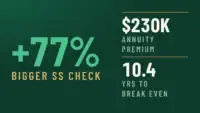
A $500,000 Annuity Pays a 65-Year-Old Man About $3,500 a Month. The Same $500,000 in 5% Treasuries Pays $2,083 and Leaves the $500,000. Here Is the Age Where the Annuity Wins

This post may contain links from our sponsors and affiliates, and Flywheel Publishing may receive compensation for actions taken through them.
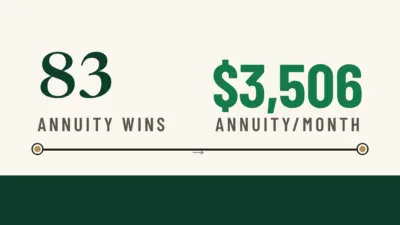
A 65-year-old with $500,000 can do two very different things with it. The first is to buy a single-premium immediate annuity. The top quote in October 2026 paid about $3,506 a month for life to a 65-year-old man, per My Annuity Store. The second is to buy Treasuries yielding 5%, which pays $2,083 a month and leaves the principal intact.
The annuity check is bigger, but the money that bought it is gone for good. That choice is timely because rates are moving. New York Fed President John Williams indicated on November 23 that higher interest rates are likely “over time” to combat inflation. Annuity pricing follows those same bond yields.
Two Monthly Checks From One $500,000 Pile
| Feature | Immediate Annuity | 5% Treasuries |
|---|---|---|
| Monthly income | About $3,506 | $2,083 |
| Principal at death | None (life-only payout) | $500,000 |
| Backed by | Insurer’s claims-paying ability | U.S. government |
| Access to principal | Generally none | Sell or hold to maturity |
The 5% figure is an assumption, so check the yield on the day you buy. As of November 23, 2026, the 5-year Treasury yielded 4.74%, the 10-year 4.92% and the 20-year 5.33%. In just the past month the 10-year has ranged from 4.84% to 5.15%.
Age 83 Is the Breakeven Most Retirees Miss
The fair test is to make the Treasury holder match the annuity’s paycheck. That means drawing $3,506 a month and spending down principal to cover the gap. Hypothetical example: a retiree holds $500,000 at 5% and withdraws $3,506 monthly. The money runs out after about 217 months, at roughly age 83. Every month the retiree lives past that point, the annuity keeps paying and the do-it-yourself portfolio pays nothing. That is where the annuity starts to win.
Age 94 If Leaving the Full $500,000 Matters
Some buyers care about the untouched principal for heirs or emergencies. They measure differently: how long before the annuity’s extra $1,423 a month adds up to the $500,000 the Treasury holder still has? In the same hypothetical, ignoring the interest that extra cash could earn, that takes about 29.3 years, or roughly age 94.
For context, the IRS Single Life Table gives a 65-year-old a life expectancy factor of 22.9 years, which points to about age 87.9. That lands between the two breakevens. A healthy retiree has good odds of passing 83, and much lower odds of reaching 94.
Taxes Tilt the Math Toward the Annuity
Treasury interest is taxable for federal income tax purposes, though it is exempt from state income tax. Annuity payments bought with after-tax money are only partly taxable. Under 26 U.S.C. § 72(b)(1)[1], you exclude the share of each payment equal to what you paid for the contract divided by your expected return. IRS Publication 939 uses a multiple of 20.0 for a 65-year-old.
Hypothetical example: under that multiple, the exclusion ratio comes to about 59.4%. Roughly $2,083 of each check would be tax-free and about $1,423 taxable. A Treasury holder, by contrast, pays federal tax on the full $2,083. There is a limit: once you get back your full investment, the exclusion stops and every payment becomes taxable (§ 72(b)(2)[1]). If you die before getting it back, the unrecovered amount becomes a deduction on your final return (§ 72(b)(3)[1]). All of this applies to nonqualified money. Annuities held in an IRA follow different rules.
Inflation Steadily Shrinks What the Check Buys
Social Security gets a raise each year: the 2027 cost-of-living adjustment (COLA) is 3.6%. A level annuity payment gets no raise unless the contract includes an inflation adjustment[2]. Hypothetical example: at 3% annual inflation, a $3,506 check at age 83 buys what about $2,059 buys today. The Treasury holder faces the same erosion on income but keeps a principal balance that can be reinvested at whatever rates are available then. Americans 62 and older saw their research CPI hit 368.8[2] in October 2026, up from 368.1 in the prior month. Housing and medical costs carry heavy weight in that index.
Who the Trade Fits, and Who Should Pause
The annuity’s guarantee depends on the insurer’s claims-paying ability. State guaranty associations provide a backstop, but their coverage limits differ by state. On The Clark Howard Podcast in April 2026, the guest advisor told a caller asking about a fixed annuity, “There is no comparison between FDIC guarantee and what a company says is guaranteed.”
- Favors annuity: good health, family history of long lives, little interest in leaving money behind, and a fear of outliving savings.
- Favors Treasuries: health concerns, a priority on leaving money to heirs, a need for cash in emergencies, or worry about putting money with one insurance company.
- Middle ground: annuitize only enough to cover essential bills alongside Social Security, and keep the rest in a Treasury ladder.
What to Check Before Locking In
Get annuity quotes and the Treasury yield on the same day, because both move with the bond market. Rate-hike talk from the Fed in November 2026 suggests both could change before year-end. Then ask yourself whether you expect to live past 83. That age, more than the headline payout, is the number your decision depends on.
Contact [email protected] for any questions or corrections.
Gerelyn Terzo is the author of dividend investing handbook "Dividend Investing Strategies: How to Have Your Cake & Eat It Too." A veteran financial journalist, she covers agri-finance for outlets like Global AgInvesting and the broader stock market and personal finance for 24/7 Wall Street. She began at CNBC and later helped launch Fox Business in New York. Gerelyn currently resides in Woodland Park, Colorado and dabbles in nature photography as a hobby.