She Thinks Her $700,000 Target-Date 2030 Fund Is Playing It Safe at 62 as AI Stocks Slide. About 59% Sits in Stocks, So a 20% Market Drop Would Cost Her About $82,500

This post may contain links from our sponsors and affiliates, and Flywheel Publishing may receive compensation for actions taken through them.
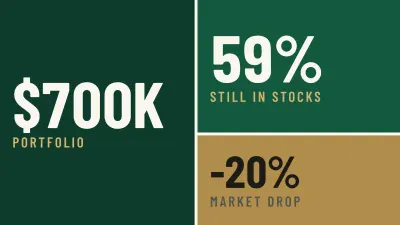
Consider a 62-year-old with $700,000 in the Vanguard Target Retirement 2030 Fund (NASDAQ:VTHRX). She figures the date on the label means her money is already parked somewhere safe.
The fund’s holdings say otherwise. About 59% is still in stocks, so a 20% market drop in those holdings would erase roughly $82,500.
Her 2030 Fund Still Holds $412,000 in Stocks
Target-date funds are built for the average saver, who retires near the date on the label and then spends down slowly over 25 or 30 years. That design keeps plenty of equity exposure on purpose. The fund becomes more conservative over time, but it still retains meaningful equity-market exposure[1] along the way.
At about 59% stocks, roughly $412,300 of her balance moves with the stock market.
If she had chosen a 40% stock mix herself, the same drop would cost $56,000. That $26,460 gap is the price of letting a fund designed for a decades-long horizon set her risk level.
AI Selloff Is Testing That Exposure Right Now
That risk is already playing out. On Nov. 16, the S&P 500 fell 1.9% and the Nasdaq lost 2.5%.
NVIDIA (NASDAQ:NVDA | NVDA Price Prediction) saw its market value sink to $3.9 trillion from about $5.8 trillion in early October.
The damage has spread. The SPDR S&P 500 ETF Trust (NYSE ARCA: SPY) is down about 5.5% over the past week and 6.7% over the past month, and the index experienced its sixth straight decline on Thursday. The VIX sits near 25, a level that signals elevated uncertainty. Her fund owns the broad market through index funds, so the AI giants leading this slide carry heavy weight inside it.
Why a Loss at 62 Hurts More Than at 42
Timing changes the math. A 4% withdrawal from $700,000 is $28,000 a year.
That means an $82,460 loss equals nearly three years of income. After that drop, her balance would be about $617,540.
Pulling living expenses from a shrunken account forces her to sell more shares at depressed prices. A 42-year-old can sit through a 20% drawdown and keep buying. A 62-year-old who starts withdrawals into one locks in part of the loss permanently. Planners call this sequence-of-returns risk, and we walked through how to defend the first few years of withdrawals in a free guide here.
A Panic Move Can Trigger the Tax Cascade
Exchanging funds inside the 401(k) costs nothing in taxes. Cashing out to sit in a bank account is a different story, because every traditional 401(k) dollar withdrawn counts as ordinary income.
That income sets off a chain reaction. Medicare uses a two-year lookback[2], so the income she reports at 63 sets her premiums when she enrolls at 65.
For perspective, in 2026, a single filer with modified adjusted gross income (MAGI) above $109,000 and up to $137,000 pays $284.10 a month for Medicare Part B instead of $202.90, plus a $14.50 Part D surcharge.
Once she claims Social Security, extra withdrawals can make up to 85%[3] of her benefits taxable under 26 U.S.C. § 86(a)(2). In the 22% bracket, that stacking pushes the marginal rate on each new withdrawal dollar well above 22%.
She does have time. Born in 1964, her RMD age is 75, and her first RMD year is 2039. That long runway gives her full control over when taxable income shows up, as long as she avoids a forced lump-sum move.
Three Moves to Make Before the Next Leg Down
Setting a stock allocation that matches her own timeline puts her in control of her risk level. These steps can be researched without triggering taxes.
- Run the 20% test on your own balance. Pull the fund fact sheet from your plan, multiply your balance by the stock percentage, then by 20%. If that dollar figure would push back your retirement date, the fund carries more risk than your timeline can absorb.
- Research rebalancing inside the plan. Shifting part of a target-date fund into a plan’s bond or stable value option is one way savers bring their stock share down to a level they chose. Exchanges inside a 401(k) create no taxable income and leave your Medicare lookback untouched.
- Map 2027 income before any withdrawal. Add pension, wages, and planned distributions. If the total would cross $109,000[2] single or $218,000 joint, roughly where Medicare’s income surcharges kick in currently, spread the withdrawals across tax years or bring in a fee-only planner to sequence them.
Contact [email protected] for any questions or corrections.
Gerelyn Terzo is the author of dividend investing handbook "Dividend Investing Strategies: How to Have Your Cake & Eat It Too." A veteran financial journalist, she covers agri-finance for outlets like Global AgInvesting and the broader stock market and personal finance for 24/7 Wall Street. She began at CNBC and later helped launch Fox Business in New York. Gerelyn currently resides in Woodland Park, Colorado and dabbles in nature photography as a hobby.