Inflation Is 3.7%. Here’s the Savings Rate You Need Just to Break Even.

This post may contain links from our sponsors and affiliates, and Flywheel Publishing may receive compensation for actions taken through them.

Consumer prices rose 3.7% in the 12 months through September 2026, according to the consumer price index for all urban consumers. Your savings rate has to clear that number. If your account gives less, the balance still goes up, but the money gets less each month. Taxes raise the bar further.
September is the latest full year-over-year reading because the government did not publish an index for October 2025. Without it, there is no clean October comparison.
Breaking Even Before Taxes Only Keeps Your Buying Power Flat
A savings rate equal to inflation holds your purchasing power where it was and brings nothing. Take a sample $10,000 earning 3.7% in a year when prices also rise 3.7%. You end the year with more dollars, but each dollar gets less. The groceries your balance could cover in January are the same groceries it covers in December.
Economists separate the nominal rate, which is the figure your bank advertises, from the real rate, which is what remains after inflation. Any rate below 3.7% gives you a negative real return. Your statement shows growth while your money loses ground.
Taxes Push Your True Break-Even Rate Above Inflation
The IRS counts savings interest as income. Publication 550 says taxable interest includes interest you receive from bank accounts. Even the so-called dividends credit unions pay on share accounts are reported as interest. That money is taxed as ordinary income at your marginal rate, which is the same rate that holds to your last dollar of wages.
Taxes change the math. If you make exactly the inflation rate and then pay tax on that interest, you holds less than inflation took. Your rate matched inflation and you still lost ground. Breaking even for real means make a pre-tax rate high enough that the interest left after tax still equals inflation. The larger the government’s share, the higher that pre-tax rate has to be.
The federal brackets for tax year 2027, which holds to returns filed in 2028, show where that share gets large.
| Marginal Rate | Single Filers | Married Filing Jointly |
|---|---|---|
| 10% | $12,800 or less | $25,600 or less |
| 12% | Over $12,800 | Over $25,600 |
| 22% | Over $52,025 | Over $104,050 |
| 24% | Over $109,125 | Over $218,250 |
| 32% | Over $208,325 | Over $416,650 |
| 35% | Over $264,550 | Over $529,100 |
| 37% | Over $661,375 | Over $793,650 |
Interest sits on top of your other income, so it is taxed at your highest bracket. A sample single filer with $60,000 of taxable income is in the 22% bracket, so 22% of every extra dollar of interest goes to federal tax. Savers in the bottom two brackets need only a small margin above inflation. From the 22% bracket up, the rate you need climbs with each step, and state income tax pushes it higher in most states.
How Typical Bank Rates and Treasury Yields Compare
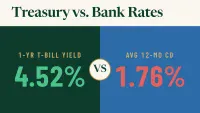
The FDIC’s national average rate on a 12-month CD was 1.76%[1] in October 2026. That is below inflation before any tax is taken out. A saver make the average bank rate loses gets power every month the money stays put.
Treasury bills look different. The 13-week bill yielded 4.21% on November 12, 2026, which beats inflation before tax. T-bill interest is taxable for federal income tax purposes but is not taxed at the state or local level. After federal tax, a saver in the 12% bracket ends up right at inflation. In the 22% bracket and above, the after-tax yield falls below 3.7%.
Federal Reserve policy shows why the two rates are so far apart. The top of the Fed’s target range was 4.00%[2] as of November 16, 2026, up from 3.75% before September 17, 2026. T-bill yields stay close to that policy rate. Banks choose for themselves how much to pass on to savers, and many pass on very little.
Ways to Earn More When Your Rate Trails Inflation
If your current rate is below inflation, compare these four options directly.
- High-yield savings accounts. Online banks and some credit unions pay rates much closer to Treasury yields than the national average, and deposits carry the same federal insurance up to legal limits. The rates are variable and usually move after the Fed acts, so check yours after each rate decision.
- Treasury bills. They are guaranteed by the U.S. government and free of state income tax, which helps most in high-tax states. TreasuryDirect and brokerages both offer them. Terms run from weeks up to a year, so pick a maturity that matches when you need the cash.
- CDs. A CD locks in a rate for a set term, which protects you if rates fall. Shop well beyond the national average, read the early withdrawal penalty, and match the term to your timeline.
- I bonds. Series I bonds issued from November 2026 through April 2027 pay a combined rate of 5.51%, which includes a 1.4% fixed rate. The rate adjusts with inflation. You cannot cash them in during the first year, and redeeming early costs you some interest.
Your Next Step Is Finding Your Rate and Your Bracket
Look at your savings statement and find the APY you are actually make. Then check last year’s tax return for your marginal bracket. A rate below 3.7% loses ground before taxes. A rate only a little above it can still fall behind once taxes are paid, depending on your bracket. Those two numbers tell you whether your money should move.
Frequently Asked Questions About Beating Inflation With Savings
Can a high-yield savings account beat inflation?
That depends on how far the account’s rate sits above the latest CPI reading and on your tax bracket. When the Fed’s policy rate is above inflation, the strongest high-yield accounts can beat inflation before tax. Savers in lower brackets have the best chance of staying ahead after tax.
Do I owe tax on savings interest I never withdraw?
Yes. IRS guidance says you constructively receive income on the deposit once interest is credited and available to withdraw, even if you leave it in the account. Your bank reports it to you on Form 1099-INT.
Are Treasury bills taxed otherwise from bank interest?
Both are subject to federal income tax. T-bill interest is not taxed at the state or local level, so in a state with an income tax, a T-bill holds more of its yield than a bank account gives the same rate.
What is a real interest rate?
The real rate is your nominal rate minus inflation. A positive real rate means your gets power increases, and a negative one means it shrinks. For savers, the figure to watch is the after-tax real rate, which also takes out the tax on your interest.
Contact [email protected] for any questions or corrections.
Austin Smith is a financial publisher with over two decades of experience as an investor, analyst, and advisor. He covers stocks, ETFs, Artificial intelligence and personal finance for 24/7 Wall St. Previously, he spent over a decade at The Motley Fool as a senior editor for Fool.com, portfolio advisor for Millionacres, and launched The Ascent to help reader take control of their personal finances.
His work has been featured on Fool.com, NPR, CNBC, USA Today, Yahoo Finance, MSN, AOL, Marketwatch, and many other publications. He is as an advisor to private companies, and co-hosts The AI Investor Podcast with Eric Bleeker.
When not looking for investment opportunities, he can be found skiing, running, or playing soccer with his children. Learn more about Austin's investment approach here.