7 Signs Your Savings Account Is Quietly Costing You Money

This post may contain links from our sponsors and affiliates, and Flywheel Publishing may receive compensation for actions taken through them.

The account where you keep your savings can cost you money without a single charge on your statement. It happens when the rate trails prices, when a fee eats into the balance, or when cash sits in the wrong place. Each of these problems shows up somewhere you can see it, and each takes minutes to check. Here are the seven signs to look for in your own account.
1. You Have Never Looked Up Your Rate
Most people with an underpaying account have never checked what it pays. It sits buried in a disclosure you scanned when you opened the account, and your bank has no reason to bring it up again. An adviser on a February 2026 episode of The Clark Howard Podcast said "nobody’s going to tap you on the shoulder" to tell you that you are losing out, because banks "like that interest rate spread."
That spread is the gap between what the bank earns on your deposit and what it pays you, so log in, find the annual percentage yield (APY), and write it down. You need that number to check every other sign below.
2. Your Rate Sat Still After the Fed’s September Hike
The Fed raised its benchmark rate on September 16, 2026. As of November 12, 2026[1], the upper bound of the federal funds target range was 4.00%. Competitive savings accounts usually adjust within weeks of a Fed move. If your rate just moved, the bank kept the difference.
Short-term Treasury bills make a good yardstick. The 4-week bill had an average yield of 4.04% on November 20, 2026. If your savings rate is far below that, the bank is counting on you not to notice. One Fed governor argued in November 2026 that more rate hikes are needed to bring inflation down, so the gap could widen further.
3. Your Rate Falls Short of Inflation
Prices for consumers climbed 3.7% in the 12 months through September 2026. If your savings rate is lower than that, your balance grows on paper while what it can buy shrinks.
Across the country, the average 12-month CD paid 1.81%[2] as of November 1, 2026. Many basic savings accounts pay even less than a CD because you can pull your money out at any time. Cash earning a rate in that range loses ground to prices every month. A competitive high-yield account gives you a realistic chance of keeping up.
4. You Pay a Monthly Fee or Must Keep a Minimum Balance
A monthly maintenance fee works like a negative interest rate. On a modest balance, a few dollars a month can wipe out a full year of interest. A minimum balance requirement costs you in a different way. It forces you to leave cash parked in the account just to avoid the charge.
Consumers filed ~104,200 complaints about checking and savings accounts with the Consumer Financial Protection Bureau in 2025. Many online high-yield savings accounts charge no monthly fee and require no minimum. If you are paying one, you can stop by switching.
5. A Promotional Rate Expired Without Warning
Banks often attract deposits with an introductory rate that drops after a set period. Others pay their top rate only up to a balance cap or only if you set up a monthly direct deposit. When the rate steps down, the bank rarely makes a point of telling you. The CFPB’s annual complaint report for 2025 describes consumers complaining about to fine print that made promotional benefits harder to collect.
Pull up your account disclosure and look for an end date, balance tiers, and any activity requirements. If you opened the account for its headline rate a year or more ago, assume that rate is gone until you confirm otherwise.
6. You Keep Far More in Savings Than You Would Ever Need Quickly
Money set aside for emergencies needs to be available on short notice. Cash beyond that cushion can earn more in places that tie it up a little longer. On November 20, 2026, Treasury bill yields ranged from 4.04% for 4-week bills to 4.57% for 52-week bills. CDs and funds that invest in short-term debt also let you spread out when your money becomes available.
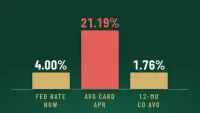
The most expensive version of this mistake is keeping idle cash while carrying a credit card balance. The average card APR was 21.19%[3] as of August 2026. If your savings earns a small fraction of that, the card interest costs you far more than your cash earns.
7. One Bank Holds More Than FDIC Insurance Covers
FDIC deposit insurance has a limit. It applies to each depositor, each insured bank, and each category of ownership. Single accounts, joint accounts, certain retirement accounts, and trust accounts each count as separate categories. That means one person can be insured above the base limit at one bank by using different categories correctly.
A large balance held in one name at one bank can push some of your money past the limit. Check the current limit and run your accounts through the FDIC’s online deposit insurance estimator. If any of your money falls outside coverage, spread it across ownership categories or other banks. Some brokerage cash management accounts spread deposits across several partner banks to extend coverage, so read how yours splits your money.
Run One Check Today to Catch Most of These
You can check nearly every sign on this list in a few minutes. Log in and note your APY, any monthly fee, and any promotional end date. Then compare your rate with what competitive high-yield accounts pay right now. If the gap is wide, moving your cash takes an afternoon, and you earn more every month after that. Use the accounts below as a starting point for that comparison.
Savings Account Questions Readers Also Ask
How Often Should I Check My Savings Rate?
Check it after every Federal Reserve rate decision, and at least once a quarter otherwise. Banks can change variable rates at any time. A quick look keeps a slow slide from running for a year before you notice.
Is a High-Yield Savings Account as Safe as a Regular One?
It does, as long as the bank is FDIC insured or the credit union is federally insured through the NCUA. Insurance protection works regardless of what rate the account pays. Confirm the bank’s insured status with the FDIC’s BankFind tool before you deposit.
Will Opening a New Savings Account Hurt My Credit?
Opening an account for saving generally involves no hard credit inquiry. Some banks review your banking history through a consumer reporting agency such as ChexSystems, and that review has no effect on your credit score.
Should My Savings Be at the Same Bank as My Checking?
Keeping them together is more convenient, but you can usually get a better rate by separating them. Linking an online high-yield savings account to your existing checking account gives you both. Transfers between the two typically arrive within a couple of business days.
Do I Owe Taxes on Savings Interest?
Yes. The bank credits interest to your account, and the IRS taxes it as ordinary income in that year, with banks reporting it on Form 1099-INT. A higher rate does mean a larger tax bill. Even so, you keep more after taxes than you would at a lower rate.
Contact [email protected] for any questions or corrections.
Austin Smith is a financial publisher with over two decades of experience as an investor, analyst, and advisor. He covers stocks, ETFs, Artificial intelligence and personal finance for 24/7 Wall St. Previously, he spent over a decade at The Motley Fool as a senior editor for Fool.com, portfolio advisor for Millionacres, and launched The Ascent to help reader take control of their personal finances.
His work has been featured on Fool.com, NPR, CNBC, USA Today, Yahoo Finance, MSN, AOL, Marketwatch, and many other publications. He is as an advisor to private companies, and co-hosts The AI Investor Podcast with Eric Bleeker.
When not looking for investment opportunities, he can be found skiing, running, or playing soccer with his children. Learn more about Austin's investment approach here.