Walmart Opens ‘Dark Stores’ to Improve Delivery
Walmart reportedly is opening so-called dark stores to speed up same-day delivery. The move is a sign of how heated its rivalry with Amazon is.

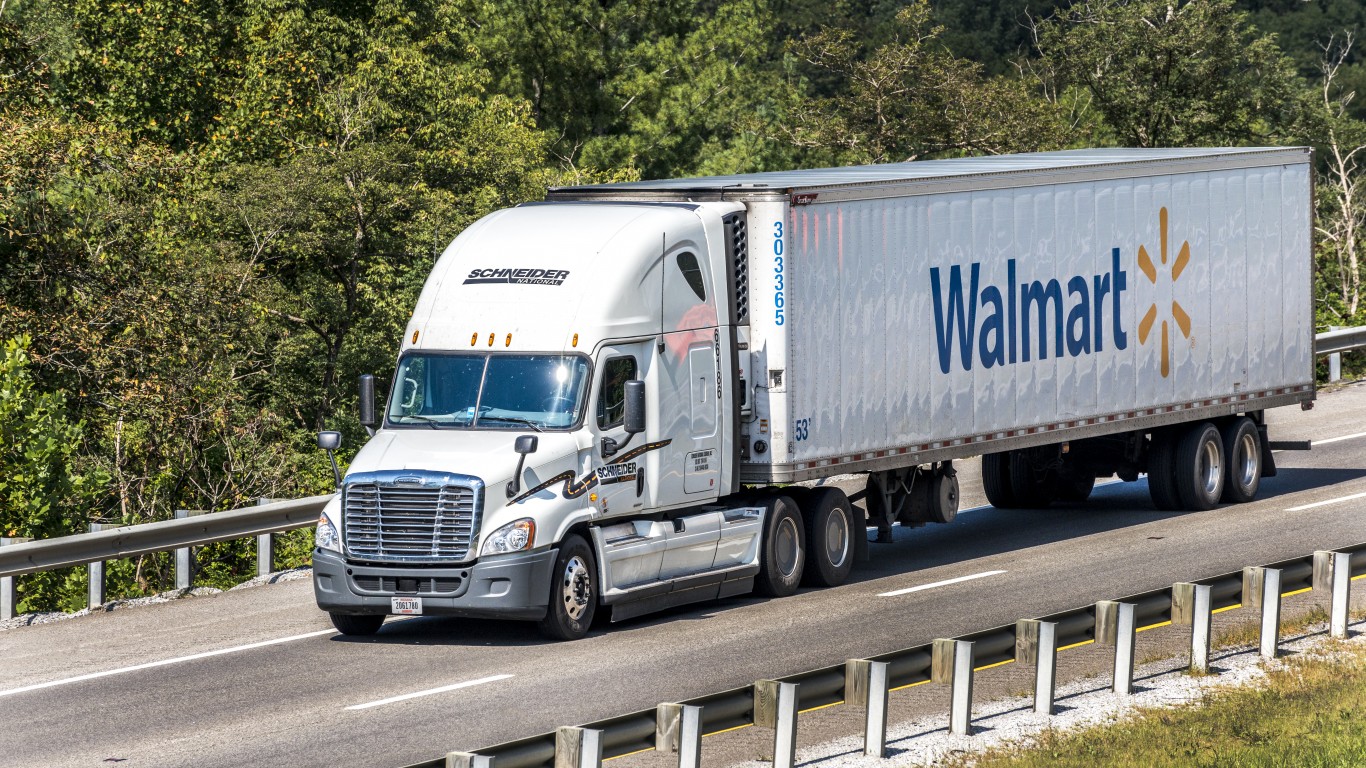
Walmart Inc. (NYSE: WMT | WMT Price Prediction) wants to speed up the pace at which it can deliver to customers who order online. Amazon.com Inc. (NASDAQ: AMZN) keeps warehouses around the country to do the same. The Walmart facilities are called “dark stores” because they are buildings with inventory but no doors for retail shoppers and little hint of their locations.
Bloomberg reports that this move is part of a plan Walmart has used before:
The new dark stores will carry some of the most popular items that shoppers buy, amplifying the reach of existing stores and bigger warehouses that fulfill orders. Walmart operated a handful of similar warehouses during the mid-2010s through the pandemic before closing them.
Walmart already has an advantage over almost all brick-and-mortar retailers in America. It claims that among its 4,700 stores, at least one of them is within 10 miles of 90% of the U.S. population.
Amazon has trumped all other retailers with one- to two-hour delivery on some items, many of which are food. This option has a service fee of as much as $9.95. The option is only offered in a limited number of Zip codes.
While the new dark stores offer proximity to customers, it is unclear that it matters. Walmart isn’t saying. However, faster delivery, even if it is same-day, is a sign of how much is at stake, particularly in its competition with Amazon.
In the most recently reported quarter, Walmart U.S. had revenue of $112.2 billion, which was up 3.2% from the same quarter the year before. Operating income rose 7% to $5.7 billion. That is quite a small operating margin.
Amazon reports its revenue slightly differently. In the most recent quarter, North American revenue was $92.9 billion, or up from $86.3 billion in the same quarters a year ago. Operating income was $5.8 billion, a $5 billion increase.
No other retailers in the United States have revenues close to those of Walmart and Amazon. The dark stores are another sign of how heated the rivalry is.
Amazon Stock Price Prediction and Forecast 2025-2030
Contact [email protected] for any questions or corrections.
Douglas A. McIntyre is the co-founder, chief executive officer and editor in chief of 24/7 Wall St. and 24/7 Tempo. He has held these jobs since 2006.
McIntyre has written thousands of articles for 24/7 Wall St. He is an expert on corporate finance, the automotive industry, media companies and international finance. He has edited articles on national demographics, sports, personal income and travel.
His work has been quoted or mentioned in The New York Times, The Wall Street Journal, Los Angeles Times, The Washington Post, NBC News, Time, The New Yorker, HuffPost USA Today, Business Insider, Yahoo, AOL, MarketWatch, The Atlantic, Bloomberg, New York Post, Chicago Tribune, Forbes, The Guardian and many other major publications. McIntyre has been a guest on CNBC, the BBC and television and radio stations across the country.
A magna cum laude graduate of Harvard College, McIntyre also was president of The Harvard Advocate. Founded in 1866, the Advocate is the oldest college publication in the United States.
TheStreet.com, Comps.com and Edgar Online are some of the public companies for which McIntyre served on the board of directors. He was a Vicinity Corporation board member when the company was sold to Microsoft in 2002. He served on the audit committees of some of these companies.
McIntyre has been the CEO of FutureSource, a provider of trading terminals and news to commodities and futures traders. He was president of Switchboard, the online phone directory company. He served as chairman and CEO of On2 Technologies, the video compression company that provided video compression software for Adobe’s Flash. Google bought On2 in 2009.