Despite Troubles, Boeing Raises Its Estimate of Commercial Airplane Market
The world's commercial jet fleet will buy more than 44,000 new airplanes over the next 20 years according to Boeing's 2019 commercial outlook.

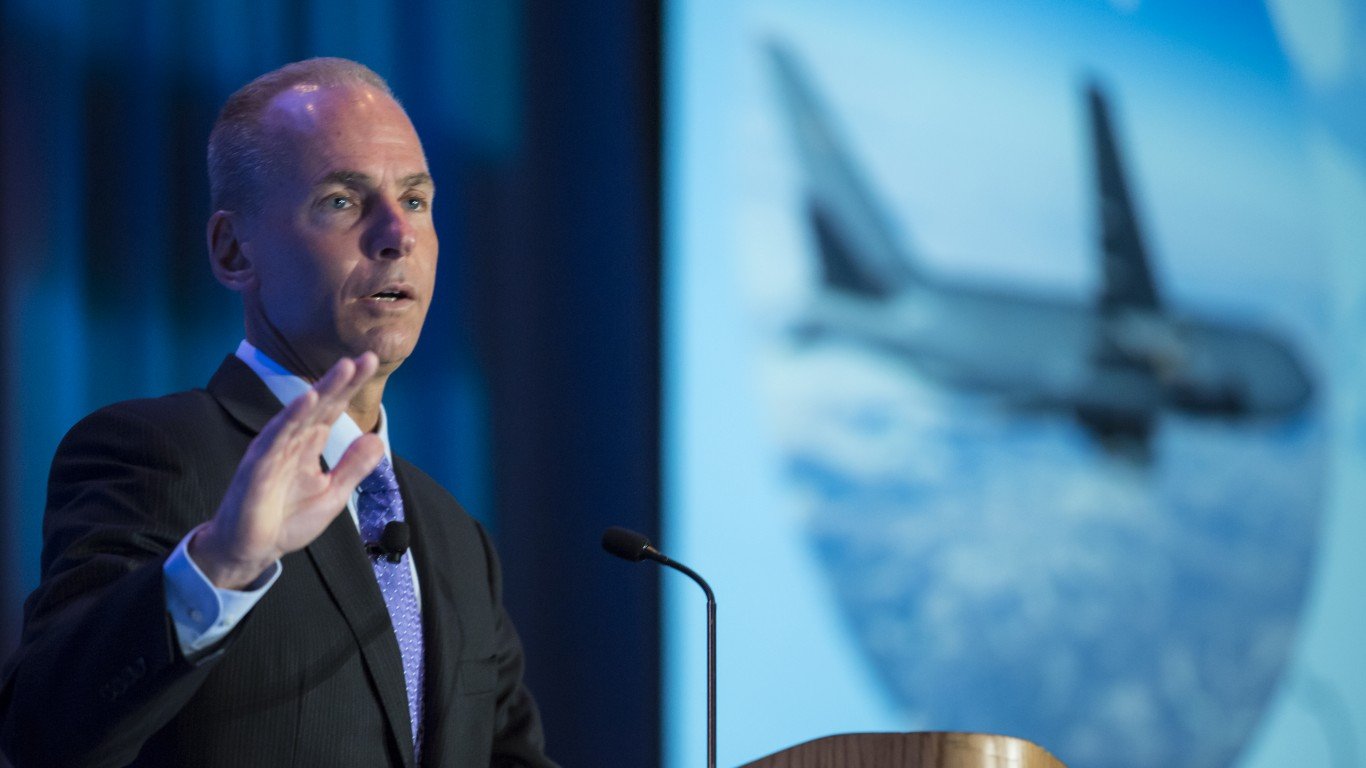
Dennis Muilenburg, CEO of The Boeing Co. (NYSE: BA | BA Price Prediction), said on Sunday that Boeing came to the 2019 Paris Air Show “with a tone of humility and learning.” Given the company’s disastrous five months from last October through March, the company was already being crushed at the event.
That doesn’t mean that Boeing plans to take a seat on the sideline and just swallow its medicine. The company took the occasion of the show to release its forecast for the next 10 years in the aerospace and defense markets and its 20-year forecast for the commercial aircraft market.
Through 2028, Boeing forecasts a total aerospace and defense market valued at $8.7 trillion, up from last year’s estimate of $8.1 trillion. The Boeing Market Outlook (BMO) includes $3.1 trillion in demand for commercial jets and $2.5 trillion in defense and space. Demand for supporting all that equipment is forecast at another $3.1 trillion.
The company’s commercial market outlook (CMO) extends for 20 years, double the length of the BMO. The market for new aircraft is up about 3% compared with last year’s CMO. Even larger than the market for new planes is the aviation services market that Boeing estimates will rise to $9.1 trillion by 2038. The total commercial market for 2038 is valued at $16 trillion.
For that period, Boeing forecasts demand for 44,040 new commercial jets. Single-aisle planes like the Boeing 737 and Airbus A320 account for nearly three-quarters of the demand or 32,420 aircraft valued at $3.78 trillion. About 19% of all commercial jets (8,340) entering the global fleet will be widebodies (twin-aisle) with a market value of around $2.65 trillion, while regional jets (2,240 aircraft valued at $105 billion) and widebody freighters (1,040 aircraft valued at $300 billion) bring the total value of new aircraft to $6.8 trillion.
Passenger traffic is expected to rise the most on domestic flights within China, which will displace the intra-North American market (United States and Canada) as the region with the most traffic in 2028. Flights within Europe will rank third, while traffic from Europe to North America is expected to be the fourth-most heavily traveled routes.
Aircraft deliveries over the next 20 years will be weighted heavily toward the Asia-Pacific region, where 17,390 new planes will be delivered, nearly double the 9,130 forecast for deliveries in North America.
Interestingly, when Boeing evaluates the industry’s prospects over the next 20 years, trade issues such as those currently threatening U.S. trade with China are not mentioned at all. By the middle of the next decade, China is expected to have developed its own single-aisle jet, and by the end of the decade, could have a twin-aisle plane near first delivery. Competition from China-based aircraft makers could be a big deal for Boeing over the next two decades.
Contact [email protected] for any questions or corrections.
Paul Ausick has been writing for 247Wallst.com for more than a decade. He has written extensively on investing in the energy, defense, and technology sectors. In a previous life, he wrote technical documentation and managed a marketing communications group in Silicon Valley.
He has a bachelor's degree in English from the University of Chicago and now lives in Montana, where he fishes for trout in the summer and stays inside during the winter.