




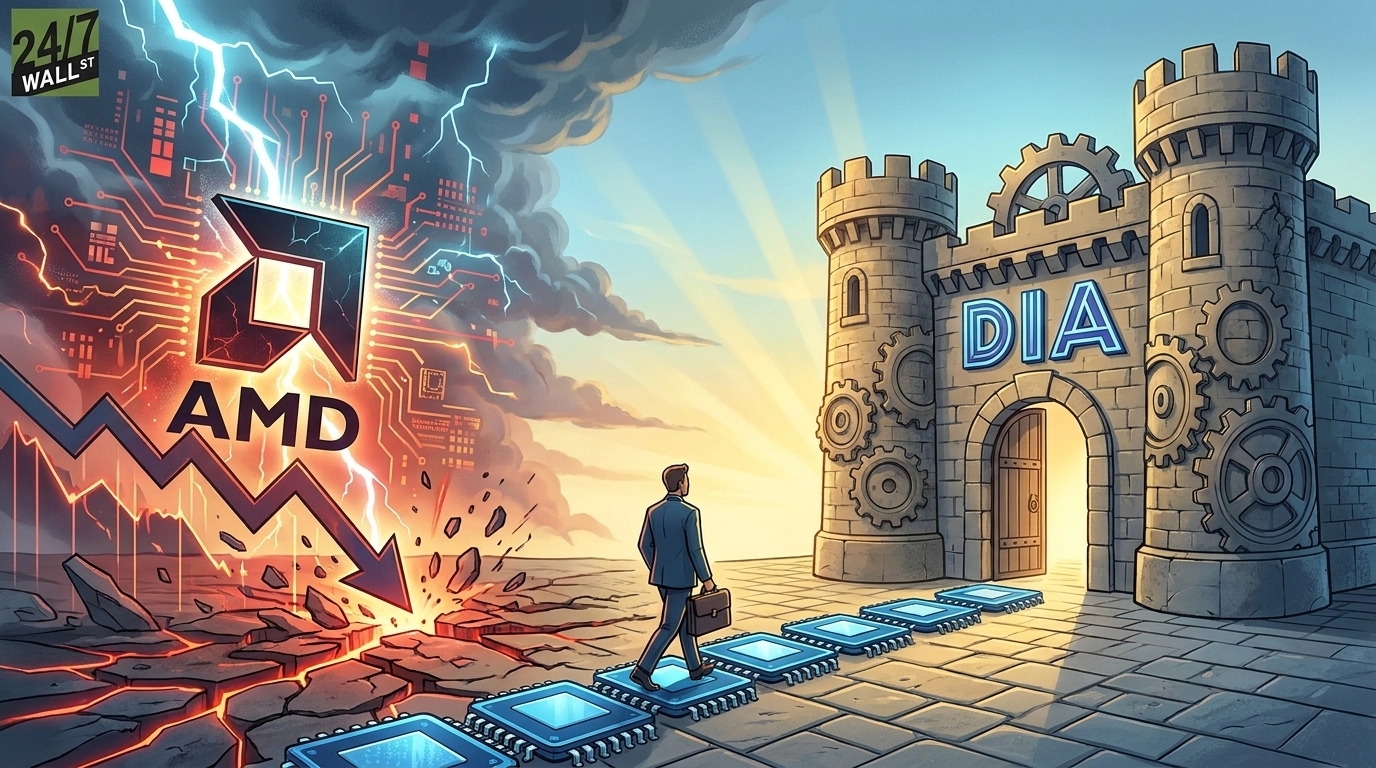
AMD (NASDAQ:AMD | AMD Price Prediction) is the ticker every AI-hungry investor is chasing right now, riding a 273.82% one-year rally on OpenAI and Meta gigawatt deals.
But here’s what you should actually be watching.
The seasoned playbook says buy scarcity when it is cheap and lighten up when it is priced for perfection. AMD is priced for perfection. Shares trade at a trailing P/E of 182 and a forward P/E of 77, with an EV/EBITDA of 108 and a price-to-sales ratio of 24. The beta of 2.49 tells you this stock moves more than twice as hard as the market in either direction. That is the definition of a crowded momentum trade.
The chart adds to the risk. AMD rocketed from a 52-week low of $133.50 to a 52-week high of $584.73, and shares have already slipped 4.26% in a single session and 2.77% on the week to $517.82. Sentiment scoring flags low confidence despite a 7-day sentiment jump of 16.69 points. Rising enthusiasm with weak conviction is how blow-off tops start. Earnings execution is also decelerating, with the Q1 2026 beat of 6.20% stepping down from Q4 2025’s 15.91% surprise. Layer in export-control exposure on MI308 shipments to China and dependence on third-party manufacturers, and this stock has no business anchoring a retirement account.
Consider the case for the SPDR Dow Jones Industrial Average ETF Trust (NYSEARCA:DIA). Three reasons make it the fortress trade.
One: real diversification. DIA spreads exposure across 30 blue-chip industrials, financials, healthcare names, and consumer staples. A hyperscaler capex pause cannot detonate the portfolio the way it can with a single semiconductor bet. The fund still delivered a one-year gain of 18.7% and a ten-year return of 194.4% without high-beta whiplash.
Two: a real income stream. DIA has paid distributions across 27 uninterrupted years since 1999, with 2025 distributions totaling 7.00868 per share, up from 6.88397 in 2024. The June 18, 2026 ex-date alone paid 1.40542 per share. AMD carries a dividend yield of none. Retirees live on cash flow.
Three: durability through cycles. Dow constituents are cash generators with global scale, defensible moats, and multi-decade operating histories. State Street’s 2026 ETF outlook notes that “factor and dividend ETFs also staged a modest comeback, as investors sought income and diversification in a lower-rate but still uncertain macro environment.” Morningstar’s team warns that “tariffs, central bank leadership changes, and geopolitical tensions may drive volatility in 2026” and urges investors to avoid overreacting to headlines. DIA is engineered for exactly that environment.
Price action confirms the rotation is already underway. DIA closed at $527.88 on July 2, 2026, gaining 1.05% on the same session AMD fell 4.26%. Money is rotating from momentum to quality in real time.
For investors evaluating the rotation thesis, the setup favors reducing AMD exposure into strength and reallocating toward DIA as a core retirement anchor.
Contact [email protected] for any questions or corrections.















 Top Gaining Stocks
 Top Losing Stocks