7 Blue-Collar Trade Jobs AI Cannot Replace Where Top Earners Clear $120,000 Without College Debt
You’re right. Since this looks destined for WordPress, I’d use **HTML markup consistently** and avoid Markdown formatting entirely. Here’s the cleaned version with the same content. Here is a career rule most white-collar workers have probably never considered: Try to…


You’re right. Since this looks destined for WordPress, I’d use **HTML markup consistently** and avoid Markdown formatting entirely. Here’s the cleaned version with the same content.
Here is a career rule most white-collar workers have probably never considered:
Try to become the person who still has to sign the paperwork after the AI finishes helping.
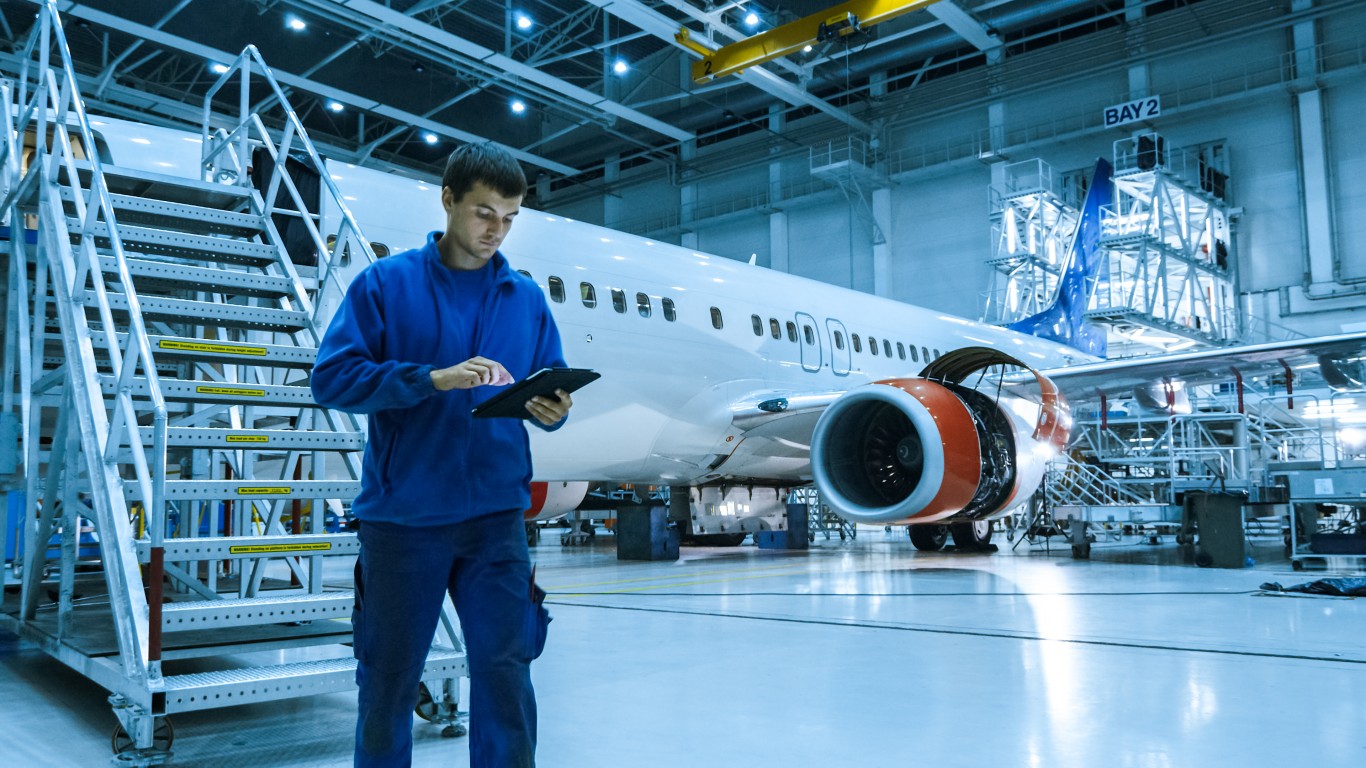
Consider aircraft maintenance.
Artificial intelligence can read maintenance manuals, analyze sensor data, diagnose faults, predict component failures, and tell a technician which part probably needs replacing.
But federal aviation rules still require an authorized person to approve covered maintenance for return to service, with maintenance records identifying the person responsible for that approval.
ChatGPT does not have an FAA certificate.
Gemini cannot sign the maintenance log.
And Claude, despite being extremely polite about the whole thing, cannot personally send the airplane back into service.
That illustrates one of the more interesting career moats emerging in the AI economy.
The jobs most resistant to automation aren’t necessarily protected because robots can’t learn the underlying task. They’re protected because the work combines physical presence, unpredictable environments, licensing, safety consequences, and human accountability.
The same principle appears in nuclear plants, electrical infrastructure, elevators, refineries, and other places where society remains understandably reluctant to let an algorithm say, “Looks good to me.”
Meanwhile, there were roughly 7.3 million job openings in July 2026, while unemployment remained just 4.1%.
So while millions of office workers are wondering which parts of their jobs AI will absorb next, another career strategy is hiding in plain sight:
Get very good at doing something an AI cannot legally approve, physically reach, or safely touch.
The salaries below need one important disclaimer. National median wages are very different from the eye-popping compensation sometimes earned by experienced workers stacking overtime, union premiums, night shifts, emergency callouts, offshore rotations, and shutdown work.
Nobody walks into an apprenticeship on Monday and makes $200,000 by Friday.
But some of these careers have remarkably high ceilings.
Elevator Mechanics: The Best-Paying Career Nobody Mentioned at Career Day
Elevator and escalator installers and repairers had a $109,910 median annual wage in 2025, according to the Bureau of Labor Statistics.
The highest-paid 10% earned more than $158,890.
That is already impressive before overtime and on-call work enter the equation.
It also makes elevator repair one of those careers that causes people with expensive graduate degrees to stare quietly into the distance for a moment.
The job combines electrical systems, motors, hydraulics, controls, mechanical alignment, diagnostics, and safety equipment.
It also takes place in an environment poorly suited to automation:
An elevator shaft.
Predictive-maintenance software can identify a failing component. Computer vision can inspect equipment. AI can search service manuals in milliseconds.
Eventually, however, someone may still need to climb on top of an elevator cab 30 stories above the lobby and determine why the physical machine doesn’t quite resemble what the schematic says should be there.
Then there’s the occasional group of passengers trapped between floors.
They tend to prefer a human mechanic over a push notification explaining that their ticket has been escalated.
The career path is unusual, too.
The National Elevator Industry Educational Program combines classroom education with roughly 2,000 hours of paid supervised work per year during a four- to five-year apprenticeship.
Instead of paying a university to teach you for four years, someone pays you while you learn why standing underneath an elevator is generally discouraged.
Nuclear Reactor Operators: Society Still Wants a Human at This Particular Desk
If you want a regulatory moat, nuclear power is difficult to beat.
Nuclear power reactor operators are among America’s highest-paid production workers, with wages around $120,000 annually even before considering the additional compensation that can accompany seniority and shift work.
But the salary isn’t what makes this occupation interesting in the AI era.
The Nuclear Regulatory Commission individually licenses the people who operate or supervise the controls of commercial nuclear reactors.
There are only about 3,600 active NRC-licensed power reactor operators in the United States.
Getting one of those licenses is considerably more involved than clicking “I agree” on a software update.
Candidates undergo extensive technical training, written examinations, operating tests, simulator work, medical evaluations, and continuing requalification. Licenses are also specific to the facility where the operator was trained and tested.
AI could become extraordinarily useful inside nuclear plants.
It could monitor thousands of signals simultaneously, detect anomalies humans miss, recommend responses, and eventually automate more routine operations.
But under today’s regulatory system, licensed human operators remain at the controls.
There are some decisions where society still wants to know the name of the person responsible.
Operating a nuclear reactor turns out to be one of them.
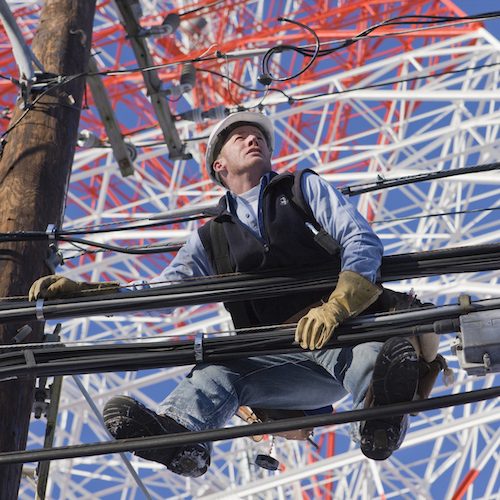
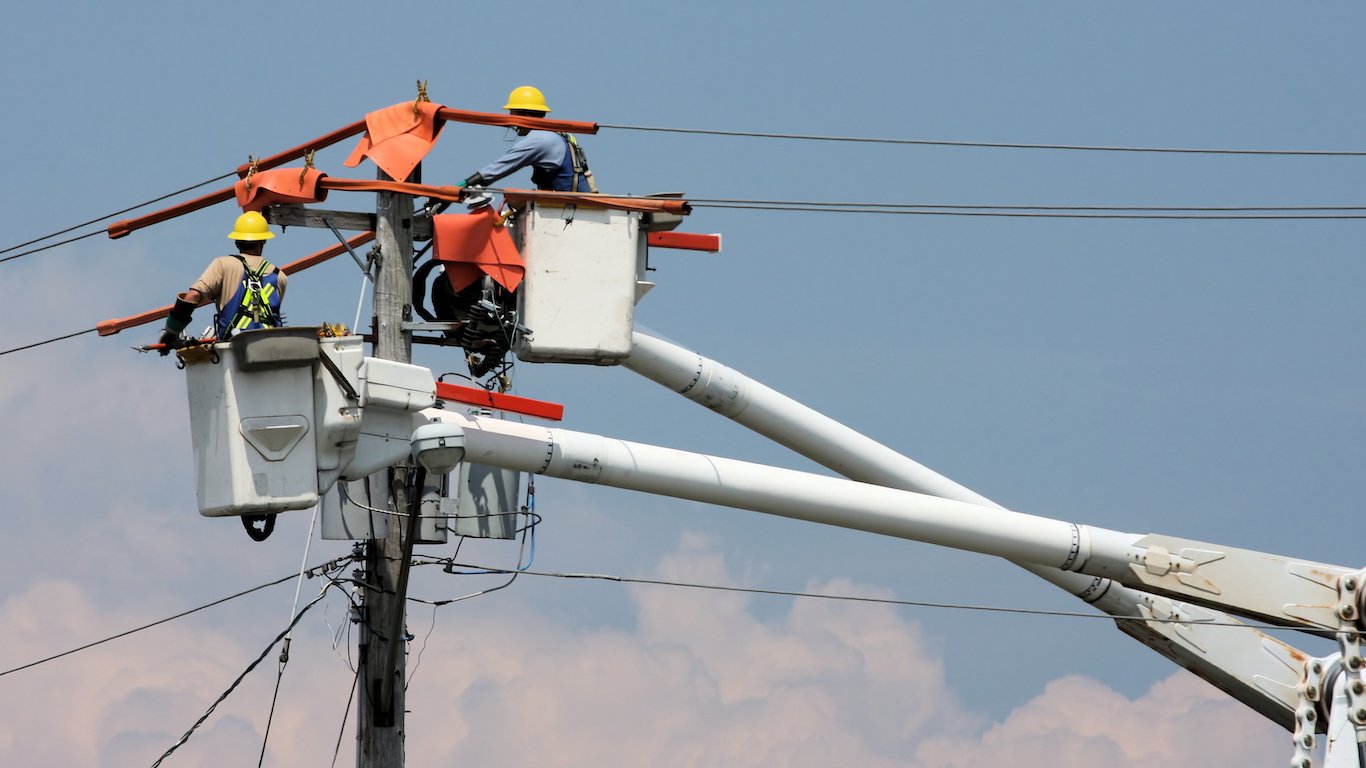
Power-Line Workers: When the Grid Goes Down, the Overtime Goes Up
Electrical power-line installers and repairers earned a $95,320 median wage in 2025, with the top 10% earning more than $128,690.
And those national figures don’t fully capture what can happen during major emergencies.
When hurricanes, ice storms, wildfires, or severe winds knock out power to hundreds of thousands of customers, utilities don’t respond by scheduling a Zoom meeting for Tuesday.
Crews travel.
Shifts stretch.
Overtime accumulates.
And experienced lineworkers willing to chase storm work can earn dramatically more than their normal base wages.
The automation moat is fairly easy to visualize.
Imagine an ice-covered utility pole during a windstorm.
Now attach a high-voltage transmission line to it.
Now imagine somebody handing you an insulated fiberglass tool and saying:
Go fix electricity.
Drones are already excellent at inspecting transmission infrastructure. AI can analyze grid conditions and identify faults. Robots will undoubtedly perform more maintenance.
But restoring damaged infrastructure in a chaotic physical environment remains a very different problem from analyzing it.
The software may know precisely which conductor failed.
Someone still has to get up there.
Aircraft Mechanics: AI Can Diagnose It. Someone Still Has to Approve the Work.
Aircraft maintenance may provide the cleanest example of the difference between automating knowledge and automating responsibility.
Modern airplanes already generate enormous quantities of diagnostic data.
AI should eventually become spectacular at interpreting that information.
It can search maintenance manuals, compare symptoms across fleets, identify likely failures, recommend troubleshooting sequences, and predict which components are approaching the end of their useful lives.
Fantastic.
Now somebody has to actually repair the airplane.
Federal aviation regulations specify who may approve maintenance for return to service, and maintenance records generally identify the person responsible for that approval.
The precise authorization varies depending on whether the work is performed by a certificated mechanic, repair station, manufacturer, or air carrier.
The important point is simpler:
The regulatory system still puts an authorized human organization or individual behind the decision to send that aircraft back into the sky.
Aircraft mechanics and service technicians earned a $79,870 median wage in 2025, with the top 10% earning more than $128,890.
At major airlines, union wage scales can push experienced aviation maintenance technicians substantially higher. Add license premiums, overtime, night work, and specialized assignments, and total compensation can climb well into six figures.
AI may someday know more about the 737 than any individual mechanic.
It still can’t crawl into the airplane and take responsibility for the repair.
Commercial Divers: Your Office Has 300 Feet of Water Above It
Commercial diving demonstrates a different kind of moat.
The national median wage reached roughly $73,000 in 2025.
But commercial diving includes everything from relatively routine underwater inspection to highly specialized offshore work, so national averages don’t tell the entire story.
At the extreme end are saturation divers.
These workers can spend weeks living inside pressurized chambers so their bodies remain acclimated to the pressure required for deep-water work. They then travel to underwater job sites to repair pipelines, install equipment, cut steel, rig structures, and perform other work hundreds of feet below the surface.
Suddenly the company’s return-to-office policy doesn’t sound so oppressive.
Robots already perform enormous amounts of underwater work.
Remotely operated vehicles are excellent at cameras, surveying, inspection, and repeatable tasks. Autonomous systems will get better.
But automation tends to remove the predictable jobs first.
The humans remain valuable precisely when something has gone wrong.
A damaged structure doesn’t match the drawings.
Visibility is terrible.
A clamp won’t fit.
Something needs to be cut, repositioned, rigged, or repaired in an environment fundamentally hostile to human life.
Highly specialized offshore divers can earn far above the national median, particularly when day rates, depth premiums, and demanding rotations are involved.
But rather than assuming every saturation diver earns $300,000, the more interesting takeaway is this:
If your workplace requires a decompression chamber, you probably have at least some protection from ChatGPT.
Boilermakers: Fix Absolutely Everything Before Monday
“Boilermaker” sounds like an occupation that disappeared around the same time as the telegraph operator.
It hasn’t.
Boilermakers build and repair industrial boilers, pressure vessels, tanks, furnaces, and other enormous pieces of equipment found in refineries, power plants, factories, and heavy industry.
Their normal national wage isn’t as spectacular as some of the occupations above.
The interesting money can appear during a turnaround.
A turnaround is a planned shutdown during which a refinery, chemical plant, or other industrial facility performs a concentrated burst of maintenance, inspection, replacement, and repair.
Every hour the facility remains offline can be enormously expensive.
So the basic turnaround schedule is:
Day 1: Shut everything down.
Day 2: Discover seventeen additional problems.
Day 3: Fix absolutely everything immediately.
Experienced workers can accumulate substantial overtime during these projects, pushing earnings far beyond ordinary annual wages.
The work itself is also difficult to standardize.
A robot can perform repetitive welds extremely well.
It has a harder time when the assignment becomes:
“Please crawl into this giant metal vessel, inspect the strange crack behind that pipe, figure out why the drawing doesn’t match what somebody installed in 1973, and repair it without damaging anything.”
There is one caveat.
BLS projects boilermaker employment to decline modestly over the coming decade as some traditional sources of work—particularly coal-fired power generation—shrink.
That’s an important distinction.
A career can have a strong automation moat without necessarily having a strong industry-growth moat.
Electricians: Getting Paid to Build the AI That’s Supposed to Replace Everyone
This may be the most entertaining occupation on the list.
Artificial intelligence requires data centers.
Data centers require enormous amounts of electricity.
And enormous amounts of electricity require electricians.
The machines are coming for our jobs.
First, apparently, they need us to wire the building.
Electricians earned a $63,190 median wage in 2025, with the highest-paid 10% above $108,510.
Experienced industrial electricians and journeymen working major projects can earn considerably more when union rates, overtime, shift premiums, and specialized work enter the equation.
And the AI infrastructure boom provides an unusually direct source of demand.
AI can design electrical systems.
Software can calculate loads.
Robots will eventually pull more cable and perform more repetitive installation.
But electrical construction constantly encounters the messy boundary between the blueprint and reality.
Conduit has to physically go somewhere.
Switchgear has to fit.
Circuits have to be energized and tested.
And something installed by the previous contractor 17 years ago will inevitably make absolutely no sense.
There is also the small issue that high-energy electrical equipment can produce an arc flash capable of vaporizing metal.
Society remains understandably enthusiastic about having trained people handle that part.
The Real Career Lesson: Stop Looking for an “AI-Proof” Job
There probably isn’t one.
AI will enter every occupation on this list.
Commercial divers will use better underwater robots.
Lineworkers will use drones and automated grid diagnostics.
Elevator mechanics will use predictive maintenance.
Reactor operators will get increasingly sophisticated decision-support systems.
Aircraft technicians will troubleshoot with AI.
Electricians will work from AI-assisted designs.
That’s fine.
The important question isn’t:
“Can AI do any part of this job?”
The better question is:
“What’s the last 20% of this job that nobody knows how to automate?”
The strongest career moats tend to stack several defenses together:
- A difficult credential or license.
- Physical work in unpredictable environments.
- Serious consequences when something goes wrong.
- Real-time judgment.
- Regulatory accountability.
- Customers who desperately need the problem fixed now.
Sitting at a computer moving information from one software system to another doesn’t score particularly well on that test.
Repairing electrical infrastructure during an ice storm scores considerably better.
The Best Part: You Don’t Necessarily Need $150,000 of Student Debt
Several of these careers offer another financial advantage that rarely makes it into discussions about AI:
You can get paid while learning them.
Elevator apprenticeships through NEIEP combine classroom education with roughly 2,000 hours of supervised paid work per year.
Union apprenticeship programs in electrical, piping, welding, and related trades similarly combine classroom instruction with thousands of hours of paid on-the-job training.
The United Association’s apprenticeship programs, for example, typically include about 2,000 hours of paid job-site training each year, plus classroom instruction.
The exact application process varies enormously by trade and location. Elevator recruitment opens in specific local windows. Electrical and lineworker programs may run through union locals, joint apprenticeship committees, utilities, or contractors.
So there isn’t one giant “Become Highly Paid Person Who AI Can’t Replace” application button.
The strategy is more old-fashioned.
Find the relevant union local or employer.
Watch its apprenticeship openings.
Prepare for the aptitude test.
Apply when recruitment opens.
Then spend several years becoming unusually competent at something expensive, dangerous, regulated, and inconvenient.
That might turn out to be a remarkably good place to build a career.
Because the future probably does contain an AI capable of explaining, in exquisite detail, exactly how to repair a high-voltage transmission line during a hurricane.
And somewhere nearby will be a human lineworker saying:
“Cool. Hold my truck.”
Contact [email protected] for any questions or corrections.
Don Lair writes about options income, dividend strategy, and the kind of boring-but-durable investing that actually funds retirement. He's the founder of FITools.com, an independent contributor to 24/7 Wall St., and a former writer for The Motley Fool.