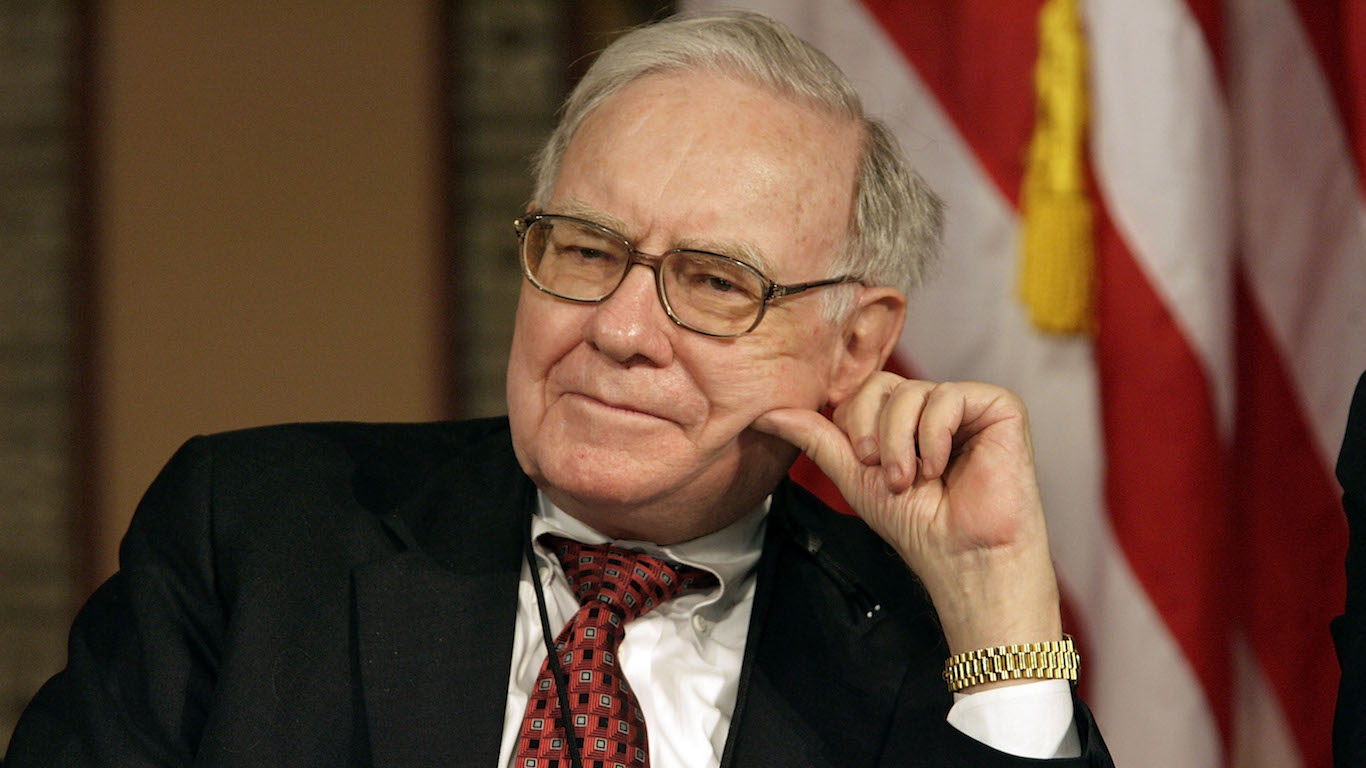
Red October Sell-Off Could Be Coming: 5 Warren Buffett Dividend Stocks Are Safe Havens
A stock market correction of up to 20% may arrive sooner than most investors expect, but five Berkshire Hathaway holdings are already positioned to weather the storm while paying investors to wait.

Warren Buffett stepped down as CEO of Berkshire Hathaway on December 31, 2025, after six decades leading the conglomerate he transformed from a struggling textile mill into a $1 trillion empire. The “Oracle of Omaha” left his successor, Greg Abel, with a very concentrated portfolio: more than 71% of Berkshire’s $365.5 billion portfolio is invested in just seven stocks. Abel, who has served as vice chair overseeing non-insurance operations, officially took over as CEO on January 1, 2026. At 96, Buffett isn’t fully retiring. He remains board chair and comes to the Omaha headquarters as much as before. However, he has stated he will be “going quiet” and leaving all decision-making to Abel.
One thing that Abel has been careful about, as he has started some rearrangement of the Berkshire Hathaway (NYSE: BRK-B | BRK-B Price Prediction) portfolio, is to carefully maintain some of the longest-held stocks at Berkshire Hathaway, and with good reason. Some key holdings have not only been outstanding performers this year, but also pay dependable dividends, which are often reinvested or added to the gigantic $365 billion cash pile Buffett has been accumulating over the last five years. Berkshire Hathaway generates a stunning $4.37 billion in dividend income each year, and an additional $12 to $16 billion in risk-free interest income.
While Buffett and Abel patiently wait to put some of the cash to work, they may not have to wait long, as the stock market could be poised for a 10% to 20% correction, and it could be coming right around the corner. With the potential for higher interest rates, a massive $40 trillion national debt, a tired and overbought stock market, and fading artificial intelligence momentum, all the ingredients for a big correction are lining up. Toss in the potential for more geopolitical fallout, especially if the fighting in the Middle East expands, the sellers, and especially the short sellers, could have their fingers on the sell button.
Five of Berkshire Hathaway’s premier holdings are a good place to shift capital now, and all pay reliable dividends that, in some cases, are raised every year. Top Wall Street firms rate all as Buys, and they make sense for worried investors now.
Why Do We Cover Berkshire Hathaway Stocks?
Few investors have the results and reputation Buffett has earned over the past 60 years. Though he has stepped away from the CEO chair, his impact and investment guidelines are likely to remain in place long after he is gone. While investing has evolved since Buffett took control of Berkshire Hathaway in 1965, buying good companies with globally recognized products and services that pay dividends will remain a timeless approach.
American Express
American Express (NYSE:AXP) is a bank holding company and multinational financial services corporation specializing in payment cards, and it pays a 1.09% dividend. This globally integrated payments company operates card-issuing, merchant-acquiring, and card-network businesses. The company raised its quarterly dividend from $0.82 to $0.95 between January and April 2026.
The company offers products and services to customers worldwide, including consumers, small businesses, midsized companies, and large corporations. Its segments include:
- U.S. Consumer Services, which offers travel and lifestyle services, as well as banking and non-card financing products.
- Commercial Services offers payment, expense management, banking, and non-card financing products.
- International Card Services provides services to international customers, including travel and lifestyle services, and manages certain international joint ventures and its loyalty coalition business.
- Global Merchant and Network Services operates a payments network that processes and settles card transactions, acquires merchants, and provides multichannel marketing programs, capabilities, services, and data analytics.
Berkshire Hathaway owns 151,610,700 shares, 22.2% of American Express’s float, and 14.1% of the portfolio.
Piper Sandler has an Overweight rating with a $405 target price.


Bank of America
Buffett has trimmed his Bank of America (NYSE:BAC) position over the past two years, selling a whopping 50 million shares in the fourth quarter of 2025 and another 30 million shares in Q2 of 2026. This quality financial giant remains an exceptional long-term holding with a solid 1.79% dividend yield. The dividend was raised from $0.26 to $0.28, then to $0.32 per quarter, with two increases over the past 12 months. Bank of America is a bank holding company and financial holding company that reported impressive Q2 results. Berkshire Hathaway still owns 483,394,015 shares, or 7.9% of the portfolio and 6.9% of the float, despite the massive sales.
Its Consumer Banking segment offers a range of credit, banking, and investment products and services to consumers and small businesses. The Global Wealth & Investment Management segment comprises two businesses:
- Merrill Wealth Management offers tailored solutions to meet clients’ needs through a comprehensive suite of investment management, brokerage, banking, and retirement products.
- Private Bank provides comprehensive wealth management solutions.
Its Global Banking segment offers a range of lending-related products and services, including integrated working capital management and treasury solutions, as well as underwriting and advisory services. The Global Markets segment offers sales and trading services, as well as research services, to institutional clients across fixed income, credit, currency, commodity, and equity markets.
Jefferies has a Buy rating with a $75 target price.


Chevron
Chevron (NYSE:CVX) is an American multinational energy company primarily focused on oil and gas. This integrated giant is a safer option for investors seeking a position in the energy sector. It pays a substantial 3.26% dividend, which was raised by 5% earlier this year, and has a 39-year streak of dividend increases. Chevron operates integrated energy and chemicals businesses worldwide through its subsidiaries. Berkshire Hathaway owns 84,375,856 shares, which equals 4.2% of the float and 4.7% of the portfolio.
The company operates in two segments. The Upstream segment is involved in:
- Exploration, development, production, and transportation of crude oil and natural gas
- Processing, liquefaction, transportation, and regasification associated with liquefied natural gas
- Transportation of crude oil through pipelines, and transportation and storage
- Marketing of natural gas, as well as operating a gas-to-liquids plant
The Downstream segment engages in:
- Refining crude oil into petroleum products
- Marketing crude oil, refined products, and lubricants
- Manufacturing and marketing renewable fuels
- Transporting crude oil and refined products by pipeline, marine vessel, motor equipment, and rail car
- Manufacturing and marketing of commodity petrochemicals, plastics for industrial uses, and fuel and lubricant additives
It also involves cash management, debt financing, insurance operations, real estate, and technology businesses.
Piper Sandler has an Overweight rating with a $243 target price.


Coca-Cola
Coca-Cola (NYSE:KO) is an American multinational corporation founded in 1892. It remains one of Buffett’s longest-held holdings. Berkshire owns 400 million shares, which represent 9.3% of the float and 9.3% of the portfolio. The stock pays a dependable 2.36% dividend. The raised to $0.53 per share in May 2026, marked the 64th straight year of dividend increases.
Coca-Cola is the world’s largest beverage company, offering consumers more than 500 sparkling and still brands. Led by Coca-Cola, one of the world’s most valuable and recognizable brands, the company’s portfolio features 20 billion-dollar brands, including:
- Diet Coke
- Coca-Cola Light
- Coca-Cola Zero Sugar
- Caffeine-free Diet Coke
- Cherry Coke
- Fanta Orange
- Fanta Zero Orange
- Fanta Zero Sugar
- Fanta Apple
- Sprite
- Sprite Zero Sugar
- Simply Orange
- Simply Apple
- Simply Grapefruit
- Fresca
- Schweppes
- Dasani
- Fuze Tea
- Glacéau Smartwater
- Glacéau Vitaminwater
- Gold Peak
- Ice Dew
- Powerade
- Topo Chico
- Minute Maid
Globally, it is the top provider of sparkling beverages, ready-to-drink coffees, juices, and juice drinks. Through the world’s most extensive beverage distribution system, consumers in more than 200 countries enjoy the company’s beverages at a rate of over 1.9 billion servings per day. And the company owns 19.5% of Monster Beverage (NASDAQ:MNST), which continues to deliver strong financial results.
UBS has a Buy rating and set a target price of $104.


Occidental Petroleum
After years of building this position, Buffett and Berkshire Hathaway are finally in the money on this company, which pays a 1.63% dividend. Occidental Petroleum (NYSE:OXY) is an international energy company with assets primarily in the United States, the Middle East, and North Africa. The company is an oil and gas producer in the United States, including the Permian and D.J. basins and the offshore Gulf of America. Occidental’s most recent dividend increase was on February 19, 2026. The board raised the quarterly dividend by more than 5%, from $0.24 to $0.26 per share. That bumped the annualized rate from $0.96 to $1.04.
Berkshire Hathaway has a large position in the company, owning 264,941,431 shares, representing 26.6% of the float and 4.3% of the portfolio.
Occidental’s oil and gas segment explores for, develops, and produces oil (including condensate), natural gas liquids (NGLs), and natural gas. The midstream and marketing segment purchases, markets, gathers, processes, transports, and stores oil (including condensate), NGLs, natural gas, carbon dioxide (CO2), and power. This segment provides flow assurance, maximizes the value of its oil and gas, and optimizes the company’s transportation and storage capacity. It also invests in companies that do similar activities, including low-carbon ventures.
A notable development was Occidental’s decision to sell its OxyChem subsidiary to Berkshire Hathaway, with the bulk of the proceeds expected to strengthen the company’s balance sheet and further concentrate its business on oil and gas. The move was notable because Buffett had reportedly long coveted OxyChem, and Berkshire now owns the business outright. Berkshire Hathaway completed its purchase of OxyChem from Occidental on January 2, 2026. That gives Buffett full ownership of the chemicals business while providing Occidental with $9.7 billion in cash to reduce debt and sharpen its focus on energy.
Wells Fargo has an Overweight rating on this stock and an $82 price objective.


Contact [email protected] for any questions or corrections.
Lee Jackson has covered Wall Street analysts' equity and debt research and equity strategy daily for 24/7 Wall St. since 2012. His broad, diverse career, including a stint as creative services director at an NBC affiliate in Austin, Texas, gives him unique insight into the financial industry.
Lee Jackson's journey in the financial industry spans more than 30 years, including nearly two decades as an institutional equity salesperson at Bear Stearns, Lehman Brothers, and Morgan Stanley. His career spanned pivotal sell-side Wall Street events, from the dot-com rise and bubble to the Long-Term Capital Management debacle, 9/11, and the Great Recession of 2008. This reflects his resilience and adaptability amid market volatility.
Lee Jackson’s practical financial industry experience, gained through a career at some of the biggest banks and brokerage firms, is complemented by a lifetime of writing across various platforms. This unique combination allows him to shed light on the intricacies of Wall Street in a way only someone with deep insider experience and knowledge can. Moreover, his extensive network across Wall Street continues to provide direct access for him and 24/7 Wall St., a privilege few firms enjoy.
Since 2012, Jackson’s work for 24/7 Wall St. has been featured in Barron’s, Yahoo Finance, MarketWatch, Business Insider, TradingView, Real Money, The Street, Seeking Alpha, Benzinga, and other media outlets. He attended the prestigious Cranbrook Schools in Bloomfield Hills, Michigan, and has a degree in broadcasting from the Specs Howard School of Media Arts.