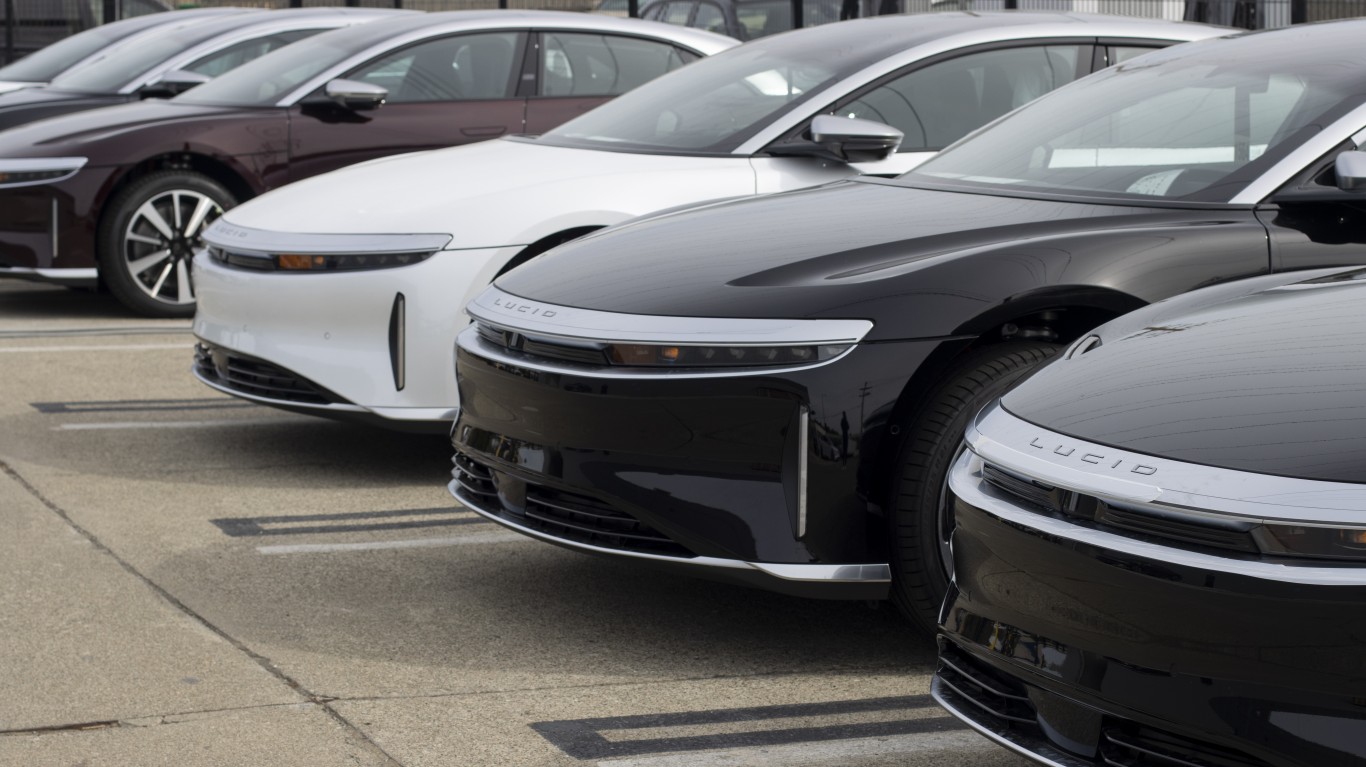
Lucid Stock Plunges Again This Year
Pessimism about electric vehicle sales has Lucid stock down 10% this year. If bigger car companies are challenged to make money selling EVs, how can Lucid succeed?


In addition to falling over 70% since its initial public offering, Lucid Group Inc. (NASDAQ: LCID | LCID Price Prediction) stock is down 10% this year. At least in part, the reason is pessimism about electric vehicle (EV) sales in 2025. In 2024, only 8% of new cars sold in the United States were EVs. This year, the $7,500 tax credit on EV purchases will be discontinued. Federal support for more charging stations across the country has also disappeared. And a lack of charging stations is one objection potential EV buyers have.
Lucid has recently received support from one of America’s most prominent investors. BlackRock holds just over 12% of Lucid’s total share count. The reason may be a Saudi investment in the EV company. In August, Ayar Third Investment, an affiliate of the Public Investment Fund, agreed to purchase $750 million of convertible preferred stock via private placement, and it provided for a $750 million unsecured delayed draw term loan facility. The fund was already Lucid’s largest investor.
However, sales results and financials show that these investments are risky. Lucid only produced 2,081 vehicles in the third quarter of last year. The company lost $949 million on revenue of $200 million.
The EV market is such that investors are worried about sales of the industry giant Tesla. Ford said it would lose money on EVs again this year. Ford, GM, and Hyundai/Kia are battling to get 10% of the market, without success so far.
If some of the largest car companies in the world are challenged to make money in the U.S. EV market, how can tiny Lucid have a chance?
Are Electric Cars Really Better for the Environment?
Contact [email protected] for any questions or corrections.
Douglas A. McIntyre is the co-founder, chief executive officer and editor in chief of 24/7 Wall St. and 24/7 Tempo. He has held these jobs since 2006.
McIntyre has written thousands of articles for 24/7 Wall St. He is an expert on corporate finance, the automotive industry, media companies and international finance. He has edited articles on national demographics, sports, personal income and travel.
His work has been quoted or mentioned in The New York Times, The Wall Street Journal, Los Angeles Times, The Washington Post, NBC News, Time, The New Yorker, HuffPost USA Today, Business Insider, Yahoo, AOL, MarketWatch, The Atlantic, Bloomberg, New York Post, Chicago Tribune, Forbes, The Guardian and many other major publications. McIntyre has been a guest on CNBC, the BBC and television and radio stations across the country.
A magna cum laude graduate of Harvard College, McIntyre also was president of The Harvard Advocate. Founded in 1866, the Advocate is the oldest college publication in the United States.
TheStreet.com, Comps.com and Edgar Online are some of the public companies for which McIntyre served on the board of directors. He was a Vicinity Corporation board member when the company was sold to Microsoft in 2002. He served on the audit committees of some of these companies.
McIntyre has been the CEO of FutureSource, a provider of trading terminals and news to commodities and futures traders. He was president of Switchboard, the online phone directory company. He served as chairman and CEO of On2 Technologies, the video compression company that provided video compression software for Adobe’s Flash. Google bought On2 in 2009.