NVIDIA vs. Intel: Which AI Chip Stock Should Retirement Investors Own?
Retirement investors hunting AI chip exposure face a simple binary: NVIDIA (NASDAQ:NVDA | NVDA Price Prediction) or Intel (NASDAQ:INTC). Both sit at the center of the AI buildout, both trade on the NASDAQ, and both have climbed in 2026. But…

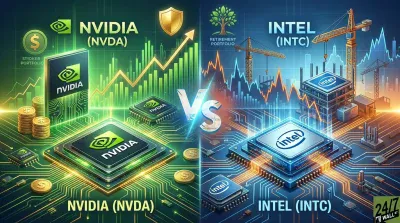
Retirement investors hunting AI chip exposure face a simple binary: NVIDIA (NASDAQ:NVDA | NVDA Price Prediction) or Intel (NASDAQ:INTC). Both sit at the center of the AI buildout, both trade on the NASDAQ, and both have climbed in 2026.
But for a portfolio funding withdrawals, only one of these is a stock. The other is a bet. Here is the head-to-head comparison across the three dimensions that actually matter for a retirement book: income, growth trajectory, and risk-adjusted valuation.
Dimension 1: Yield and Capital Return
Retirement portfolios live on cash returned, not promises. NVIDIA in May 2026 raised its quarterly dividend from $0.01 to $0.25 per share and authorized an additional $80.0 billion in share repurchases. In Q1 FY2027 alone, Jensen Huang’s team returned roughly $20.0 billion to shareholders through buybacks and dividends. The yield is small, but the capital-return engine is enormous and growing.
Intel, by contrast, last paid a $0.125 quarterly dividend with an ex-date of August 7, 2024, after slashing the payout from $0.365 in 2023. Alpha Vantage now reports no dividend per share and no dividend yield for INTC. There are no active buybacks either. For a retiree, Intel returns zero cash today.
Winner: NVDA, decisively.
Dimension 2: Growth Trajectory
NVIDIA’s Q1 FY2027 earnings report is the cleanest growth story in mega-cap tech. Revenue hit $81.61 billion, up 85% year over year, with Data Center revenue at $75.2 billion, up 92%. Net income climbed 211% to $58.32 billion, and management guided Q2 to $91.0 billion. Full-year FY2026 revenue landed at $215.9 billion, up 65%, with free cash flow of $96.58 billion. Huang framed it bluntly: “The buildout of AI factories, the largest infrastructure expansion in human history, is accelerating at extraordinary speed.”
Intel’s Q1 2026 looked respectable on the surface: revenue of $13.6 billion, up 7%, with the Data Center and AI segment up 22% to $5.1 billion. But the company posted a GAAP loss of $3.7 billion, the foundry generated a $2.4 billion operating loss, and free cash flow ran negative $3.87 billion. One business is compounding earnings; the other is compounding losses while trying to rebuild.
Winner: NVDA, decisively.
Dimension 3: Valuation Versus Risk
This is where the turnaround crowd argues Intel deserves a look. The trouble is that the recovery is already in the stock. INTC is up 459% over the past year and 196% year to date through June 1, 2026. The stock now carries a forward P/E of 143 and, per the brief, trades at over 70x annualized Q1 adjusted earnings. That is a hypergrowth multiple on a company still printing GAAP losses.
NVIDIA trades at a trailing P/E of 34, a forward P/E of 26, and a PEG of 0.691 on a 63% net profit margin. The stock is up 66% over the past year, less than one-sixth of Intel’s run, despite far better fundamentals. Analyst consensus targets $296.81 for NVDA versus $87.76 for INTC, which sits below INTC’s current quote of $108.15.
Winner: NVDA on risk-adjusted valuation.
The Verdict
NVIDIA wins this matchup outright for retirement investors. You get the dominant AI franchise, 63% profit margins, nearly $100 billion in annual free cash flow, a growing dividend, and an $80 billion buyback, at a forward multiple cheaper than Intel’s. Analysts back it with 10 Strong Buys and 48 Buys against a single Sell.
Intel belongs in a different bucket entirely. Lip-Bu Tan’s turnaround is real, the NVIDIA $5.0 billion equity investment validates the foundry strategy, and the Xeon win inside NVIDIA’s DGX Rubin NVL8 systems is meaningful. But a stock with no dividend, negative free cash flow, GAAP losses, and a triple-digit forward P/E is a speculative recovery play. Retirees who want a swing at the U.S. semiconductor renaissance can carve out a small satellite position in INTC. The core AI chip allocation in a retirement portfolio belongs in NVDA.
Contact [email protected] for any questions or corrections.
Joel South covers large-cap stocks, dividend investing, and major market trends, with a focus on earnings analysis, valuation, and turning complex data into actionable insights for investors.
He brings more than 15 years of experience as an investor and financial journalist, including 12 years at The Motley Fool, where he served as an investment analyst, Bureau Chief, and later led the Fool.com investing news desk. He has also co-hosted an investing podcast and appeared across TV and radio discussing market trends.