Vanguard vs. Fidelity: Which Is the Better High-Yield ETF to Buy Now?
Buying Income and Price Appreciation Dividend investing can be a powerful strategy for building wealth and generating passive income, offering investors a steady cash flow while potentially cushioning portfolios against market volatility. High-yield ETFs, in particular, appeal to those seeking…


Buying Income and Price Appreciation
Dividend investing can be a powerful strategy for building wealth and generating passive income, offering investors a steady cash flow while potentially cushioning portfolios against market volatility.
High-yield ETFs, in particular, appeal to those seeking income in low-interest-rate environments or aiming to supplement retirement funds. However, chasing yield can be risky — high yields often signal exposure to financially unstable companies or sectors vulnerable to economic shifts.
With numerous high-yield dividend ETFs on the market, many fall short due to high fees, poor diversification, or unsustainable payouts. Investors must tread carefully, prioritizing funds with strong fundamentals and cost efficiency.
Two ETFs stand out as reliable options for income-focused investors: the Vanguard High Dividend Yield ETF (NYSEARCA:VYM) and the Fidelity High Dividend ETF (NYSEARCA:FDVV). Both offer compelling features, but which is the better buy in 2025? Let’s explore the strengths of each to determine the winner.
The Case for Vanguard High Dividend Yield ETF (VYM)
Launched in 2006, Vanguard High Dividend Yield ETF tracks the FTSE High Dividend Yield Index, which includes U.S. companies with above-average dividend yields, excluding real estate investment trusts (REITs).
With 557 holdings as of early 2025, VYM offers broad diversification across sectors like financials (21.5%), industrials (13.4%), and technology (12.3%), reducing concentration risk. Its top holdings, including stalwarts like JPMorgan Chase (NYSE:JPM | JPM Price Prediction), ExxonMobil (NYSE:XOM), and Procter & Gamble (NYSE:PG), are known for stable dividends and financial resilience. VYM’s yield of approximately 2.6% is competitive, providing a solid income stream without excessive risk.
VYM’s standout feature is its rock-bottom expense ratio of 0.06%, among the lowest in its category, ensuring investors keep more of their returns. The ETF’s focus on companies with sustainable dividends minimizes the risk of cuts, appealing to conservative investors.
Over the past five years, VYM has delivered an annualized return of about 14%, balancing income and modest capital appreciation. Its low turnover (around 10% annually) further enhances tax efficiency, making it ideal for long-term holders.
For investors prioritizing stability, low costs, and broad exposure, VYM is a compelling choice that aligns with a disciplined, income-focused strategy.
The Case for Fidelity High Dividend ETF (FDVV)
The Fidelity High Dividend ETF, launched in 2016, takes a different approach by tracking the Fidelity High Dividend Index and offering a narrower range of investments. With 134 holdings, it’s less diversified than VYM but focuses on companies with high dividend yields and growth potential, including REITs and tech giants like Nvidia (NASDAQ:NVDA), Apple (NASDAQ:AAPL), and Microsoft (NASDAQ:MSFT).
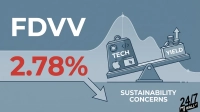
FDVV’s sector allocation leans heavily toward technology (25.5%) and financials (21.7%), offering exposure to growth-oriented dividend payers. Its yield of 3% is higher than VYM’s, making it attractive for investors seeking maximum income.
FDVV’s expense ratio of 0.16% is higher than VYM’s but remains competitive among actively managed ETFs. The fund’s active strategy allows flexibility to capitalize on market opportunities, potentially boosting returns in favorable conditions.
Over the past five years, FDVV has achieved an annualized return of approximately 18.1%, outperforming VYM, though with higher volatility due to its tech-heavy tilt. For investors comfortable with moderate risk and seeking higher yield with growth potential, FDVV offers a dynamic alternative that balances income and capital appreciation.
The Verdict
Both VYM and FDVV are strong additions to an income-focused portfolio, offering low costs, solid yields, and thoughtful diversification. However, VYM emerges as the better buy in 2025. Its ultra-low expense ratio of 0.06% — compared to FDVV’s 0.16% — provides a significant advantage for long-term investors, preserving returns over time.
VYM’s 582 holdings offer broader diversification, reducing risk compared to FDVV’s 134 holdings and tech-heavy focus. While FDVV’s 3% yield and narrow focus appeal to those chasing higher income and growth, its increased volatility and smaller portfolio also make it less suitable for risk-averse investors.
VYM’s emphasis on stable, high-yield companies and its tax-efficient, low-turnover approach make it the superior choice for most investors seeking reliable income and long-term stability.
Contact [email protected] for any questions or corrections.
After two decades of patrolling the dark corners of suburbia as a police officer, Rich Duprey hung up his badge and gun to begin writing full time about stocks and investing. For the past 20 years, he’s been cruising the markets looking for companies to lock up as long-term holdings in a portfolio while writing extensively on the broad sectors of consumer goods, technology, and industrials. Because his experience isn’t from the typical financial analyst track, Rich is able to break down complex topics into understandable and useful action points for the average investor. His writings have appeared on The Motley Fool, InvestorPlace, Yahoo! Finance, Money Morning, and, of course, 24/7 Wall St. He has been featured in both U.S. and international publications, including MarketWatch, Financial Times, Forbes, Fast Company, and USA Today.