Vanguard’s Forgotten ETF Yields 3.5% and Could Pop in 2026 as the Fed Lowers Rates | VNQ
The Vanguard Real Estate Index Fund ETF Shares (NYSEARCA:VNQ) has struggled badly. Over the past five years, the fund gained just 2.6% while the S&P 500 surged 85%, a gap wide enough to make investors question whether real estate deserves…


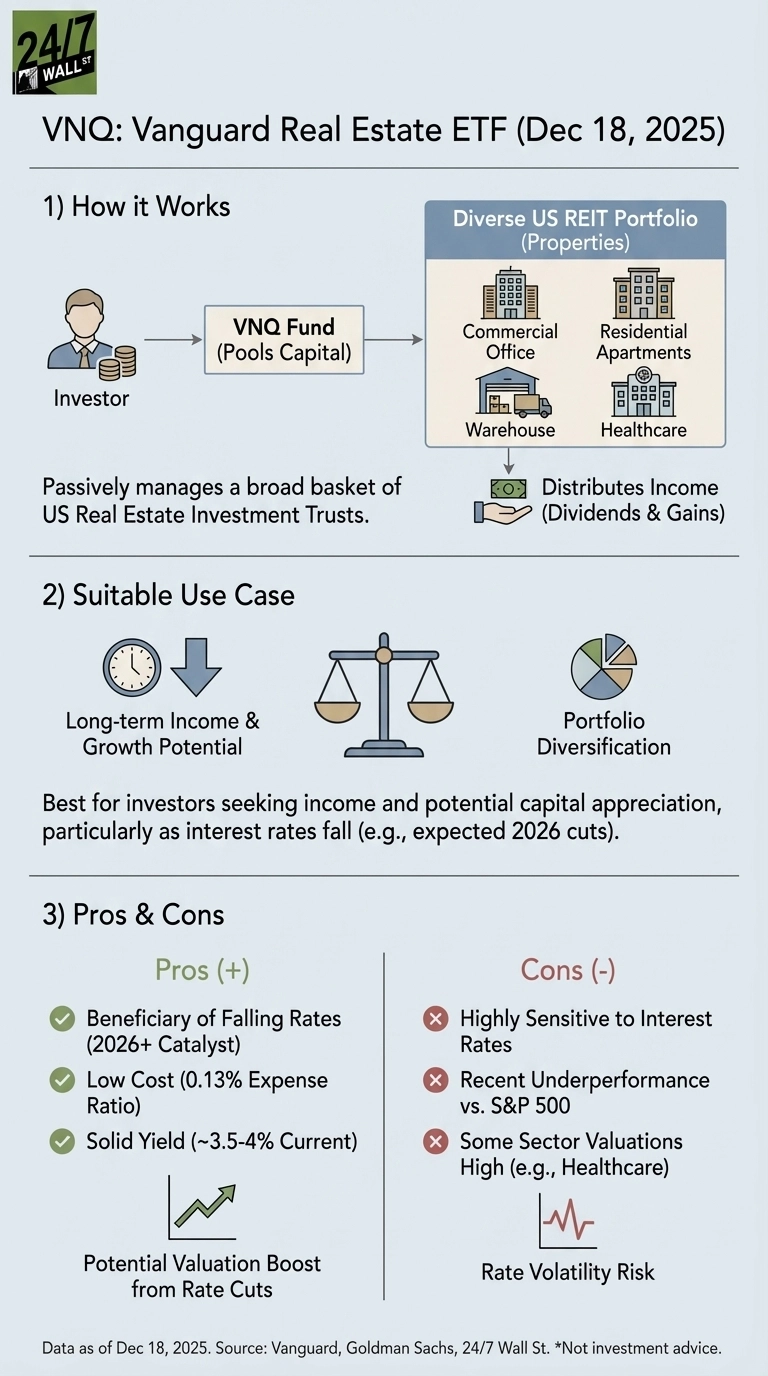
The Vanguard Real Estate Index Fund ETF Shares (NYSEARCA:VNQ) has struggled badly. Over the past five years, the fund gained just 2.6% while the S&P 500 surged 85%, a gap wide enough to make investors question whether real estate deserves a place in their portfolios. The culprit: the Federal Reserve’s aggressive rate hiking campaign beginning in March 2022 sent REITs into a prolonged downturn. Higher borrowing costs squeezed property valuations, compressed cap rates, and made Treasury bonds suddenly competitive with REIT yields. But that cycle appears to be reversing.
The Fed cut rates in December 2025 and Goldman Sachs Research expects two more cuts in 2026, bringing the fed funds rate down to 3% to 3.25% from the current 3.75% to 4%. That matters enormously for real estate. Lower rates make debt cheaper, which is the lifeblood of property acquisitions and development. They push down Treasury yields, making VNQ’s nearly 4% dividend yield more attractive on a relative basis. And they reduce the cap rates at which properties trade, boosting valuations across the sector. For an asset class starved of liquidity and investor interest, falling rates are exactly what’s needed.
What Could Propel VNQ Higher in 2026
The primary macro force to watch is the pace and trajectory of Fed easing. Markets are pricing in a gradual descent toward 3%, but any acceleration would be rocket fuel for REITs. Conversely, if inflation proves stickier than expected or the labor market stays resilient enough to pause cuts, VNQ could stall. Investors should monitor the monthly Consumer Price Index and Personal Consumption Expenditures reports, both released mid-month by the Bureau of Labor Statistics and Bureau of Economic Analysis. Each Fed meeting brings updated dot plot projections, and those quarterly signals will dictate whether 2026 delivers the rate relief that real estate needs.
The Fund’s Internal Dynamics Matter Too
VNQ’s $65 billion in assets and 0.13% expense ratio make it one of the most liquid and cost-effective ways to access broad REIT exposure. But not all REITs are created equal, and the fund’s sector tilt matters. Healthcare REITs like Welltower (NYSE:WELL | WELL Price Prediction), the fund’s second-largest holding at 6.8%, trade at sky-high valuations, with Welltower carrying a price-to-earnings ratio of 130x. Industrial logistics plays like Prologis (NYSE:PLD) offer more reasonable multiples near 37x earnings and direct exposure to e-commerce tailwinds. Investors should review VNQ’s quarterly holdings updates on Vanguard’s site to track any meaningful shifts in sector allocation, particularly if the fund rotates toward higher-yielding or more cyclical property types as the rate environment improves.
Consider This Alternative
For investors seeking similar exposure with a focus on monthly income, the Schwab U.S. REIT ETF (NYSEARCA:SCHH) offers a comparable portfolio at an even lower 0.07% expense ratio and distributes dividends monthly rather than quarterly, smoothing cash flow for income-focused portfolios.
The most important variable for VNQ in 2026 is whether the Fed delivers on expected rate cuts, and the key internal factor is how the fund’s sector composition positions it to capture the recovery in property valuations.
Contact [email protected] for any questions or corrections.
I am a long time investor and student of business, and believe finding good companies that can become great investments is the best game on earth. After 20 years of writing and researching the public markets it is clear that individuals have never had more tools and information to take control of their financial lives. From ETFs and $0 commissions to cryptos and prediction markets there has never been a greater democratization of access to investing.
I write to help people understand the investments available to them so they can make the best choice for their portfolio, whether they're starting out or looking for income in retirement.