Can the R2 Really Save Rivian Automotive?
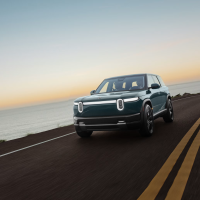
Rivian Automotive (NASDAQ:RIVN | RIVN Price Prediction) is betting its future on the R2, a midsize electric SUV scheduled to enter production in the first half of 2026. Priced at approximately $45,000 before any incentives, the R2 is designed to…


Rivian Automotive (NASDAQ:RIVN | RIVN Price Prediction) is betting its future on the R2, a midsize electric SUV scheduled to enter production in the first half of 2026. Priced at approximately $45,000 before any incentives, the R2 is designed to reach a much broader audience than Rivian’s current premium R1 lineup, which starts above $70,000.
The EV maker hopes the more affordable model will drive significantly higher volumes, improve gross margins, and finally put Rivian on a path to profitability. Rivian’s stock has surged over 52% in a single month, fueled primarily by analyst upgrades that highlight the R2’s launch timeline and Rivian’s new in-house artificial intelligence (AI) chip for autonomous driving. But can this one model truly rescue Rivian from its ongoing financial and operational challenges?
EV Market Hits a Wall
The electric vehicle market in 2025 has entered a difficult phase. U.S. battery-electric vehicle (BEV) sales are projected to decline year-over-year for the first time since 2019. Cox Automotive forecasts total BEV sales will fall roughly 2.1% to about 1.275 million units, reflecting declining buyer enthusiasm for pure EVs. High upfront costs, persistent range anxiety, and limited public charging infrastructure continue to deter many potential buyers.
Meanwhile, demand for hybrid and plug-in hybrid vehicles has surged. Ford Motor (NYSE:F) has dramatically scaled back its BEV ambitions, redirecting resources toward hybrids and announcing plans to convert its next-generation F-150 Lightning into a plug-in hybrid. Even Tesla (NASDAQ:TSLA) has acknowledged a challenging near-term environment for EV sales, with U.S. deliveries declining significantly in the second half of 2025.
Rivian’s Recent Surge Was Temporary
Rivian reported a strong third quarter in 2025, delivering 13,201 vehicles and boosting revenue 78% year-over-year. However, much of that strength stemmed from buyers rushing to take delivery before the $7,500 federal EV tax credit expired on Sept. 30. After the credit ended, demand softened noticeably, prompting Rivian to lower its full-year delivery guidance to between 41,500 and 43,500 vehicles.
Wall Street expects growth to remain muted in 2026 without federal incentives, though Rivian anticipates the R2 will help accelerate sales starting in the second half of the year and analysts are on board with the improved outlook.
Baird analyst Ben Kallo raised his price target on Rivian stock from $14 to $25 per share, citing the R2’s upcoming introduction, with Wedbush Securities‘ Dan Ives saying the new EV could help Rivian hit $25, just as the AI chip and a push to autonomous vehicles give it new revenue streams..
Big Differences, Bigger Risks
The R2 represents a significant departure from the R1T pickup and R1S three-row SUV. Those models prioritize extreme off-road capability, large size, and premium features, appealing primarily to adventure-focused buyers willing to pay a high price.
The R2, by contrast, is a compact midsize SUV — roughly 15 to 20 inches shorter overall — with a more on-road-oriented design. It is expected to offer more than 300 miles of range, single-, dual-, and tri-motor powertrain options, and NACS charging compatibility. Rivian believes many consumers will accept the trade-offs — smaller size, reduced towing capacity, and less extreme off-road prowess — in exchange for a lower price and improved efficiency.
However, the R2 enters a highly competitive segment dominated by the Tesla Model Y, Hyundai Ioniq 5, Kia EV6, and upcoming affordable options from legacy automakers.
Key Takeaway
While the R2 could expand Rivian’s addressable market, it is unlikely to be the silver bullet the company needs. Rivian continues to burn cash at a rapid pace, projecting adjusted EBITDA losses of $2 billion to $2.25 billion for 2025. Analysts do not expect profitability until at least 2032, and the company’s valuation remains elevated relative to its current revenue and production scale.
The new Rivian Autonomy Processor chip is promising, but it enters a crowded field with established competitors like Tesla, Waymo, and Mobileye Global (NASDAQ:MBLY) already far ahead in real-world autonomous driving data and deployment. Nvidia (NASDAQ:NVDA) and other AI chipmakers also have their eye on the EV and autonomous vehicle market. With more street credibility than Rivian, these companies could make it difficult for the EV maker’s chip to gain traction.
The recent stock rally appears driven more by optimism and speculative momentum than by near-term fundamentals. Without a meaningful recovery in broader EV demand, significant cost reductions, and a clear path to sustained profitability, the R2 alone is unlikely to transform Rivian’s trajectory. The current valuation may already reflect the best-case scenario, and investors should not chase Rivian’s stock higher.
Contact [email protected] for any questions or corrections.
After two decades of patrolling the dark corners of suburbia as a police officer, Rich Duprey hung up his badge and gun to begin writing full time about stocks and investing. For the past 20 years, he’s been cruising the markets looking for companies to lock up as long-term holdings in a portfolio while writing extensively on the broad sectors of consumer goods, technology, and industrials. Because his experience isn’t from the typical financial analyst track, Rich is able to break down complex topics into understandable and useful action points for the average investor. His writings have appeared on The Motley Fool, InvestorPlace, Yahoo! Finance, Money Morning, and, of course, 24/7 Wall St. He has been featured in both U.S. and international publications, including MarketWatch, Financial Times, Forbes, Fast Company, and USA Today.