Dave Ramsey Says 35% of Americans Will ‘Learn the Hard Way’ About Social Security
Dave Ramsey warns that 35% of today's workers expect Social Security to be a major source of retirement income, a reliance he says will "hurt them when they retire." With the program replacing only about 40% of pre-retirement wages and…

This post may contain links from our sponsors and affiliates, and Flywheel Publishing may receive compensation for actions taken through them.
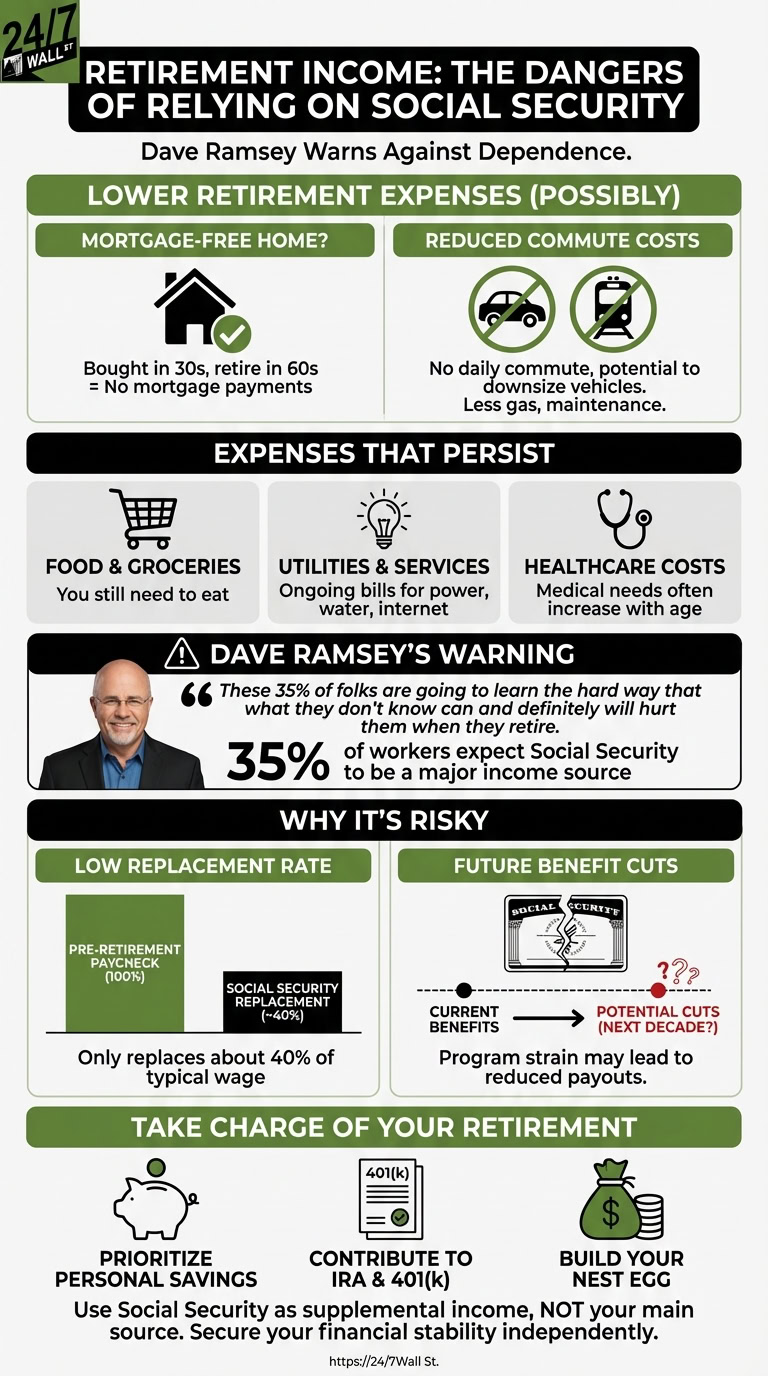
When you retire, you may find that you need less income than during your working years. Several expenses tend to shrink in retirement, and in some cases they disappear entirely.
If you bought your home in your 30s and retire in your 60s, the mortgage may already be paid off. That alone can free up hundreds of dollars a month in your budget. Commuting costs vanish too, and many retired couples find they can get by with one vehicle instead of two, trimming both insurance and maintenance bills.
Still, there is only so much of a pay cut any household can absorb. Food, utility bills, and healthcare costs do not shrink just because you stopped working, and healthcare in particular tends to grow as you age. That reality is precisely why treating Social Security as the primary pillar of your retirement income is a risky strategy.
Dave Ramsey cautions on Social Security dependence
Dave Ramsey has built his reputation on helping people avoid financial mistakes that could devastate them later in life. One warning he returns to often involves Social Security, and it starts with a striking piece of survey data.
Ramsey cited a survey by the Employee Benefit Research Institute (EBRI) showing that 35% of today’s workers expect Social Security to be a major source of retirement income. That same EBRI data found that 62% of current retirees already report Social Security as a “major source of income,” a figure Ramsey points to as a cautionary example. In his view, the 35% of working Americans heading down the same path are in for a rude awakening: “These 35% of folks are going to learn the hard way that what they don’t know can and definitely will hurt them when they retire.”
His concern rests on two concrete problems. First, Social Security is designed to replace only about 40% of pre-retirement income for a worker earning a typical wage. Even if your bills shrink in retirement, they are unlikely to shrink by 60%, which means a meaningful income gap remains for anyone relying primarily on their benefits check. The average monthly Social Security retirement benefit runs roughly $2,084, according to the Social Security Administration, which covers everyday expenses for many retirees but leaves little margin for error.
Second, the program’s finances are under mounting pressure. According to the Social Security Administration’s 2026 Trustees Report, released in June 2026, the Old-Age and Survivors Insurance (OASI) Trust Fund is now projected to be depleted in the fourth quarter of 2032. That is just six years away, and a year sooner than the prior estimate. If Congress takes no action before that date, the SSA would be able to pay only 78% of scheduled benefits, an automatic cut of 22%. The One Big Beautiful Bill Act, signed into law on July 4, 2025, partially contributed to that earlier depletion date by reducing the income-tax revenue that flows into the trust fund, even as it delivered a temporary $6,000 senior deduction for taxpayers age 65 and older.
Together, the low wage-replacement rate and the looming funding shortfall make Ramsey’s warning hard to dismiss.
Take charge of your own retirement
None of this means Social Security should be written off entirely. Benefits are still payable even after trust fund depletion, and lawmakers have a long record of acting before automatic cuts take effect. The prudent move is to treat Social Security as one layer of a broader income plan rather than the foundation of it.
Ramsey’s own prescription is straightforward: save at least 15% of household income throughout your working years, funnel those savings into tax-advantaged accounts such as a 401(k) or IRA, and build a nest egg large enough that your benefit check becomes supplemental income rather than the primary paycheck you depend on. As Ramsey has put it, “Your financial security in retirement shouldn’t come from Social Security. You are the CEO of your retirement.”
The math behind that approach is compelling. A worker earning $80,000 annually who invests $1,000 per month in diversified growth funds could accumulate more than $1.5 million by age 65, according to projections from Ramsey Solutions. Social Security benefits on top of that balance become a meaningful bonus rather than a lifeline, which is exactly the position Ramsey argues every worker should aim for.
Editor’s note: This article has been updated to reflect the Social Security Administration’s 2026 Trustees Report, which moved the OASI Trust Fund depletion date to Q4 2032 (six years away, sooner than the prior estimate of 2033), revised the projected automatic benefit cut to 22%, added EBRI data showing 62% of current retirees already treat Social Security as a major income source, and incorporated context on the One Big Beautiful Bill Act’s temporary senior deduction and its effect on trust fund revenues.
Contact [email protected] for any questions or corrections.
Maurie Backman has more than a decade of experience writing about financial topics, including retirement, investing, Social Security, and real estate. Her work has appeared on sites that include The Motley Fool, USA Today, U.S. News & World Report, and Kiplinger.
Prior to becoming a full-time financial writer, Maurie worked in the financial industry trading distressed debt. She then changed course and spent a few years designing electronic toys. After a stint in content marketing and UX, she shifted back into writing and has since covered everything from the housing market to estate planning to Medicare.
When she's not busy writing, Maurie can be found hiking, walking her dogs, driving her kids to their various sports practices and games, and curling up with a good book. She cooks on occasion and bakes way too often.