Is Invesco’s China Technology ETF Still A Buy After Trouncing The S&P 500 With 35% Run?
China tech stocks spent much of 2024 and early 2025 under regulatory anxiety, trade tensions, and economic slowdown fears. Yet the Invesco China Technology ETF (NYSEARCA:CQQQ) has attracted investor attention despite ongoing volatility. The question now is whether CQQQ still…


China tech stocks spent much of 2024 and early 2025 under regulatory anxiety, trade tensions, and economic slowdown fears. Yet the Invesco China Technology ETF (NYSEARCA:CQQQ) has attracted investor attention despite ongoing volatility. The question now is whether CQQQ still serves a purpose in portfolios given its structural risks and opportunities.
A Tactical Play on Valuation Dislocation
CQQQ’s best portfolio role is as a tactical allocation for investors seeking undervalued tech exposure with meaningful geopolitical risk. The ETF tracks 163 Chinese technology companies across internet platforms, semiconductors, AI infrastructure, and consumer tech. Top holdings include Tencent, PDD Holdings, Meituan, and Baidu, companies trading at valuations that appear discounted compared to U.S. market peers. These companies generate substantial cash flow and operate at scale, but trade at discounts reflecting regulatory overhang, delisting fears, and capital flight concerns.
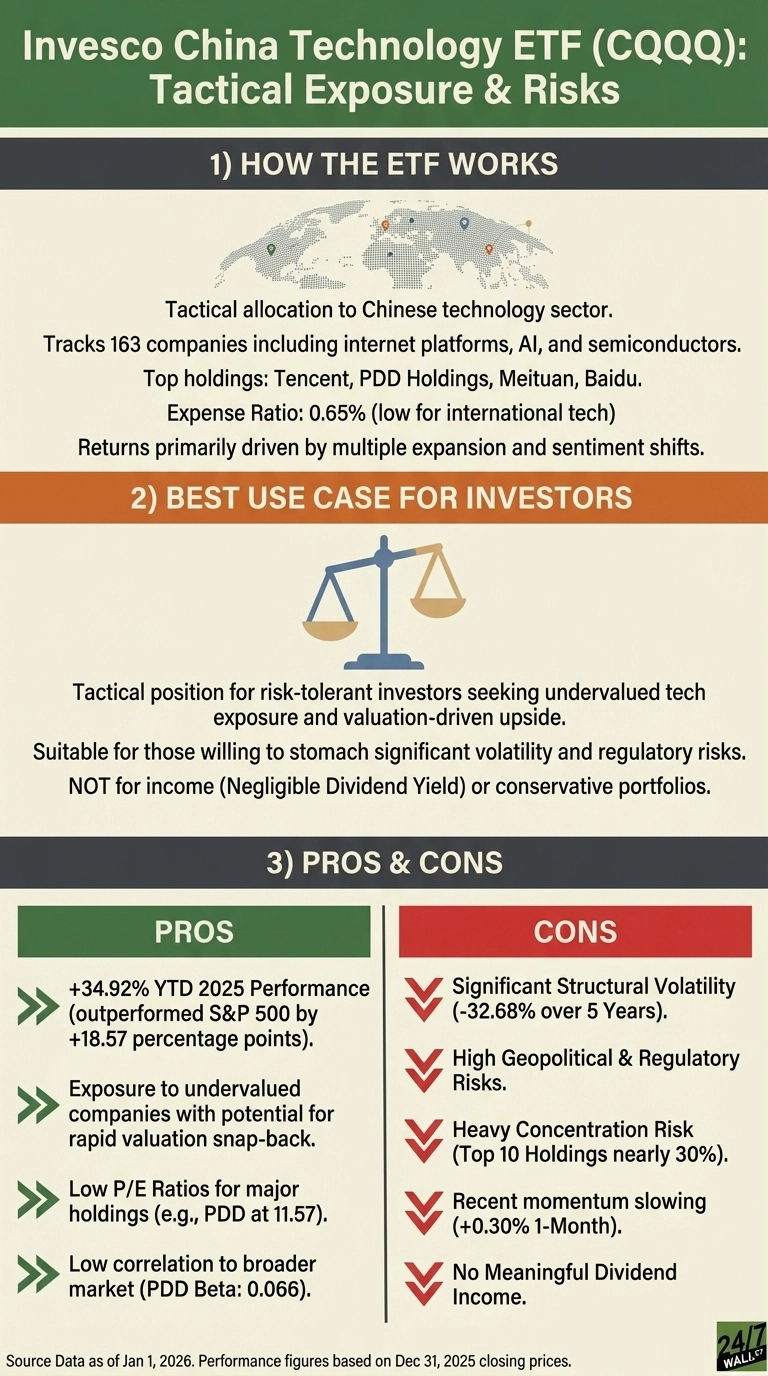
The return engine here is multiple expansion driven by sentiment shifts rather than explosive earnings growth. When regulatory and geopolitical anxieties ease, valuations can snap back quickly. The 0.65% expense ratio keeps costs reasonable for international exposure.
Performance Comes With Structural Volatility
CQQQ has experienced significant volatility over its history, with performance heavily influenced by factors beyond company fundamentals. The ETF remains well below its 2021 peak. This volatility stems from regulatory unpredictability, variable enforcement of data security laws, and ever-present U.S. delisting threats. Holdings are primarily Hong Kong-listed or ADRs, adding currency and jurisdictional complexity.
Geopolitical headlines can erase months of gains in days, regardless of underlying business quality. The ETF’s performance trajectory reflects the broader challenges facing Chinese technology investments in international portfolios.
Who Should Avoid This ETF
Income-focused investors should look elsewhere. CQQQ’s dividend yield is negligible, with annual distributions around $0.11 per share. This is a pure capital appreciation bet. Conservative investors or those nearing retirement should avoid CQQQ. The combination of geopolitical risk, regulatory uncertainty, and historical drawdowns makes it unsuitable for portfolios that cannot withstand 30% to 50% declines.
Consider KWEB for Concentrated Internet Exposure
The KraneShares CSI China Internet ETF (NYSEARCA:KWEB) offers a similar but more focused alternative. KWEB concentrates heavily on internet and software companies, with Alibaba representing nearly 10% of the portfolio compared to CQQQ’s broader tech sector diversification. The tradeoff is a slightly higher 0.70% expense ratio and greater single-stock concentration risk. For investors who believe China’s internet platforms will lead any sustained rally, KWEB provides cleaner exposure to that thesis.
CQQQ works as a small, tactical position for risk-tolerant investors willing to stomach volatility in exchange for valuation-driven upside, but the geopolitical discount may never fully close.
Contact [email protected] for any questions or corrections.
I am a long time investor and student of business, and believe finding good companies that can become great investments is the best game on earth. After 20 years of writing and researching the public markets it is clear that individuals have never had more tools and information to take control of their financial lives. From ETFs and $0 commissions to cryptos and prediction markets there has never been a greater democratization of access to investing.
I write to help people understand the investments available to them so they can make the best choice for their portfolio, whether they're starting out or looking for income in retirement.