That $85,000 Retirement Only Looks Comfortable Until You Hit Year 20
An $85,000 annual retirement income sits just barely above the U.S. median household income of $83,730, and whether it provides genuine security or hidden risk depends on where the money comes from and how long it needs to last. On…

This post may contain links from our sponsors and affiliates, and Flywheel Publishing may receive compensation for actions taken through them.

An $85,000 annual retirement income sits just barely above the median U.S. household income of $83,730, according to the Census Bureau’s most recent Current Population Survey data. It can cover most middle-class expenses comfortably, but whether it provides genuine long-term security or quietly erodes over time depends entirely on where the money comes from and how many years it must last.
On Reddit’s r/FinancialPlanning forum, one user asked how much they’d need saved to live on $80,000 annually, with responses emphasizing “you need $2,000,000 today for $80,000 a year to last at least 30 years, including increases for inflation.” The core tension is identical for anyone targeting $85,000: can a portfolio sustain annual withdrawals while keeping pace with inflation across a 25- to 30-year horizon?
Key Scenario Details
- Annual Income Target: $85,000
- Primary Challenge: Balancing sustainable withdrawals with inflation protection
- Time Horizon: 25-30+ years in retirement
- Critical Factor: Asset allocation between growth and income investments
The Real Financial Tension: Growth vs. Safety
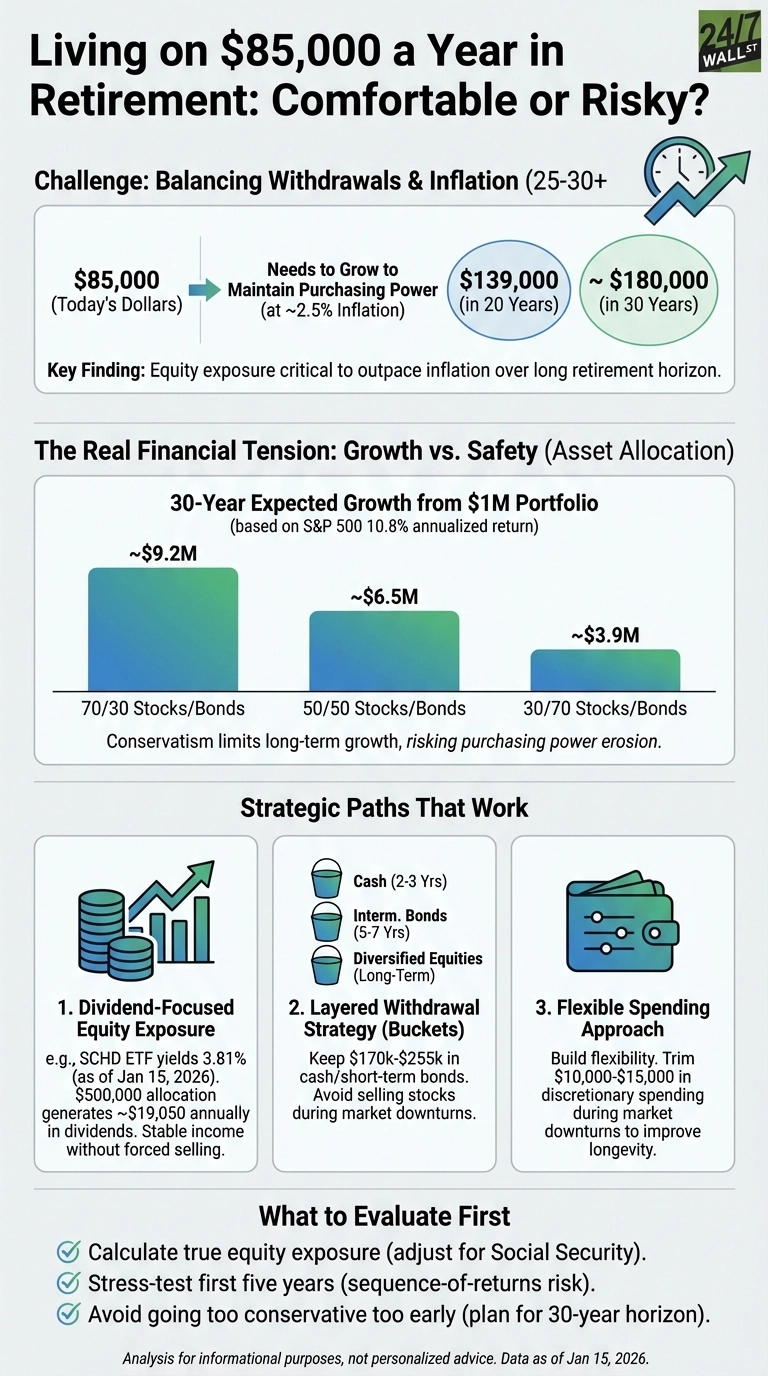
The central risk for a retiree targeting $85,000 a year is whether that purchasing power can survive decades of compounding inflation. At 2.5% annual inflation, $85,000 in today’s dollars must grow to roughly $139,000 within 20 years and to approximately $180,000 within 30 years just to preserve the same standard of living. Equity exposure is the primary tool available to close that gap, and retirees who underweight stocks often discover the problem far too late to correct it.
Using the traditional 4% withdrawal guideline, a retiree needs roughly $2.1 million invested to generate $85,000 annually. Morningstar’s 2026 research places the safe withdrawal rate at 3.9% for portfolios holding 30% to 50% in equities, up from 3.7% in its prior-year report, which pushes the required starting portfolio somewhat higher. One counterintuitive finding from the same research: portfolios above 50% in equities did not produce the highest safe withdrawal rates, because greater volatility amplifies sequence-of-returns risk early in retirement. Retirees willing to flex their spending alongside market conditions can start withdrawing at up to 5.7%. Portfolio composition matters as much as the headline withdrawal rate.
The S&P 500 has delivered an approximately 11% annualized total return over the past 20 years. Applying that history, a $1 million portfolio split 30/70 between stocks and bonds would grow to approximately $3.9 million over 30 years, while a 70/30 allocation would reach roughly $9.2 million. That gap in ending values determines whether a retiree’s income grows with inflation or gets quietly eroded by it. Retirees who lean too heavily on fixed-income investments often find themselves cutting spending in their 70s and 80s, precisely when healthcare costs accelerate most sharply.
Strategic Paths That Work
Dividend-Focused Equity Exposure
Schwab U.S. Dividend Equity ETF (NYSEARCA:SCHD) offers one practical way to build income without sacrificing growth. The fund currently yields approximately 3.2%, reflecting its focus on financially strong companies with consistent dividend histories. A $500,000 allocation at that yield would generate roughly $16,000 annually in dividends while retaining meaningful upside, providing income without forcing asset sales during market downturns. The fund has grown its dividend at roughly 9% annually over the past five years, which means the income stream can compound over time without requiring additional capital.
Layered Withdrawal Strategy
A bucket approach segments the portfolio by time horizon rather than treating it as a single pool. Two to three years of living expenses sit in cash or short-term bonds, roughly $170,000 to $255,000 at an $85,000 annual spend. A second bucket covering the following five to seven years holds intermediate bonds. The remainder goes into diversified equities. This structure allows equity positions to remain untouched during bear markets, letting growth assets recover fully while near-term spending draws from the stable buckets. The market volatility of 2025 and 2026 has reinforced just how valuable that insulation can be for retirees who launched their drawdown without it.
Flexible Spending Approach
Building a spending cushion into the $85,000 target adds substantial protection. Identifying $10,000 to $15,000 in discretionary expenses that could be trimmed during market downturns, categories like travel, dining, and subscriptions, significantly extends portfolio longevity. Variable withdrawal strategies consistently outperform rigid fixed-dollar approaches in long-run simulations. Morningstar’s research supports a starting rate of up to 5.7% for retirees who commit to adjusting spending alongside portfolio performance, compared to just 3.9% for those locked into fixed withdrawals. The gap between those two rates represents years of additional financial runway.
What to Evaluate First
Calculate your true equity exposure. Social Security provides an average retired worker approximately $2,088 per month as of August 2026, roughly $25,000 a year, according to the Social Security Administration’s Monthly Statistical Snapshot. Higher earners who delay claiming can receive substantially more, so the actual investment gap varies widely by individual. If Social Security and any pension together cover $30,000 to $40,000 annually, a retiree only needs to generate $45,000 to $55,000 from investments. That narrower gap changes the required portfolio size considerably and may allow for somewhat more conservative positioning without sacrificing long-term security.
Stress-test the first five years. Sequence-of-returns risk is most acute at the start of retirement. Withdrawing $85,000 annually while a portfolio drops 20% compresses the recovery runway sharply. Each share sold at depressed prices cannot participate in the eventual rebound, which is exactly why a cash cushion covering two to three years of expenses is so valuable at the outset. The market swings of 2025 and early 2026 have made this dynamic vivid for anyone who retired recently without that buffer in place.
Avoid going too conservative too early. A 65-year-old retiree may well live to 90 or beyond, meaning the investment horizon can span three full decades. Treating a 30-year retirement like a short-term bond portfolio almost guarantees purchasing power erosion over time. Compounding works in a retiree’s favor only when enough of the portfolio remains in growth assets long enough to accumulate meaningfully. The practical goal is a structure that funds near-term needs from stable sources while letting equities do the heavy lifting over the long run.
This analysis is meant to be helpful but does not constitute personalized advice. Every individual situation requires its own evaluation.
Editor’s note: The SCHD dividend yield has been updated to approximately 3.2% based on data through late September 2026, which raises the estimated annual dividend income on a $500,000 allocation from $15,000 to roughly $16,000. The Social Security average monthly benefit for retired workers has been updated to approximately $2,088 per the SSA’s August 2026 Monthly Statistical Snapshot, up from the July 2026 figure of $2,086 cited in the previous version.
Contact [email protected] for any questions or corrections.
I am a long time investor and student of business, and believe finding good companies that can become great investments is the best game on earth. After 20 years of writing and researching the public markets it is clear that individuals have never had more tools and information to take control of their financial lives. From ETFs and $0 commissions to cryptos and prediction markets there has never been a greater democratization of access to investing.
I write to help people understand the investments available to them so they can make the best choice for their portfolio, whether they're starting out or looking for income in retirement.