For a $1.8M Retiree, Timing Matters More Than Total Savings
A 62-year-old retiree with $1.8 million faces a reality few anticipate: when they stop working matters as much as how much they have saved. This is about sequence-of-returns risk, where early retirement losses can permanently damage portfolio sustainability, even if…


A 62-year-old retiree with $1.8 million faces a reality few anticipate: when they stop working matters as much as how much they have saved. The culprit is sequence-of-returns risk, where early retirement losses can permanently impair portfolio sustainability even when markets eventually recover.
One Reddit user in the r/Fire community, planning to retire in 2026 at 55, captured this tension directly, noting they were not particularly worried about what the community calls SORR. Their solution was to build spending flexibility into their budget rather than try to time the market.
| Scenario Element | Details |
|---|---|
| Portfolio Value | $1.8 million |
| Retirement Age | 62 years old |
| Key Risk | Sequence-of-returns impact on withdrawal sustainability |
| Current Market | SPY near $762 (mid-September 2026, off the August 2026 all-time closing high of $778) |
The Math That Reveals the Danger
The SPDR S&P 500 ETF Trust (NYSEARCA:SPY) hit a 52-week low of $629.28 in 2025, then climbed to a 52-week intraday high of $779.37 and an all-time closing high of $777.88 on August 13, 2026, before settling near $762 in mid-September 2026. That recovery of roughly 21% from the 52-week low illustrates the upside a patient investor captured. For a retiree who started drawing down at last year’s low, however, the picture looks very different from one who retired near the summer 2026 peak.
For a $1.8 million portfolio, this timing gap creates substantial structural variance from day one. Someone forced into withdrawals near the 2025 lows would have begun with a meaningfully smaller asset base, while a retiree entering near the August high now faces a steeper cliff if a correction arrives quickly. The S&P 500 delivered 17.9% in total return for full-year 2025, so anyone who retired before that rally locked in gains. Anyone drawing down into a sharp reversal immediately afterward faces the sequence problem head-on.
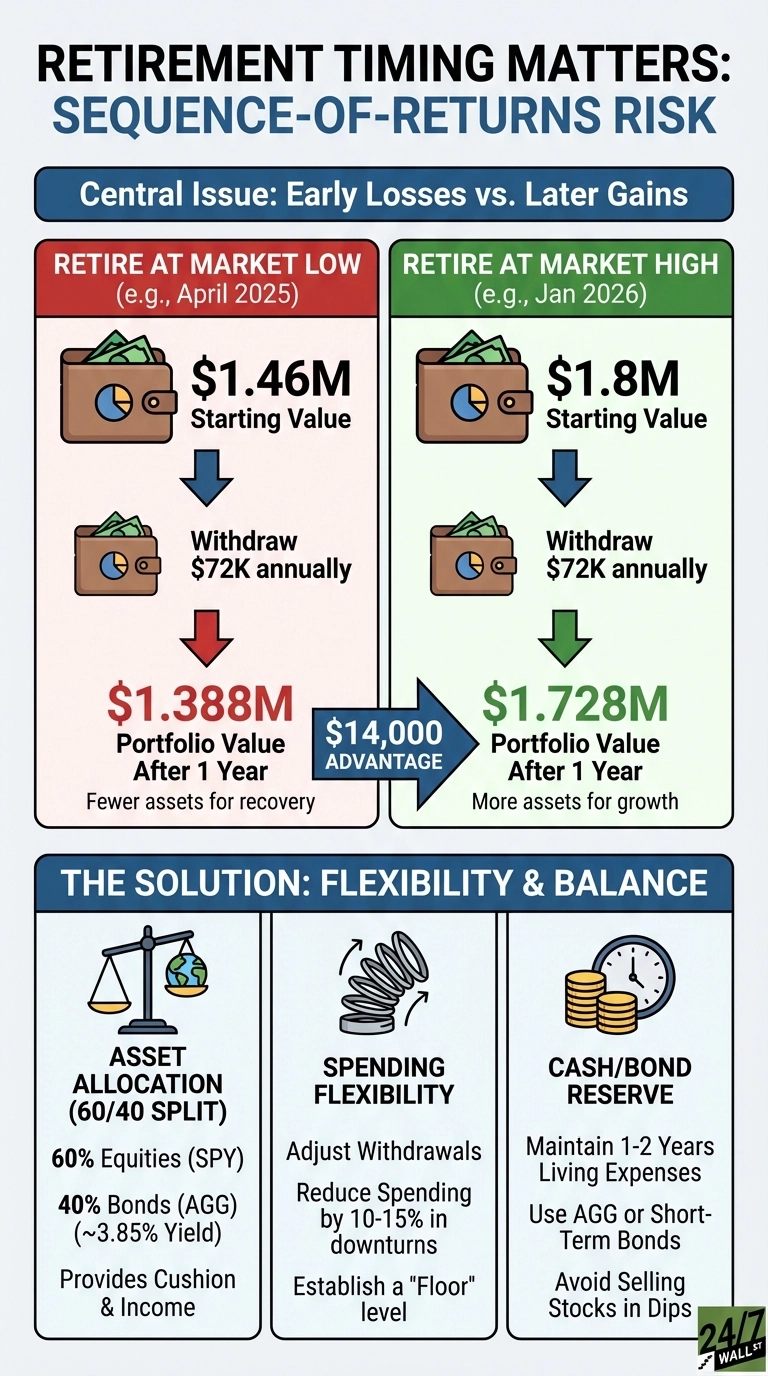
The damage compounds when static withdrawals begin. Under the traditional 4% rule, a retiree pulls $72,000 annually from a $1.8 million base. When markets drop early in retirement, the retiree is forced to sell more shares to generate that cash, permanently shrinking the asset base that could otherwise recover when prices rebound. As Schwab notes, early selling “leaves you with fewer assets that can generate growth and returns during potential future recoveries.”
The “Guardrails” Framework Override
Generic asset shifts provide a basic cushion, but mitigating true sequence risk demands systematic execution rules. Jonathan Guyton and William Klinger’s Decision Rules establish absolute guardrails for a $1.8 million asset base, requiring a retiree to track their current withdrawal rate dynamically against the initial 4% benchmark. Research by Wade Pfau quantifies why precision matters here: the returns earned in the first ten years of retirement account for roughly 77% of the final long-term outcome. Early guardrail triggers are therefore far more consequential than ones activated later in retirement.
The Capital Preservation Rule operates on a straightforward threshold. If a sharp market drop pushes the withdrawal rate more than 20% above its starting level, crossing the 4.8% threshold, the retiree automatically implements a 10% spending reduction. The Prosperity Rule runs in the opposite direction: if portfolio growth causes the active withdrawal rate to fall 20% below the starting point, dropping under 3.2%, spending can scale upward to capture equity gains safely. That mechanism removes the paralysis that often accompanies retiring into near-record market levels.
Strategic Paths: Dynamic Buffers over Fixed Rules
The right goal is not to avoid retiring during volatility. It is to build specific withdrawal flexibility into the plan from day one. A balanced 60/40 portfolio split between equities (SPY) and bonds (the iShares Core U.S. Aggregate Bond ETF (NYSEARCA:AGG)) provides a concrete buffer. With AGG carrying a 30-day SEC yield of 4.51% as of June 30, 2026, the fixed-income sleeve generates dependable income without requiring capital liquidation during equity drawdowns. Morningstar’s 2026 retirement income research supports this logic: portfolios with equity allocations above 50% can sustain only a 3.9% withdrawal rate at 90% success over 30 years, meaning the bond allocation is a structural necessity, not just defensive padding.
Rather than holding a static cash drag, consider a Valuation-Based Cash Buffer strategy. When equity forward multiples and index levels approach historic thresholds, retirees expand their defensive allocation to a full three years of living expenses. When a structural correction arrives, the buffer is deliberately drawn down to zero without being refilled from equities, fully insulating the core equity allocation through a typical 18-to-24-month recovery cycle.
De-Risking via the Discretionary “Floor”
To balance math with behavioral realities, retirees benefit from defining a non-discretionary spending floor explicitly. The practical approach is to separate outlays into a baseline survival budget covering housing, healthcare, and basic food, and a variable lifestyle budget covering travel and leisure. If a retiree’s household floor sits at $50,000 and guaranteed income like Social Security covers $30,000 of that, the portfolio only needs to bridge a net $20,000 gap during an active market crisis. That kind of precision sharply reduces the emotional weight of short-term market tracking and keeps the guardrails from being abandoned at precisely the wrong moment.
What to Evaluate Now
Financial advisors typically stress-test sequence-of-returns exposure across three factors: spending flexibility (the ability to reduce expenses by 15-20% during market stress), asset allocation (balanced portfolios with 30-40% in bonds rather than a pure equity position), and retirement timing relative to current valuations. Building in automated decision guardrails, dynamic cash buffer targets, and a segregated spending floor addresses all three simultaneously.
The core mistake is assuming that $1.8 million behaves identically regardless of when withdrawals begin. The data and the math say otherwise.
Editor’s note: SPY’s price data was updated to reflect the September 2026 trading level near $762 and the all-time closing high of $777.88 reached on August 13, 2026, with the 52-week low revised from $618.05 to $629.28. The AGG 30-day SEC yield was updated to 4.51% per the iShares fund fact sheet dated June 30, 2026.
Contact [email protected] for any questions or corrections.
Austin Smith is a financial publisher with over two decades of experience as an investor, analyst, and advisor. He covers stocks, ETFs, Artificial intelligence and personal finance for 24/7 Wall St. Previously, he spent over a decade at The Motley Fool as a senior editor for Fool.com, portfolio advisor for Millionacres, and launched The Ascent to help reader take control of their personal finances.
His work has been featured on Fool.com, NPR, CNBC, USA Today, Yahoo Finance, MSN, AOL, Marketwatch, and many other publications. He is as an advisor to private companies, and co-hosts The AI Investor Podcast with Eric Bleeker.
When not looking for investment opportunities, he can be found skiing, running, or playing soccer with his children. Learn more about Austin's investment approach here.