Suze Orman: Why the 4% Rule No Longer Works for Today’s Retirees
A lot of people reach retirement age without much money in savings. But if you worked hard and saved well, you may be in a very different position. And if you’re retiring with a respectable nest egg, it’s important to…

This post may contain links from our sponsors and affiliates, and Flywheel Publishing may receive compensation for actions taken through them.

A lot of people reach retirement age without much money saved. But if you worked hard and built a genuine nest egg, your challenge shifts from accumulating wealth to deploying it wisely. Managing withdrawals carefully can matter just as much as the years of disciplined saving that preceded them.
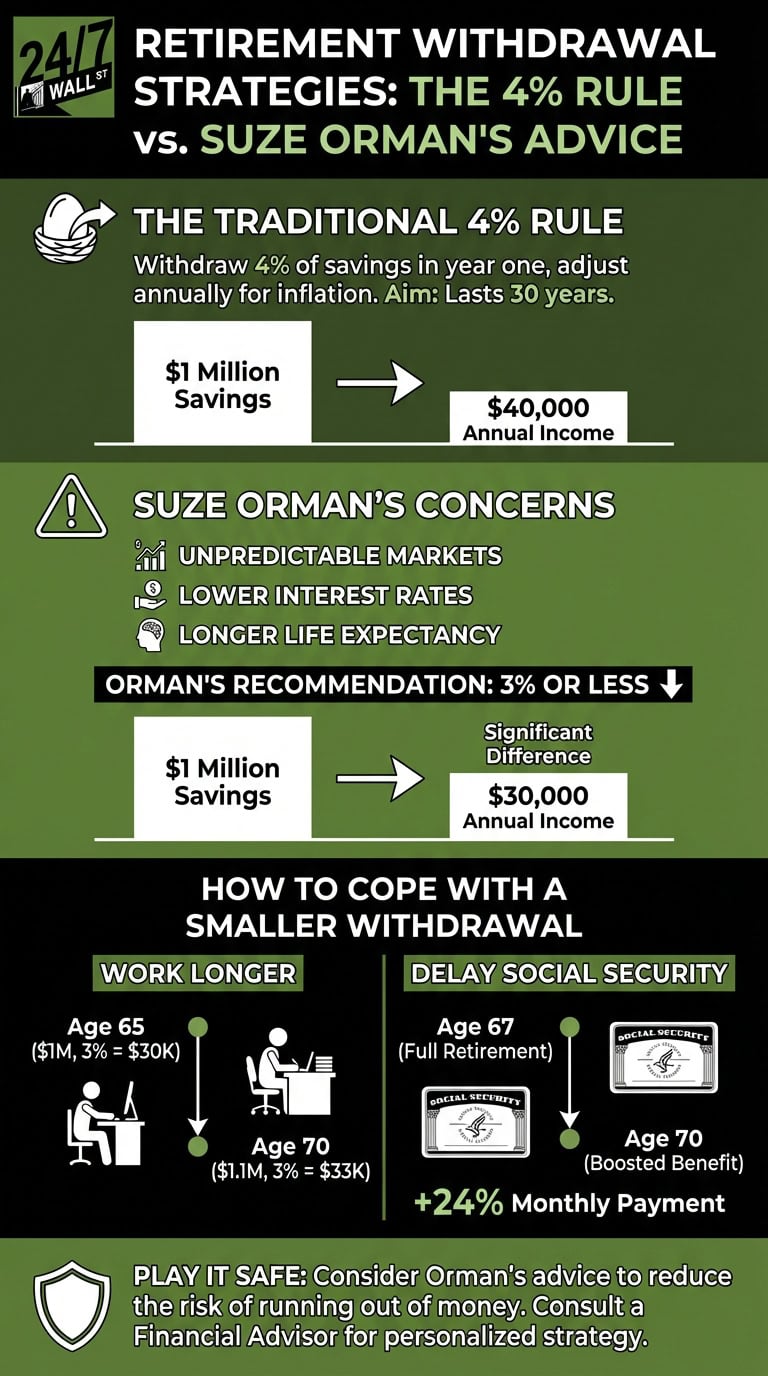
Many financial experts recommend a strategy called the 4% rule. It calls for withdrawing 4% of your savings balance in your first year of retirement, then adjusting each subsequent withdrawal for inflation. Financial planner Bill Bengen developed the rule in 1994, basing it on historical market returns from a balanced portfolio of roughly 50% stocks and 50% bonds. Followed faithfully, the strategy is designed to give your savings a high probability of lasting 30 years. Many financial professionals remain fans of the rule. Suze Orman is not among them.
Orman believes the 4% rule no longer serves today’s retirees well, and she recommends a fundamentally different approach to managing withdrawals.
Why Orman thinks the 4% rule is a problem
The 4% rule rests on assumptions that may no longer hold. It was calibrated to a specific interest-rate environment and a particular asset mix that prevailed decades ago. Orman argues that markets are unpredictable, interest rates have shifted considerably since Bengen’s original research, and Americans simply live longer than they did in 1994. That combination makes the 4% rule genuinely risky for anyone who could spend 30 or even 40 years in retirement.
Orman therefore recommends starting with a 3% withdrawal rate, or even less, depending on how the portfolio is invested. For a retiree with $1 million in savings, that translates to $30,000 a year instead of $40,000. Bridging that $10,000 gap requires deliberate planning, but several modern strategies make it far more manageable. Independent research from Morningstar is consistent with Orman’s caution: the firm’s 2025 State of Retirement Income report puts the safe starting withdrawal rate at 3.9% for a 30-year horizon (up from 3.7% in 2024), suggesting the debate is very much alive and that the right number depends heavily on market conditions at the moment of retirement.
Modern strategies to cope with smaller withdrawals
Running out of money ranks among the most common fears retirees express. A lower withdrawal rate does not have to mean a lower quality of life, though. Several legislative and planning tools can help close the gap between a conservative spending rate and a comfortable retirement.
Utilize SECURE 2.0 “Super Catch-Ups”
Orman recommends working longer to keep your nest egg growing, and under current tax law those extra years are more rewarding than ever. SECURE Act 2.0 allows workers who turn ages 60, 61, 62, or 63 during the calendar year to make super catch-up contributions to their employer-sponsored retirement plans. For both 2025 and 2026, the IRS held that enhanced limit at $11,250, the greater of $10,000 or 150% of the standard age-50 catch-up amount. Workers aged 50 and older who fall outside that 60-to-63 window can contribute up to $7,500 in extra catch-up dollars in 2025 and $8,000 in 2026.
One important development for 2026: workers whose prior-year FICA wages from the plan-sponsoring employer exceeded $150,000 are now required to make catch-up contributions on a Roth (after-tax) basis. The IRS finalized that threshold at $150,000 in November 2025, up from the $145,000 the statute originally specified. The Roth treatment reduces the immediate tax break but produces tax-free withdrawals in retirement. Directing those additional dollars into a tax-advantaged account during your final working years can meaningfully increase the nest egg you carry into retirement.
Implement Dynamic Guardrails
Rather than locking into a rigid 3% or 4% rate from day one, many planners now favor a “dynamic guardrails” approach. The concept is straightforward: withdrawals rise when the portfolio performs well, but you commit in advance to pulling back if the balance falls below a predetermined floor. That built-in flexibility can support a higher starting withdrawal than the strict 3% Orman recommends, while still protecting against the sequence-of-returns risk that can devastate a portfolio during a rough early stretch.
Morningstar’s 2025 research found that a guardrails strategy applied to a 40% equity / 60% bond portfolio can support a starting withdrawal rate of 5.2%, and retirees who also delay Social Security can push that figure as high as 5.7%. The trade-off is a willingness to accept some year-to-year variability in spending, which is most tolerable for retirees whose fixed living expenses are already covered by income sources outside the portfolio. The guardrails approach also tends to produce higher lifetime withdrawals than a fixed-rate strategy, though often at the cost of a smaller ending balance after 30 years.
Beware the IRMAA Surcharge
One of the most underappreciated threats to retirement income is the Income-Related Monthly Adjustment Amount (IRMAA). Medicare uses your Modified Adjusted Gross Income (MAGI) from two years prior to determine whether you owe a surcharge on top of your standard Part B and Part D premiums. In 2026, the standard Part B premium is $202.90 per month, up nearly 10% from $185.00 in 2025, and the annual Part B deductible rose to $283, up $26 from 2025. Because Medicare looks back two years, your 2026 premiums are based on your 2024 income. Any large Roth conversion or asset sale you complete in 2026 will surface in your 2028 Medicare bill, not your current one, so continuous planning is essential.
IRMAA kicks in once MAGI exceeds $109,000 for single filers or $218,000 for married couples filing jointly (up from $106,000 and $212,000 in 2025). Because IRMAA operates as a cliff, crossing a threshold by even one dollar triggers the full surcharge for that tier. Coordinating withdrawal amounts and Roth conversion timing with these brackets can preserve thousands of dollars each year.
Income Layering and Synthetic Dividends
A growing number of retirees are turning to “income layering” to reduce their dependence on portfolio withdrawals. This approach combines Social Security, bond ladders, and options-based income strategies (sometimes called synthetic dividends) to build a reliable cash-flow floor. Writing covered calls on existing stock holdings, for example, can generate income without forcing a sale of shares. That is especially valuable during market downturns, when selling at depressed prices would lock in losses and permanently shrink the portfolio’s recovery potential.
Maximizing Social Security
Orman is a firm advocate of delaying Social Security until age 70. For workers whose full retirement age is 67, waiting until 70 permanently increases their monthly benefit by 24%, reflecting an 8% boost for each of the three additional years. That guaranteed, inflation-adjusted income acts as a counterweight to a lower portfolio withdrawal rate and significantly reduces the risk that the portfolio runs dry in the later decades of retirement.
Morningstar’s research reinforces this point: delaying Social Security pairs especially well with flexible withdrawal strategies because it shrinks the share of spending that depends on volatile market returns. Congress has also taken concrete steps to make this advantage more visible. The Claiming Age Clarity Act, which passed the full House in 2025 with bipartisan support, would rename age 70 the “maximum benefit age” in Social Security communications. The current terminology obscures the financial advantage of waiting, and proponents argue the plain-language labels will help more Americans make better-informed claiming decisions.
Talking with a financial advisor about your specific circumstances is always worthwhile. A good advisor can assess your portfolio mix, project your income needs, and design a tiered income plan that balances steady cash flow with long-term principal preservation.
Editor’s note: This pass clarified that the IRMAA two-year lookback means 2026 premiums reflect 2024 income, and that income decisions made in 2026 will affect 2028 Medicare costs. It also updated the Roth catch-up mandate to reflect that the IRS finalized the income threshold at $150,000 (raised from the statute’s original $145,000) in November 2025, and noted that the Claiming Age Clarity Act passed the full House with bipartisan support in 2025.
Contact [email protected] for any questions or corrections.
Maurie Backman has more than a decade of experience writing about financial topics, including retirement, investing, Social Security, and real estate. Her work has appeared on sites that include The Motley Fool, USA Today, U.S. News & World Report, and Kiplinger.
Prior to becoming a full-time financial writer, Maurie worked in the financial industry trading distressed debt. She then changed course and spent a few years designing electronic toys. After a stint in content marketing and UX, she shifted back into writing and has since covered everything from the housing market to estate planning to Medicare.
When she's not busy writing, Maurie can be found hiking, walking her dogs, driving her kids to their various sports practices and games, and curling up with a good book. She cooks on occasion and bakes way too often.