Baby Boomers Should Answer These 3 Questions Before Locking In a Retirement Date
Choosing a retirement date feels like the finish line after decades of work. You have saved diligently, watched your balance grow, and you are now ready to reclaim your time. But picking a date based on emotion or convenience can…

This post may contain links from our sponsors and affiliates, and Flywheel Publishing may receive compensation for actions taken through them.

Choosing a retirement date feels like the finish line after decades of work. You have saved diligently, watched your balance grow, and you are now ready to reclaim your time. But picking a date based on emotion or convenience can lead to costly, irreversible mistakes, and for baby boomers retiring in 2026, the stakes have never been higher.
Baby boomers who are retiring in 2026 face a uniquely difficult set of circumstances. They have watched interest rates swing from near-zero to the highest levels in two decades. Inflation has permanently reset the cost of nearly everything they spend money on. And they are crossing into retirement at what demographers call “Peak 65”: in 2025 alone, a record 4.18 million Americans turned 65, roughly 11,400 people per day, the highest concentration of boomer retirements ever recorded. That peak belongs to a four-year “Peak 65 Zone” the Alliance for Lifetime Income says runs through 2027, and more than half of those boomers, 52.5%, carry total assets of $250,000 or less.
Perhaps most consequential of all, boomers are living longer than any previous generation. Financial plans now routinely need to cover 25, 30, or even 35 years of living without a paycheck. According to Vanguard’s Retirement Outlook, only 40% of boomers approaching retirement are on track to maintain their current standard of living, and the median boomer faces an estimated $9,000 annual income shortfall. What separates a comfortable retirement from a stressful one, more than any other single factor, is the preparation done before giving notice at work. The three questions below deserve honest answers before any date gets locked in.
Why the Timing Decision Matters More Than Ever
Retirement timing is not simply about having enough money. It is about having the right money, in the right accounts, with the right protections in place, at the right moment. A boomer retiring at 62 confronts an entirely different financial landscape than one retiring at 70. Healthcare coverage, Social Security optimization, sequence-of-returns risk, and tax strategy all shift materially depending on when you step away. Getting the timing right, or even reasonably close, can be the difference between a retirement that feels abundant and one that feels perpetually constrained.
Consider This: Dave Ramsey: “You Make $140K. Stay Out of Restaurants, Don’t Go on Vacation, And Get Rid of the Ferrari Bike”
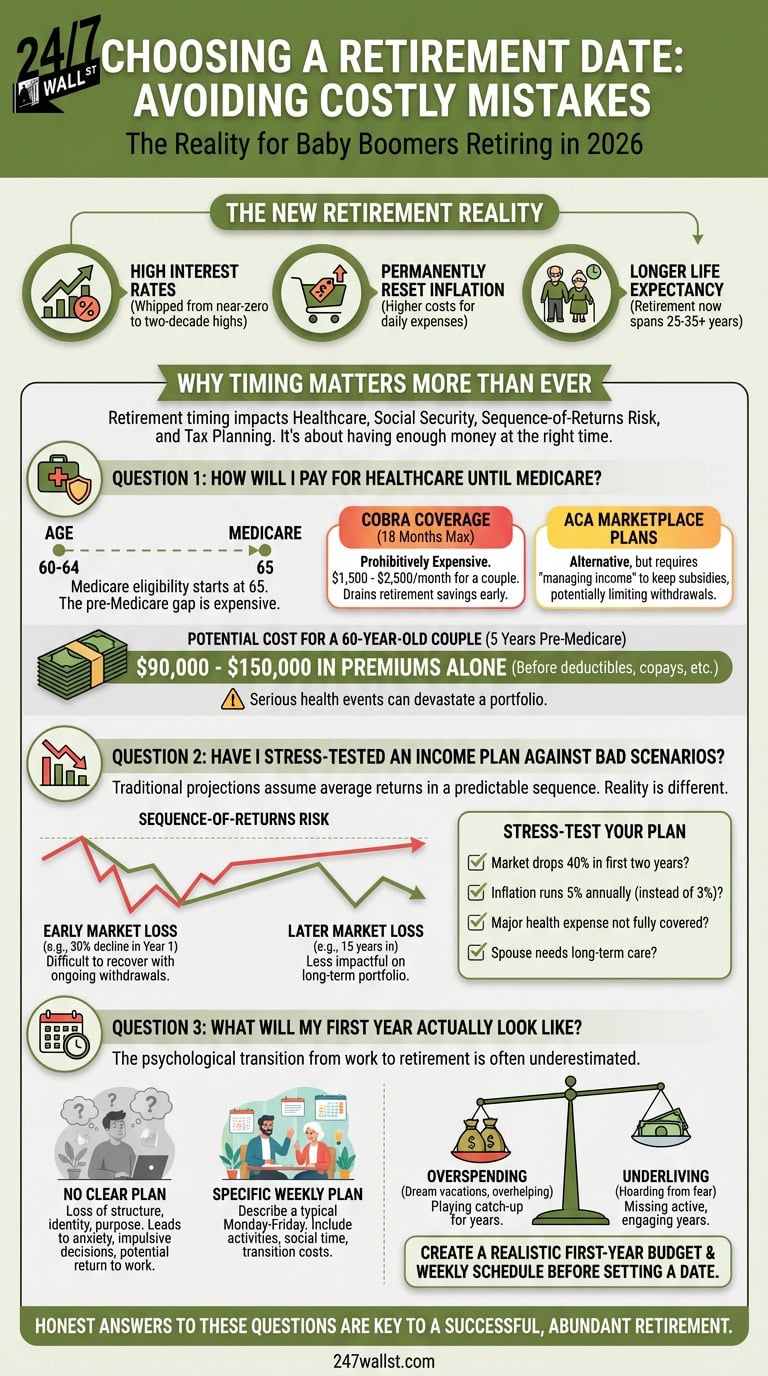
Question 1: How Will I Pay for Healthcare Until Medicare?
Medicare eligibility starts at 65, and every year before that represents one of the most expensive and underestimated gaps in retirement planning. Employer health insurance ends the day you leave, and the options for replacing it carry costs that genuinely surprise most people. Fidelity’s 25th annual Retiree Health Care Cost Estimate, published in July 2026, found that a single 65-year-old retiring today should expect to spend $185,500 over their lifetime on healthcare costs alone, a figure that jumped 7.5% in a single year. For a couple, that lifetime total reaches $371,000. Those numbers assume enrollment in Original Medicare and Part D; they do not include dental, over-the-counter drugs, or custodial long-term care. For boomers who want Medigap coverage, Milliman’s 2026 Retiree Health Cost Index put the lifetime total even higher, at up to $637,000 for a healthy couple. For someone who retires before Medicare kicks in, the pre-65 years add a significant premium burden on top of all of those long-term costs.
COBRA coverage can extend an employer’s plan for up to 18 months, but the cost is jarring. Under COBRA, you pay the full premium, including your old share plus the employer’s share, plus a 2% administrative fee. For a couple, that typically runs $1,700 to $2,000 per month, coming directly out of retirement savings during the years when the portfolio is most vulnerable. ACA marketplace plans offer an alternative, but carefully managing income to qualify for subsidies creates its own complications around withdrawals and tax strategy.
The numbers grow uncomfortable quickly. A 60-year-old couple with five years until Medicare could easily face $90,000 to $150,000 in premiums alone before a single Medicare card arrives, excluding deductibles, copays, and out-of-pocket maximums. In 2026, the standard Medicare Part B monthly premium is $202.90, up 9.7% from $185 in 2025. The 2026 Social Security cost-of-living adjustment came in at just 2.8%, meaning Part B costs are growing more than three times faster than the benefit increase meant to offset them. The Part B annual deductible is $283 and the Part A hospital deductible is $1,736 per benefit period. Any serious health event during the pre-Medicare gap can deliver a significant blow to a retirement portfolio. Before committing to any retirement date before 65, boomers need a specific, budgeted healthcare plan already in place.
Question 2: Have I Stress-Tested an Income Plan Against Bad Scenarios?
Most retirement projections draw a tidy line: withdraw a steady percentage each year, assume a reasonable average return, and the money lasts. These projections are useful for rough planning but dangerous as actual guides, because they assume average returns arriving in a predictable sequence. Markets do not cooperate with that assumption, and the gap between an optimistic projection and a realistic one can be the difference between a funded retirement and a depleted portfolio.
Sequence-of-returns risk is the danger that poor market performance early in retirement can permanently damage a portfolio, regardless of what happens later. Research published by Morningstar found that a retiree whose portfolio dropped at least 15% in the first year while also withdrawing 3.3% of their balance faced odds of depleting the portfolio within 30 years that were six times higher than for someone who experienced a positive first-year return. The core mechanism is straightforward: when you sell assets during a downturn to cover living expenses, those shares are gone and cannot participate in any eventual recovery. The first decade of retirement is the most vulnerable period for this reason, when balances are at their largest and withdrawals compound the damage of any market decline.
Stress-testing means running a plan through genuinely bad scenarios, not just average ones. What if the market drops 40% in the first two years? What if inflation runs 5% annually rather than 3%? What if a major health event produces costs that insurance does not fully cover? What if a spouse needs long-term care? Fidelity’s 2026 Retiree Health Care Cost Estimate projected a long-term healthcare inflation rate of 5.8%, more than twice the projected Social Security cost-of-living adjustment of 2.4% over the long term, underscoring how quickly uncovered health costs can erode a retirement plan. A retirement date that works in optimistic projections but collapses under realistic stress is not a viable retirement date. Updating these scenarios to reflect today’s rate environment and rising healthcare costs is worth doing before any final decision.
Question 3: What Will My First Year Actually Look Like?
The psychological shift from work to retirement catches many boomers off guard. After decades of structure, deadlines, colleagues, and a professional identity, the sudden absence of all four can produce anxiety, depression, and impulsive financial decisions. That psychological reality carries a direct financial dimension: retirees without clear plans for their time return to work at higher rates within the first two years, according to multiple workforce studies. A Transamerica Center for Retirement Studies survey published in June 2025 found that 57% of boomer workers expect to retire at 70 or older, or do not plan to retire at all. That figure partly reflects financial pressure, but it also reflects how many boomers discover that retirement is less satisfying than expected when it lacks structure.
The first year also sets spending patterns that tend to persist. Retirees who overspend early, whether by taking a long-deferred dream vacation or being overly generous with family, often spend subsequent years playing catch-up. Those who pull back too aggressively out of fear may miss the most physically active years of retirement, when experiences are most accessible. Getting the balance right starts with specificity, and specificity starts before the last day of work.
Before setting a date, a retiree should be able to describe a typical Monday-through-Friday in their first retirement year with reasonable precision. Vague intentions like “traveling more” or “spending time with family” feel satisfying in the abstract but do not translate into a budget or a schedule. Concrete plans cover who you will spend time with, what ongoing commitments will provide structure, and what major expenditures the first year is likely to carry. That level of clarity allows for a realistic budget, one that accounts for transition costs without either overspending or under-living the early years that matter most.
Editor’s note: This pass added Milliman’s 2026 Retiree Health Cost Index figure of up to $637,000 in lifetime healthcare costs for a healthy 65-year-old couple with Medigap coverage, offering a broader comparison to Fidelity’s $371,000 Original Medicare estimate. The Alliance for Lifetime Income finding that 52.5% of Peak Boomers have total assets of $250,000 or less was also added, along with clarification that the Peak 65 Zone runs through 2027. The HealthView long-term healthcare inflation figure was re-attributed to Fidelity’s 2026 report.
Contact [email protected] for any questions or corrections.
David Beren has been a Flywheel Publishing contributor since 2022. Writing for 24/7 Wall St. since 2023, David loves to write about topics of all shapes and sizes. As a technology expert, David focuses heavily on consumer electronics brands, automobiles, and general technology. He has previously written for LifeWire, formerly About.com. As a part-time freelance writer, David’s “day job” has been working on and leading social media for multiple Fortune 100 brands. David loves the flexibility of this field and its ability to reach customers exactly where they like to spend their time. Additionally, David previously published his own blog, TmoNews.com, which reached 3 million readers in its first year. In addition to freelance and social media work, David loves to spend time with his family and children and relive the glory days of video game consoles by playing any retro game console he can get his hands on.