Dave Ramsey and Suze Orman Agree on Almost Nothing — Except These 2 Retirement Rules
Dave Ramsey and Suze Orman rarely see eye to eye. Ramsey champions aggressive debt payoff and famously avoids credit cards altogether. Orman encourages responsible credit use and building strong credit scores. They differ on Social Security timing, annuities, and broader…

This post may contain links from our sponsors and affiliates, and Flywheel Publishing may receive compensation for actions taken through them.

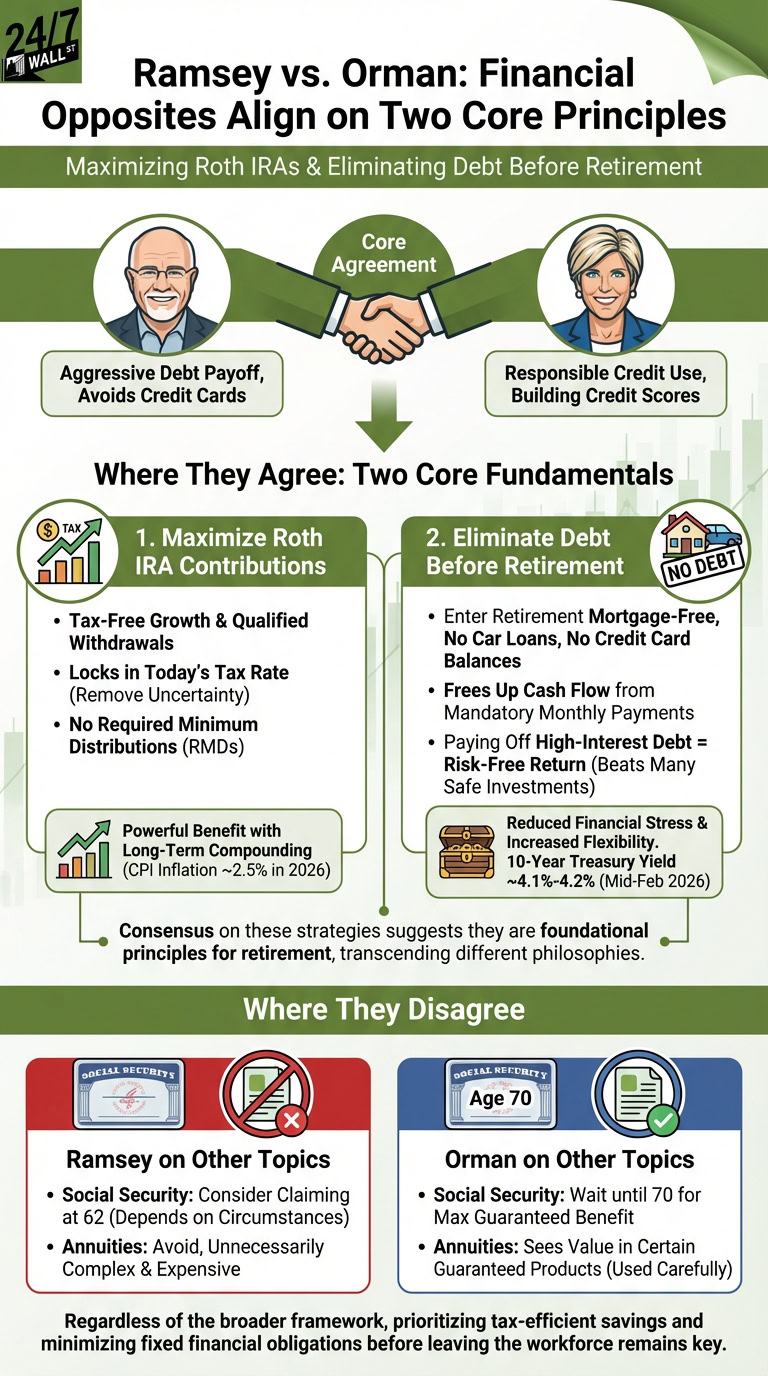
Dave Ramsey and Suze Orman rarely see eye to eye. Ramsey champions aggressive debt payoff and famously avoids credit cards altogether. Orman encourages responsible credit use and building strong credit scores. They differ on Social Security timing, annuities, and broader investment philosophy. Yet on two core retirement fundamentals, these philosophical opposites strongly align: maximize Roth IRA contributions and eliminate debt before retirement.
That alignment carries real weight precisely because the two advisors clash on so much else. When two experts with fundamentally different approaches converge on the same advice, it points to principles worth examining closely.
Why They Both Favor Roth IRAs
Both Ramsey and Orman have been vocal and consistent advocates for Roth IRAs. The structure is straightforward: you pay taxes on contributions today, then enjoy tax-free growth and tax-free qualified withdrawals in retirement. That arrangement removes much of the uncertainty around future tax rates. With headline inflation reaching 4.2% in May 2026, its highest reading since April 2023, long-term purchasing power has become a sharper concern than it has been in years. The tax-free compounding inside a Roth grows more valuable over decades, since gains are never reduced by future ordinary income taxes at the point of withdrawal.
Traditional IRAs defer taxes, but all distributions are taxed as ordinary income once you start taking money out. If tax rates rise or your taxable income in retirement runs higher than expected, that deferral becomes a costly trade. Roth IRAs reduce that risk by locking in today’s tax rate on contributions while also eliminating required minimum distributions for the original account holder.
For retirees, the practical benefit shows up most clearly in income planning. There are no mandatory withdrawals forcing taxable income at inconvenient times. Orman goes further on this point, noting that Roth withdrawals do not count as taxable income for Medicare purposes. Lower reportable income in retirement can reduce Medicare Part B premiums and limit the share of Social Security benefits subject to federal tax, making the Roth advantage considerably broader than most savers realize.
For 2026, the IRS set the annual Roth IRA contribution limit at $7,500 for savers under 50, up from $7,000 in 2025. Those age 50 and older can contribute up to $8,600, reflecting an expanded catch-up provision. Ramsey’s recommended sequence is to first contribute to a 401(k) up to the employer match, then direct the remaining retirement dollars into a Roth IRA to capture the tax-free growth advantage. Orman’s approach echoes that priority, and in a May 2026 post she pushed families to gift Roth IRA contributions to young earners in their lives, arguing that compound growth is the one financial advantage that only the young can fully exploit. Despite their different tactical frameworks, both advisors point toward the same destination: get money into a Roth and leave it there.
One caveat worth noting: Roth IRAs carry income limits. For 2026, single filers must earn below $153,000 to make a full contribution, and the ability to contribute phases out entirely above $168,000. Married couples filing jointly lose direct contribution eligibility above $252,000, though a backdoor Roth conversion remains available for higher earners at any income level.
The Debt-Free Mandate
Both advisors are equally insistent on entering retirement without debt. No mortgage, no car loans, no credit card balances. The reasoning is direct: fixed retirement income leaves little room for mandatory monthly payments, and a single unexpected expense can force portfolio liquidations at exactly the wrong moment.
The math depends heavily on the interest rate in question. Paying off high-interest debt, such as a credit card balance, delivers a guaranteed return equal to whatever interest rate you eliminate. That guaranteed return often exceeds what conservative investments can realistically provide. Lower-rate mortgage debt presents a closer call, but the cash flow flexibility of being debt-free is a powerful advantage when income is fixed and no longer growing.
With the 10-year Treasury yield rising to approximately 4.6% in mid-July 2026, safe fixed-income returns are now more competitive than they were a few years ago. Even so, eliminating debt offers a comparable or superior guaranteed outcome for many households, and it does so without credit risk or duration risk. The psychological benefit of reduced financial stress in retirement is harder to quantify but equally real.
Where They Still Disagree
Their consensus fades quickly when the topic shifts to Social Security timing. Ramsey has argued that claiming at 62 can make sense under certain circumstances, particularly when benefits are invested immediately or when a person has realistic concerns about longevity. Orman generally encourages waiting until 70 to lock in the highest guaranteed monthly benefit, which also produces larger inflation-adjusted payments over the long run.
On annuities, the two remain sharply divided. Orman sees value in certain guaranteed income products when they are used carefully and in the right context. Ramsey has long criticized annuities as unnecessarily complex and expensive, a position he has maintained consistently for years.
The fact that two advisors with such different philosophies reach identical conclusions on Roth IRAs and debt elimination points to something durable in both principles. Regardless of which broader financial framework resonates more strongly, savers benefit from prioritizing tax-efficient retirement accounts and minimizing fixed financial obligations well before they leave the workforce.
Editor’s note: The 10-year Treasury yield figure was updated from the prior “4.55% in early June 2026” to approximately 4.6% as of mid-July 2026, reflecting the yield’s rise amid renewed inflation concerns and Middle East tensions. The article also adds the Roth IRA full-contribution income threshold of $153,000 for single filers, sourced from IRS Notice 2025-67.
Contact [email protected] for any questions or corrections.
Joel South covers large-cap stocks, dividend investing, and major market trends, with a focus on earnings analysis, valuation, and turning complex data into actionable insights for investors.
He brings more than 15 years of experience as an investor and financial journalist, including 12 years at The Motley Fool, where he served as an investment analyst, Bureau Chief, and later led the Fool.com investing news desk. He has also co-hosted an investing podcast and appeared across TV and radio discussing market trends.