




Meta Platforms closed the week at $639.77, down 3.28% from February 6. The S&P 500 fell just 1.29% over the same period, while the Nasdaq 100 dropped 1.27%. It’s another losing week for Meta, and the stock is now down 13% from where it closed the day after reporting blowout earnings.
Let’s dive into the three storylines that drove price action for Meta Platforms (NASDAQ:META | META Price Prediction) this week.
The Stock’s Performance Context
Year to date, Meta is down 3.08%, trading below where it closed December 31. Over one year, shares are off 11.91% from February 13, 2025. This week’s drop pushed the stock further from its 52-week high of $795.06. The question is whether the three developments that shaped this week signal opportunity or warning.
Bill Ackman Calls Meta One of the World’s Greatest Businesses
On February 11th, Pershing Square’s Bill Ackman disclosed a significant new stake in Meta, describing it as “one of the world’s greatest businesses” with strong long-term upside from AI integration. Ackman dumped Chipotle, Nike, and Hilton to make room for Meta, Amazon (Nasdaq: AMZN), and Alphabet. That’s a bet on the Magnificent Seven over consumer discretionary, reflecting conviction that Meta’s AI infrastructure investments will pay off.
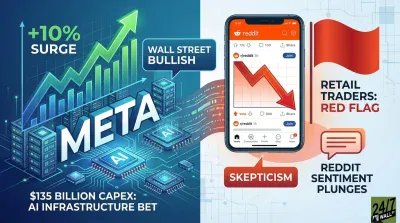
Reddit’s retail traders noticed. Sentiment spiked to 80 on February 11 at 9pm ET, the highest reading of the week.
I defended the trade on 24/7 Wall St. yesterday. Amazon now trades for half the forward P/E of Walmart. Meta is now down 13% from posting outstanding earnings and once again proved its AI spend is going to drive significant revenue acceleration. The sell-off in these names feel more than overdone right now.
The $135 Billion Capital Expenditure Question
Meta guided to $115 to $135 billion in capital expenditures for 2026, a staggering commitment to AI infrastructure and technical talent.
That’s up from $21.4 billion in Q4 2025 alone, which already represented a 48% increase year over year. Operating margin declined to 41% from 48% as total costs rose 40% year over year.
Zuckerberg framed it as necessary: “I’m looking forward to advancing personal superintelligence for people around the world in 2026.” The market isn’t sure the payoff justifies the cost. Corning announced a $6 billion multiyear fiber optic supply deal with Meta for AI data centers, and Vistra secured a 20-year power purchase agreement for zero-carbon nuclear energy to power those facilities. Meta is building the infrastructure. Whether it generates returns that exceed the capital deployed is the bet.
Despite the massive capex raise, Wall Street has increased its earnings estimates for 2027 from where they were before earnings. A month ago, Wall Street was projecting $33.33 in adjusted EPS in 2027. Now that figure sits at $34.33. Revenue acceleration is outpacing margin erosion driven by increased infrastructure spending.
Analyst Sentiment Remains Constructive Despite Pressure
Wall Street analysts maintain an average target price of $860.08, implying 34% upside from current levels. The analyst community breaks down as 11 Strong Buy ratings, 51 Buy ratings, and just 5 Hold ratings with no Sell recommendations. Our proprietary 24/7 Wall St price target is also bullish on Meta, assigning the company a target price of $769.98.
That’s overwhelming bullish consensus, yet the stock fell this week. The disconnect suggests analysts believe in the long-term AI story while the market worries about near-term margin compression. Meta’s forward P/E of 22 looks reasonable if operating income will exceed 2025 levels as management projects. It looks expensive if the $135 billion in CapEx doesn’t pay off until 2028 or later.
The week’s performance tells you the market is still deciding which scenario to price in.











 Top Gaining Stocks
 Top Losing Stocks