ASML Targets TSM in Advanced Packaging: Strategic Expansion or Unnecessary Gamble?
ASML (NASDAQ:ASML | ASML Price Prediction) reigns supreme in the semiconductor equipment world, holding a virtual monopoly on extreme ultraviolet (EUV) lithography machines essential for crafting the most advanced chips. This dominance stems from over 30 years of relentless research…


ASML (NASDAQ:ASML | ASML Price Prediction) reigns supreme in the semiconductor equipment world, holding a virtual monopoly on extreme ultraviolet (EUV) lithography machines essential for crafting the most advanced chips. This dominance stems from over 30 years of relentless research and development, backed by thousands of patents that erect an insurmountable barrier to entry for competitors. No other company can match ASML’s precision in etching nanoscale circuits, granting it a wide economic moat and pricing power.
However, ASML is now eyeing expansion beyond its EUV core into new verticals, including advanced packaging — a space currently led by Taiwan Semiconductor Manufacturing (NYSE:TSM) with a commanding share in key segments like CoWoS for AI chips. While ASML is still in the exploratory stage, focusing on tools for 10 to 15 years ahead, should it instead stick to its core EUV competency, or risk “de-worsification,” as investing legend Peter Lynch warned, by diversifying into adjacent markets where it lacks established expertise?
Decoding Advanced Packaging and TSMC’s Grip
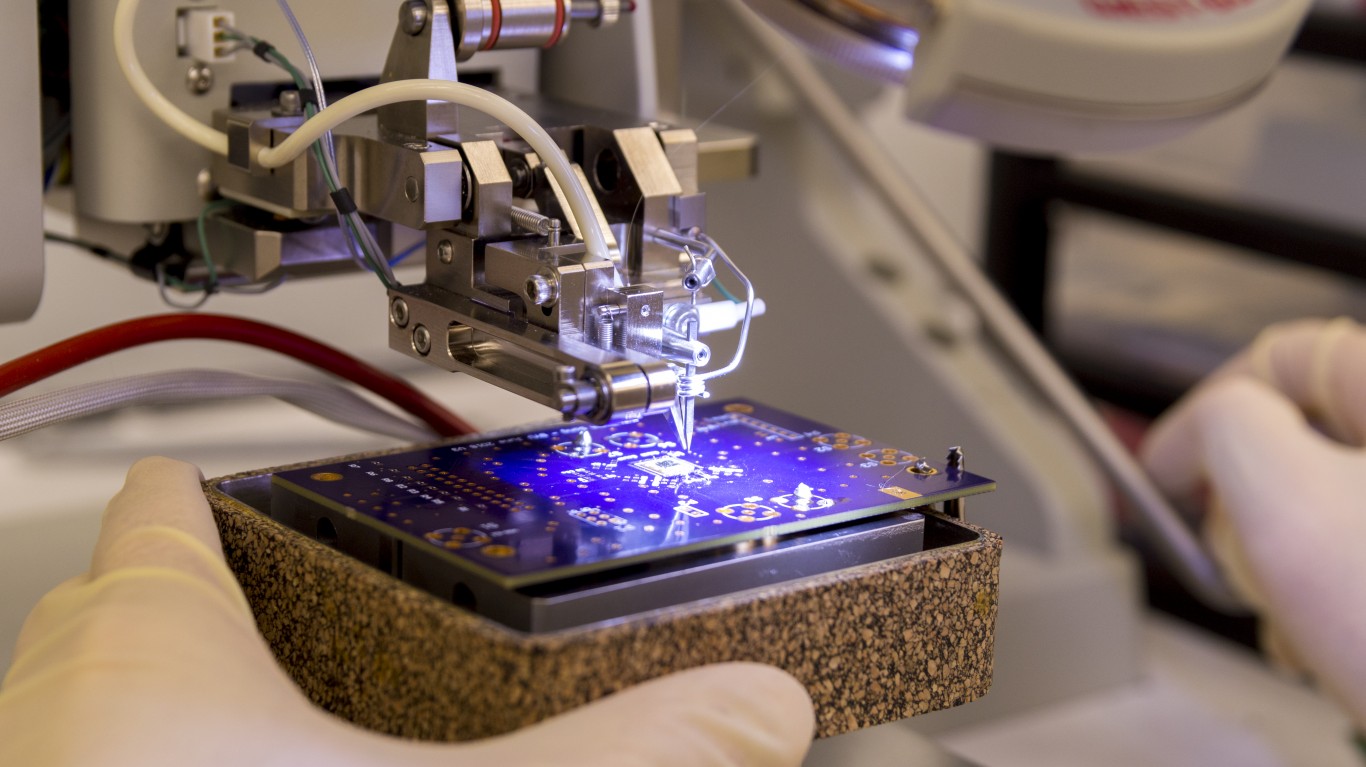
Advanced packaging is innovative techniques that integrate multiple semiconductor chips into a single, compact module to boost performance, reduce power consumption, and shrink footprints without solely relying on smaller transistors. Unlike traditional packaging, which simply encases a chip for protection and connectivity, advanced methods like 2.5D/3D stacking, fan-out wafer-level packaging (FOWLP), and heterogeneous integration “glue” chips together — often stacking logic, memory, and specialized dies vertically or horizontally. This enables faster data transfer, as seen in AI accelerators where high-bandwidth memory (HBM) is bonded directly to processors, cutting latency and energy use. The technology is pivotal for emerging applications in AI, 5G, autonomous vehicles, and high-performance computing, where Moore’s Law alone can’t keep pace.
Chip foundry Taiwan Semiconductor dominates this arena as well, holding around 18% to 20% of the overall market but commanding over 50% in high-end segments like CoWoS (Chip on Wafer on Substrate) for AI GPUs. Its integrated model — combining front-end fabrication with back-end packaging — gives it an edge, allowing seamless customization for clients like Nvidia (NASDAQ:NVDA).
The foundry’s capacity expansion programs, such as ramping CoWoS to 680,000 wafers in 2025, underscore its lead amid surging AI demand. Other major players include Intel (NASDAQ:INTC), with its Embedded Multi-Die Interconnect Bridge (EMIB) and Foveros 3D stacking for heterogeneous chips, enabling flexible designs in data centers and PCs. Samsung follows closely, leveraging I-Cube technology for HBM integration in memory-heavy applications, holding about 15% market share and focusing on automotive and mobile sectors.
These giants benefit from vast R&D budgets and ecosystem partnerships, making the space highly competitive.
Can ASML Feasibly Break In?
To break into advanced packaging, ASML would need to leverage its lithography prowess into back-end tools, developing specialized equipment for various processes. It has already taken such steps, shipping its first i-line lithography system, the TWINSCAN XT:260, in late 2025 for 3D integration and advanced packaging applications. This tool targets high-volume memory and AI processors, potentially expanding ASML’s portfolio beyond front-end EUV.
The feasibility of it doing more also looks promising: With a $550 billion market cap and engineering talent, ASML can invest in R&D to create differentiated tools, perhaps integrating AI for faster production. Analysts project the advanced packaging market to grow from $42 billion to $51 billion in 2025 to $70 billion to $90 billion by 2034, offering ample room for new entrants like ASML to capture a 5% to 10% share in tooling over a decade.
However, challenges abound. ASML lacks back-end experience, facing incumbents like Applied Materials (NASDAQ:AMAT) and Lam Research (NASDAQ:LRCX) in packaging equipment. Building a meaningful presence could take five to 10 years, requiring partnerships and acquisitions to accelerate.
Key Takeaways
Ultimately, ASML’s foray into advanced packaging appears a smart strategic pivot, opening diversification avenues in booming tech verticals like AI and 3D integration. By extending its lithography expertise, ASML can hedge against EUV market saturation and tap a $40 billion to $50 billion annual opportunity.
Taiwan Semiconductor Manufacturing may also be having difficulty meeting demand — earlier this year it was reported Alphabet (NASDAQ:GOOG)(NASDAQ:GOOGL) reduced its 2026 production target for Tensor Processing Units due to limited access to Taiwan Semi’s CoWoS advanced packaging capacity because Nvidia had already secured it through priority allocations.
Although ASML’s move carries some risk of dilution, if executed well it could open new revenue streams beyond EUV while also solidifying its role as a semiconductor powerhouse without “de-worsifying” its core strengths.
Contact [email protected] for any questions or corrections.
After two decades of patrolling the dark corners of suburbia as a police officer, Rich Duprey hung up his badge and gun to begin writing full time about stocks and investing. For the past 20 years, he’s been cruising the markets looking for companies to lock up as long-term holdings in a portfolio while writing extensively on the broad sectors of consumer goods, technology, and industrials. Because his experience isn’t from the typical financial analyst track, Rich is able to break down complex topics into understandable and useful action points for the average investor. His writings have appeared on The Motley Fool, InvestorPlace, Yahoo! Finance, Money Morning, and, of course, 24/7 Wall St. He has been featured in both U.S. and international publications, including MarketWatch, Financial Times, Forbes, Fast Company, and USA Today.