Western Digital vs Seagate After the Sell-Off: One Storage Rival Is a Clear Winner
Western Digital (NASDAQ: WDC | WDC Price Prediction) and Seagate Technology (NASDAQ: STX) both got hit in the March 3, 2026, sell-off as Iran conflict fears rattled semiconductor markets and rippled into U.S. storage names. Both stocks bounced back the…

This post may contain links from our sponsors and affiliates, and Flywheel Publishing may receive compensation for actions taken through them.
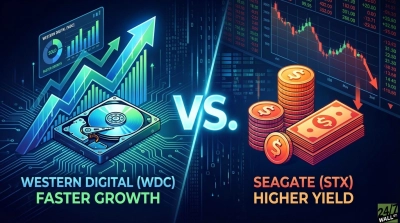
Western Digital (NASDAQ: WDC | WDC Price Prediction) and Seagate Technology (NASDAQ: STX) both got hit in the March 3, 2026, sell-off as Iran conflict fears rattled semiconductor markets and rippled into U.S. storage names. Both stocks bounced back the following day but are still off their recent peaks. Retirement-focused investors face a direct choice: which one deserves a spot in a long-term portfolio? The answer depends on what you’re actually trying to accomplish, but one stock wins more clearly than the other.
Growth Trajectory: Western Digital
Western Digital’s growth story is accelerating faster. WDC completed the SanDisk spin-off last year and $3.1 billion stake sale in February 2026, making it a pure-play HDD company with a sharply focused business. The results are showing up in guidance: The company’s entire 2026 HDD production capacity is sold out, with supply agreements extending to 2027–2028. Management guided Q3 FY26 revenue to approximately $3.2 billion at the midpoint, implying roughly 40% year-over-year growth. That follows two consecutive quarters of 25% to 27% revenue gains, both beating estimates.
Seagate is growing too. Q2 FY26 revenue rose 21.51% year-over-year to $2.83 billion, beating the $2.75 billion consensus. However, its Q3 guidance of $2.90 billion ±$100 million represents only a modest sequential step up. WDC’s growth trajectory is clearly steeper right now.
Income and Yield: Seagate
For retirement investors prioritizing income, Seagate wins without contest. It pays $0.74 per quarter, annualizing to roughly $2.90 per share, at a dividend yield of approximately 0.81%. Its rival’s recently raised dividend sits at just $0.125 per quarter, a fraction of Seagate’s payout. The yield gap is substantial and won’t close anytime soon. Seagate has also been trimming debt, reducing total debt by approximately $684 million over fiscal year 2025 while sustaining its dividend through the cycle.
Balance Sheet and Risk: Western Digital
This is where the comparison sharpens considerably. Western Digital carries shareholders’ equity of $7.111 billion, a fortress-like position for a company its size. Seagate’s balance sheet tells a different story: shareholders’ equity stood at just $459 million in Q2 FY26, recovering from a technically book-insolvent position of negative $63 million in Q1. Total liabilities of $8.249 billion against total assets of $8.708 billion leave Seagate with minimal financial cushion if the storage cycle turns. For a retirement investor who cannot afford to absorb a deep drawdown, Western Digital’s balance sheet resilience matters.
Valuation also favors Western Digital on a forward basis. It trades at a forward P/E of 25.64, versus Seagate’s forward P/E of 21.98. Western Digital’s faster growth rate and a PEG ratio of 0.655 versus Seagate’s 0.599 put both in reasonable territory. Analysts have set a consensus target of $321 for Western Digital, with Cantor Fitzgerald as high as $440. Seagate’s consensus target is $475.35.
Verdict
For a retirement investor who needs income and can accept balance sheet risk, Seagate’s dividend yield and HAMR technology roadmap (Mozaic now qualified with five of the world’s largest cloud customers) make it a defensible hold if already owned. But buying it fresh after a major run, with a leveraged balance sheet and a CEO who executed 23 separate sell transactions on March 2 alone, introduces risks that don’t belong in a retirement core position.
Western Digital clearly appears to be the better buy here. Sold-out capacity through 2028, a $4 billion buyback underway, a clean balance sheet, and the fastest growth trajectory in the HDD space make it the more compelling risk-adjusted choice after the sell-off. The 10.19% one-week pullback from recent highs offers a more attractive entry than the stock commanded just days ago. Retirement investors buying this one are buying a structurally advantaged business at a reset price—that’s the dip worth taking.
Contact [email protected] for any questions or corrections.
Trey has been an editor and author at 24/7 Wall St. for more than a decade, where he has published thousands of articles analyzing corporate earnings, dividend stocks, short interest, insider buying, private equity, and market trends. His comprehensive coverage spans the full spectrum of financial markets, from blue-chip stalwarts to emerging growth companies.
Beyond 24/7 Wall St., Trey has created and edited financial content for Benzinga and AOL's BloggingStocks, contributing additional hundreds of articles to the investment community.
Trey's editorial expertise extends across multiple publishing environments. He served as production editor at Dearborn Financial Publishing and development editor at Kaplan, where he helped shape financial education materials. Earlier in his career, he worked as a writer-producer at SVE. His freelance editing portfolio includes work for prestigious clients such as Sage Publications, Rand McNally, the Institute for Supply Management, the American Library Association, Eggplant Literary Productions, and Spiegel.
Outside of financial journalism, Trey writes fiction and has been an active member of the writing community for years, moderating workshop sessions at regional conventions.