If You Haven’t Already Bought Micron, Here Are 300 Reasons Why You Should
Micron Technology (NYSE:MU | MU Price Prediction) has delivered stunning returns for investors who got in early. The stock is up 185% over the last six months alone and has more than quadrupled in the past year. Despite this explosive…


Micron Technology (NYSE:MU | MU Price Prediction) has delivered stunning returns for investors who got in early. The stock is up 185% over the last six months alone and has more than quadrupled in the past year. Despite this explosive run, Micron still trades at incredibly discounted valuations relative to its tremendous runway for growth in the artificial intelligence era. Nvidia (NASDAQ:NVDA), though, has provided investors with 300 compelling reasons why they should be buying the stock right now.
The AI Memory Supercycle: DRAM Demand Explodes
The insatiable appetite for high-bandwidth memory (HBM) and DRAM in the AI era has created a potent tailwind for Micron. Training and running ever-larger language models, inference engines, and reasoning systems require massive amounts of fast, power-efficient memory. Every new wave of AI advancement pushes the boundaries of what data centers can handle, turning memory from a commodity into a strategic bottleneck.
While Micron trails Samsung and SK Hynix in overall memory market share, it stands poised for significant gains — and not just because of superior technology. As the only major U.S.-based supplier of advanced DRAM and HBM, Micron benefits from geopolitical tailwinds, supply-chain security concerns, and the push by hyperscalers to diversify away from Asian-centric production.
Nvidia itself has validated this opportunity, repeatedly highlighting Micron’s role in its ecosystem and demonstrating why MU stock is a must-own for anyone betting on the AI infrastructure buildout.
300 Gigabytes of Pure Opportunity
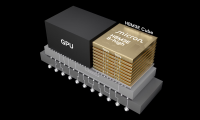
The clearest proof comes from Nvidia’s next-generation Rubin platform. Unveiled at CES 2026 in January, its flagship chips now require approximately 300GB of high-bandwidth DRAM — nearly four times the 80GB needed by the H100 just a couple of years ago. This dramatic leap reflects the shift toward longer context windows, multi-step reasoning models, and trillion-parameter architectures that simply cannot run efficiently without vastly more on-package memory.
The implications are enormous. Each new Rubin deployment devours DRAM at an unprecedented rate, creating sustained pricing power and volume growth for suppliers. Industry supply is already sold out through 2026 in many HBM categories, and the memory wall has become the primary constraint on AI scaling.
Micron’s HBM3e and upcoming HBM4 offerings are fully allocated, giving the company exceptional revenue visibility and margin expansion. For investors, this is the 300-reason catalyst that turns Micron from a cyclical memory play into a structural AI winner.
Micron’s technical edge in power efficiency, yield, and advanced packaging further strengthens its position. While competitors race to catch up on next-gen HBM, Micron’s U.S. manufacturing footprint and close collaboration with Nvidia position it to capture an outsized share of the incremental demand. The result is a multi-year growth runway that far outstrips traditional memory cycles.
Micron’s Path to Market Leadership
Beyond the immediate Rubin-driven surge, Micron is expanding its addressable market aggressively. New high-capacity DRAM modules tailored for AI servers, combined with its leadership in low-power and high-density solutions, open doors in data-center, automotive, and edge applications. The company’s $100 billion-plus total addressable market in AI memory — reached years ahead of schedule — underscores the secular shift underway.
Investors who focus only on near-term chip cycles miss the bigger picture: AI is rewriting the rules for memory consumption. What used to be a boom-bust industry is evolving into a high-growth, high-margin business dominated by a handful of players with the scale and technology to meet hyperscaler demand. Micron, with its U.S. base and proven execution, is uniquely placed to thrive.
Key Takeaway
Micron Technology trades at just 7x forward P/E, with analysts forecasting 82% annual EPS growth over the next five years. That assigns an incredibly low 0.09 PEG ratio, a valuation before the hyper-demand the Rubin GPUs are factored in. This is a bargain-basement stock ready to explode higher.
The 300GB memory requirement per Rubin chip is not just a spec bump; it is the spark that ignites the next leg of Micron’s multi-year re-rating. Investors who haven’t bought yet are missing one of the clearest AI infrastructure opportunities on the market today. With shares still undervalued despite triple-digit returns, the time to add Micron is now — before these 300 reasons become obvious to everyone.
Contact [email protected] for any questions or corrections.
After two decades of patrolling the dark corners of suburbia as a police officer, Rich Duprey hung up his badge and gun to begin writing full time about stocks and investing. For the past 20 years he’s been cruising the markets looking for companies to lock up as long-term holdings in a portfolio while writing extensively on the broad sectors of consumer goods, technology, and industrials. Because his experience isn’t from the typical financial analyst track, Rich is able to break down complex topics into understandable and useful action points for the average investor. His writings have appeared on The Motley Fool, InvestorPlace, Yahoo! Finance, and Money Morning. He has been featured in both U.S. and international publications, including MarketWatch, Financial Times, Forbes, Fast Company, and USA Today.






![A financial graphic with the blue Micron Technology logo prominently displayed on a dark green background grid. Behind the logo, a bright green line graph and vertical bar chart depict rising stock trends. At the bottom of the image, a black bar displays the stock information '129.49 +3.22 [2.55%]' in white and green text. The '24/7 WALL ST' logo is in the top right corner.](https://247wallst.com/wp-content/uploads/2024/05/Postive-1-200x113.jpg)