




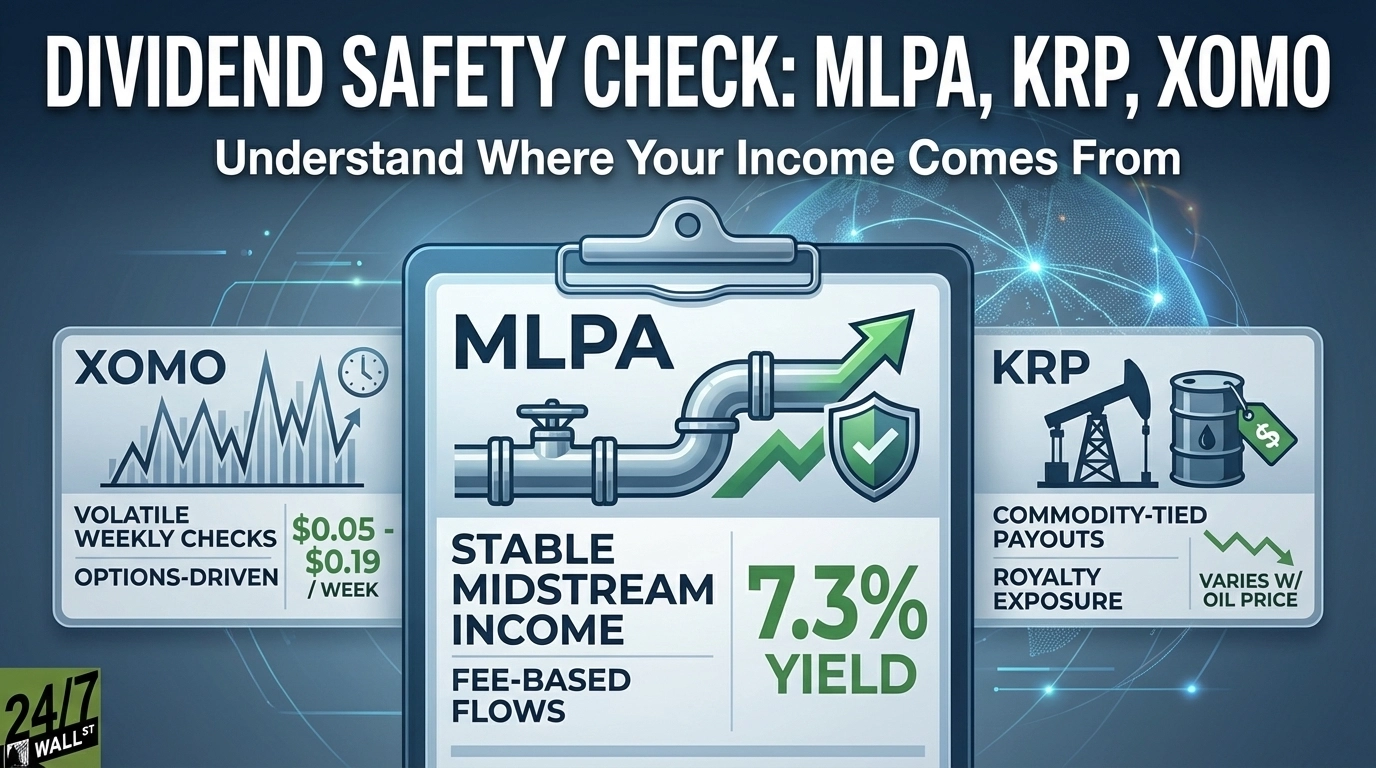
MLPA is paying a 7.3% yield while XOMO’s weekly checks have swung from $0.05 to $0.19 per share in recent months. Before assuming any of these three energy income plays are interchangeable, it helps to understand exactly where each dollar of yield comes from.
XOMO: Weekly Checks, Volatile Amounts
YieldMax XOM Option Income Strategy ETF (NYSEARCA:XOMO) generates income by selling call options on ExxonMobil stock, collecting premiums weekly and passing most of that cash to shareholders. The trade-off: when ExxonMobil rises sharply, XOMO’s upside is capped because the call options get exercised against it.
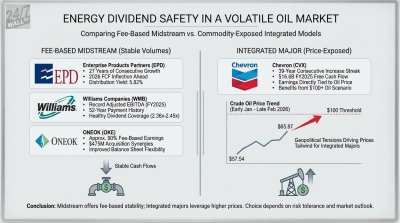
The income is real but genuinely variable. Recent weekly payments have ranged from $0.05 to $0.19 per share, depending on how much premium the options market offered. Oil volatility drives option premiums, so when crude is calm, payouts shrink. WTI crude trended lower over the past year, falling from $75.74 in January 2025 to $57.97 by December 2025 before recovering to $64.51 in February 2026, compressing premiums through much of 2025.
On the price side, XOMO has recovered well. Shares are up roughly 19% year to date in 2026, meaning total return investors have fared better than the yield-only picture suggests. The trailing dividend yield sits near 2.4%, which is low for a covered call fund. XOMO suits investors who want ExxonMobil exposure with some income cushion, but it is not a high-yield replacement for a bond ladder.
MLPA: MLP Income With a Decade of Recovery Behind It
Global X MLP ETF (NYSEARCA:MLPA) owns a concentrated basket of midstream energy partnerships. The top three holdings, Energy Transfer, Enterprise Products Partners, and MPLX, represent roughly 37% of the portfolio, and the fund is 96.6% allocated to energy. Income comes from pipeline throughput fees rather than commodity prices directly, which makes midstream more predictable than upstream producers.
MLPA has raised its quarterly payout every year since 2023, moving from $0.77 per unit in early 2023 to $1.00 in February 2026. The fund cut sharply during the 2020 energy crisis, worth remembering as a stress-test data point, but the recovery has been consistent. The current yield is approximately 7.3%, and with shares up about 13.5% year to date, unitholders are collecting both income and price appreciation in 2026.
KRP: Royalty Income With a Commodity Catch
Kimbell Royalty Partners (NYSE:KRP) is a mineral and royalty partnership owning interests in over 17 million acres across every major U.S. onshore basin. Operators drill and pay Kimbell a royalty on production. With no drilling costs, margins are insulated, but revenue is fully exposed to commodity prices.
The distribution policy is explicit: 75% of cash available for distribution goes to unitholders, with 25% directed toward debt reduction. That built-in deleveraging is a structural positive. The Q4 2025 distribution was $0.37 per unit, and the full year 2025 total came to $1.60 per unit, all classified as return of capital for tax purposes.
Distributions have moved with oil prices. The quarterly payout peaked at $0.55 in mid-2022 when crude was at cycle highs, then drifted lower alongside oil prices. The distribution math is tighter in the current price environment, but Q4 2025 operating cash flow of $57.226M confirms the business is still generating meaningful cash to support payouts.
The balance sheet deserves attention. KRP carries approximately 1.5x net leverage against trailing EBITDA, a manageable level, but total liabilities grew substantially following the Mabee Ranch acquisition. If oil softens further, that leverage could become a constraint on distribution levels.
The Verdict
MLPA distributes income from fee-based pipeline cash flows, which are less directly tied to commodity prices. Kimbell’s royalty distributions have historically moved with oil prices, as the history from 2022 highs to today illustrates. Royalty margins are high, but payouts move with oil. XOMO’s weekly payouts are driven by options market conditions rather than underlying business performance, and have ranged from $0.05 to $0.19 per share recently.















 Top Gaining Stocks

 Top Losing Stocks